Showing posts with label Death. Show all posts

Sunday, 15 December 2013

O is for ‘OK, I won’t’
 

Elvis’ final words. His last girlfriend, Ginger Alden, former Miss Traffic Safety and Miss Mid-South, had told him not to fall asleep reading in the toilet. ‘OK, I won’t,’ he replied.

His last read was either The Scientific Search For The Face Of Jesus by Frank Adams or The Shroud Of Turin by Ian Wilson. 


His last meal, according to Albert Goldman, was hamburgers and French fries at dawn the previous day, prepared by his cook Mary Jenkins. Despite her urgings, Elvis wouldn’t touch his food on the day of his death. 


Other sources say a different cook, Pauline Nicholson, served him ice cream and cookies at 4am — just the day after he’d had a cavity filled, by the way.
Tomorrow Not Presley but . . . oh, dear, publishing

Friday, 13 December 2013

An alphabetical advent calendar of Elvis

M is for Minnie Mae Presley
 
Minnie Mae was Elvis’ paternal grandmother. She was born on 17 June, 1890 and died on 8 May, 1980. That means she outlived both her son Vernon and her grandson, whose birth she attended. Hers is the one of the four gold and black gravestones in the Meditation Garden in the grounds of Graceland. (Actually, there are four and a quarter gravestones if you count the mini one for Elvis’ stillborn twin, Jesse Garon.)


Tomorrow The link between Elvis and an ancient European language

Wednesday, 11 December 2013

K is for Kalamazoo


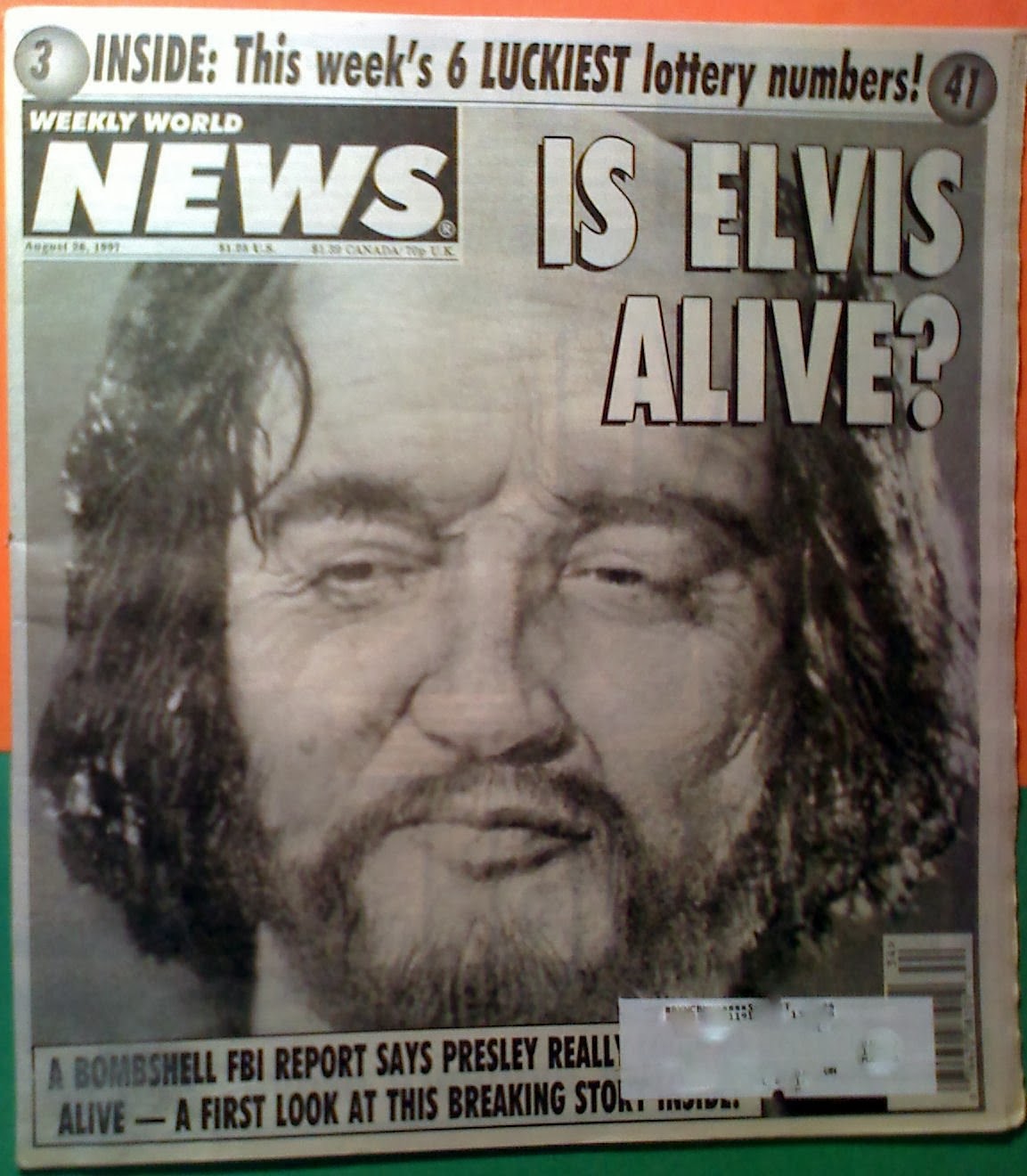
The first place Elvis was spotted after he died was Kalamazoo, a small city in south West Michigan. According to the Weekly World News, that is. The American tabloid reported the sighting by 50-year-old ‘mother of five’ Louise Welling, non-Elvis fan and wife of a car assembly worker. She saw him twice, first in a grocery store, then, with her daughter and grandson, outside a Burger King restaurant. Having eaten, Elvis ‘put on a pair of dark glasses, got into a small, light blue car and took off real fast.’ Mrs Welling then added: ‘Other people have seen him, but they are afraid to say anything.’


Tomorrow The Leg Wiggle Controversy

Sunday, 8 December 2013

H is for Harrelson
 

Woody Harrelson, actor and Elvis fan. His life story sounds like it just climbed out of a Jerry Lee Lewis song. It’s possible that there is very little character acting in his portrayals of a (very) simple country boy in the TV sitcom Cheers or a sleaze-pit of a pornographer in The People Vs Larry Flynt. He was the son of a bible-bashing Presbyterian mother and father who was a Texan good ol’ boy turned contract killer and received two life sentences in 1979. 

Woody’s first acting role was the Elvis impression he used to impress his classmates at school. Like Jerry Lee himself, Harrelson went for a dual career path — studying theology and chasing women. At one time, he reckoned he was racking up three women a day. ‘I was like a kid in a candy store.’ Like Elvis, he later found solace in the spiritual, doing yoga eight hours a day. 


Another actor, Eddie Murphy, is an even bigger Elvis fan. But, for an obvious reason, it’s unlikely he’ll be playing Elvis in any biopic. Mr Murphy is from New York, you see.


Tomorrow Elvis and I

Monday, 2 December 2013

I'm back . . . 

I've been with the King. I've been working on him, not with or for him but on him. Many, many years ago, back in the last century, I wrote a book on Elvis. It was a short and fast one. Fifty Elvis songs and their stories, making a mini-biography but focussed on the music. It came out, as Essential Elvis, to celebrate the twentieth anniversary of his death.

Earlier this year, I was asked if I was okay with it being republished, as an e-book. Of course, I said. Just let me have a quick look through it and make the necessary corrections. I already knew, for example, that, to my shame, I'd mis-spelled Ann Margaret's name. See, I did it again. It's actually Ann-Margret. (She's Chicago-raised but Swedish-born.)

So I started making the corrections and adding new bits and then more bits and even talked to some people — including the niece of the man who wrote Long Black Limousine, the song which Elvis recorded in his 1969 and which almost prefigured his own end. 

I found more and more and more and put it all in. All kinds of details. Corrections of dates. Stories about the songwriters. I found a lot of demos of the songs – which weren't around first time but have since emerged.

All in all, it became a bigger book. Almost twice the size.

It's out this Friday, from Rocket 88. Here is the cover. Buy one. Buy more. (Oh, and buy yourself a copy of my last book, Filthy English while you're about it.)


The original Essential Elvis also contained an A-Z of Elvis. It wasn't exactly padding in the original. More somewhere to put other thoughts and ideas which didn't fit into the song stories I told. It was more fun, more light-hearted, less reverent. And, so we took the decision to leave it out of the new edition.

So . . . I'm posting it here, on this blog, as an Elvis advent calendar. There will be one a day till Christmas. (Actually, given that there are 26 letters in the alphabet, it will, of course, run through to Boxing Day. At least. As Elvis' birthday is January 8, I might stretch it through till then.) And I begin with . . .

A is for Aaron

Elvis’ middle name, which his mother spelled as Aron on his birth certificate, and which was — rightly or wrongly — changed to Aaron on his gravestone.


More tomorrow Actually, more later today, as I started my A-Z Elvis calendar one day late so it coincided with the working week.

Friday, 15 February 2013

The greatest song in the world ever . . . today
 
Number four: Bloodshot Eyes by Wynonie Harris

 
As you possibly know, I’m not a big lyrics man. Or rather I am a big lyrics man. So, having grown up on a mix of musical theatre (parental taste) and metaphysical poetry (schooling), I just thought most pop lyrics were just rubbish.

Not the ones that most people think of as rubbish. To me, Little Richard — or at least his writers, notably Dorothy LaBostrie — was true poetry. Awopbopaloobopalopbamboom — even Andrew Marvell or Dorothy Fields would have struggled to find such an evocation of the human soul.

What got me was the stuff people said had good lyrics. Hard as it to imagine now, once upon a time, in the days when Hal David was writing the wondrous I Say A Little Prayer, people, grown-up people with jobs, beards even, would pay serious attention to the lyrics of, say, King Crimson.

Yet here I’ve chosen a song whose true glory is its words. Bloodshot Eyes by Wynonie ‘Mr Blues’ Harris — 1940s R&B star, big influence on Elvis. At one time, he had two Cadillacs all for himself, each with its own chauffeur.


The tune is fine, if hackneyed. The playing is joyous — but you wouldn’t expect anything else of a band put together by Johnny Otis.

But those lyrics. A tight story told over three verses, it’s a startling narrative — a song about alcoholism and para-violence, framed as a comedy. 

It is one of the best pop lyrics ever written. It’s coherent, it develops rather than repeats. Some things to notice along the way . . .

* The beat and mood is established in the first two words, ‘now’ followed by ‘just’. A weak, barely vocalised sound followed by a strong emphasised one which finishes on both a sibilant and a plosive. The set-up of the whole song is there. A light feint then a killer blow. Tragedy as comedy.

*
The rhymes are mostly masculine ones but nor are they — as is almost invariably the case in rap — so obvious you want to slap them with a ready-floured haddock. They are certain, confident, assertive — and could be heard in the loudest juke joint.

* The use of language is consistent and demotic. A big failing of all kinds of lyrics is that words are chosen to makes rhymes rather than fitting the tone of the song. Even Sondheim makes this mistake. By his own admission, the line ‘It’s alarming how charming I feel’ (in West Side Story’s I Feel Pretty) is quite unlikely to have come from the young and uneducated Maria. (In fact, he wanted to take it out but his collaborators wouldn’t have it. He still blushes when he hears it. He was right, of course. But so were his collaborators. It’s a wonderfully life-affirming line — its buoyancy a warning of the tragedy coming her way.)

* There is only one word that wouldn’t be familiar to contemporary six year old. That is ‘spree’ and, even then, I think context makes its meaning clear. Unless, of course, you mondogreen it and think it is some kind of transport mode. Making things that simple really isn’t simple.

* The metaphors are smart. ‘Two cherries in a glass of buttermilk’: accurate, evocative, suitably revolting and very, very funny. Improved, too, by the fact that the rhyme is with ‘silk’ which as a high-toned partner to ‘buttermilk’, gets a good uptown-downtown thing going.

* It doesn’t read — let alone sound — like poetry. Just like someone with a gift for words, smart-talking his way through the sad realisation that he will never change his girl, that things are over between them, that . . . well . . .

* The final word is ‘death’ — after that there is just a repeat of the chorus. It is rhymed with ‘breath’.

Here you go, all the way, from first to last . . .

Now just because you’re pretty
And you think you’re mighty wise
You told me that you love me
Then you roll those big brown eyes
When I saw you last week
Your eyes were turning black
Go find the guy that beat you up
Ask him to take you back

Don’t roll those bloodshot eyes at me
I can tell you’ve been out on a spree
It’s plain that you’re lyin’
When you say that you’ve been cryin’
Don’t roll those bloodshot eyes at me

Now I used to spend my money
To make you look real sweet
I wanted to be proud of you
When we walk down the street
Now don’t ask me to dress you up
In satin and in silk
Your eyes look like a two cherries
In a glass of buttermilk

Don’t roll those bloodshot eyes at me
I can tell that you been out on a spree
It’s plain that you’re lyin’
When you say that you've been cryin’
Don’t roll those bloodshot eyes at me

Now I guess our little romance
Has finally simmered down
You should join the circus
You’d make a real good clown
Your eyes look like a roadmap
I’m scared to smell your breath
You’d better shut your peepers
Before you bleed to death.


And here is the track . . . I couldn't get it to embed for some reason so here is a link . . . Bloodshot Eyes.


It’s said Wynonie Harris knew whereof he sang here, too, liking to take a glass or two of hot whisky before he stepped onstage. When it came to treating women, though, he was more like the song’s villain than its singer. He told Tan magazine: ‘The women who really know also know part of my secret. We can laugh about it together for they know how women can get stirred up by a man who seems cruel, ornery, vulgar and arrogant. I’ve had them to take enough pills to kill a horse, follow me from town to town in Cadillacs, give me money and fight another like crazy. It’s all because I deal in sex  . . .

‘I like to sing to women with meat on their bones and that long green stuff in their pocketbooks. You find them mostly down south. As a matter of fact, I like all kinds of women, regardless of what colour they are or what size and shape they may have. Just so long as they’re breathing, that’s me.’

Ralph Bass, his A&R man: ‘He always had a broad. Shit, man, he didn’t have any respect. He’d walk up and insult a woman right in front of her man. He’d say: Hey, bitch, what you doin’ here, whore? And call ’em all kindsa names.’

Now, I say it’s a song by Wynonie Harris but that is not quite right. His was the big hit on the US R&B charts (1951) and a top favourite in Jamaica. There’s a bouncy version by Millie, the My Boy Lollipop girl — the gender is switched and so ‘drink’ is rhymed with ‘wink’.

It wasn’t written by Harris, though, but by the man who first recorded it, Hank Penny, a banjo-playing Western Swinger. The piano tinkles and the steel guitar swishes. It’s fun but it’s not Wynonie — of whom his producer Henry Glover said ‘This man was a concept. Hell, he was too much.’

Both Penny and Harris were on the same label, King, based in Cincinnati and James Brown’s long-time home. The idea for Harris to cut it came from King’s foul-mouthed, abusive, near-blind Jewish owner Syd Nathan. He knew, deep in his heart, that everyone had the same problems, that there was no such thing as black or white alcoholism or para-violence. It was all the same thing. Everyone shared the pain. And Syd could make money out of it.


Plus A little something else for you. Here you will a quite fascinating pair of interviews with Mel Brooks and Carl Reiner. If you don't know who they — or the 2000 year old man — are, you should. And will if you listen to these podcasts.

Friday, 23 March 2012

I want my own revenge! And I want it in the Old Vic!

I went to see Eve Best
in The Duchess of Malfi the other evening. Don’t.

Or, at least, if you do, laugh. It is truly terrible. She’s as good as you’d expect, given her CV. But everything else was bad, bad, bad.

As my wife said, you knew it was really bad as soon as the actors came onstage in a kind of choreographed procession. She’s a dancer and movement teacher so she’s knows about these things. But even I . . .

In fact, I should have been tipped the wink even earlier, by the set  — which must have cost a lot but which didn’t really leave much room on the stage for the actors. So they spent all their time in the middle of the stage.

They shouted a lot, too. I know that shouting is one of the prime rules for actors in Shakespearean and Jacobean drama and I wish they’d simply stop it. But this was really shouty. No rhythm to the speeches either — Eve Best aside.

So far, so quite completely awful. My wife left at half-time but I stayed on, as I’d never seen a staged version of the play before, only read it.

I’m glad I did. Not because it improved. It didn’t. It went the other way. But . . .

It gave me a Springtime For Hitler moment. Well, a potential one, anyway. If only I’d had the guts to start laughing out loud and honking the way the first-night audience do in Mel Brooks’ great comedy, The Producers.

What happened was Eve Best died, with extreme slowness. Or rather the Duchess of Malfi did. (Why? I can’t be bothered to remember.) It took minutes of groaning and moaning. Then she revived and did it all again — though making it a little shorter for this second going.

It was like something out of, say, a Morecambe and Wise version of Shakespeare. Ludicrously protracted death played for laughs.

I remember wishing I had laughed and being a little surprised there weren’t more sniggers around me. Particularly when there were several more deaths along the same lines.

It was only today, though, after a suitable break from it that I realised that I’d probably misunderstood. I think Eve Best knew what she was doing — but we the audience had let her down.

She had realised that she was in a real stinker. With her Nurse Jackie experience of how to handle mordant comedy, she’d decided the production’s only possible salvation was to play it for laughs — make it a Jacobean revenge tragedy rival to Brooks’ Nazi musical comedy.

But we the audience just didn’t get it. So, what can I say? Eve, I’m sorry, really sorry, I failed you. Next time, I promise, I’ll laugh and laugh and laugh at your Duchess of Malfi.

Friday, 20 January 2012

Flash, bang, wallop . . .

Bang goes Kodak. Two thoughts etc . . .

One Think Cunard and White Star Line. With the early 20th century success of their Atlantic passenger lines, they thought they were in the boat business. When actually of course they were in the people-moving business. So when long-distance flight became possible, they kept on with their ships and, eventually, disappeared as businesses.

Two I was actually looking to buy some printers yesterday. One, to trial. Maybe three or four more if that one did the job. So I did a little online research. Conscious that the real cost of printing - particularly if you need, as I do in this case, to print a lot of photos - is the ink, I was taken by Kodak's regular boast that its inks were cheaper than anyone else's. So I checked out all the reviews I could find. 

The Kodak printer of choice seemed to be the one called Hero. (Yes, I know I should have set my own alarm bells then but I didn't.) I scanned the reviews and they seemed to be pretty damn positive. So I decided I might well buy one. I went to Amazon to start the process. Then I saw one bad review and it said: actually, you know what the worst thing about this printer is, that it is really not very good at printing photos. So I went back over the other reviews and I saw lines like: well, yes, it is really good but the photo-printing is not what you hope for, particularly from Kodak etc etc

So I cancelled the order and will switch to Canon. Let's see how that goes.

Which is an object lesson in company decline and failure. As Xerox developed the personal computer (mouse, icon interface etc etc), then let Apple steal it, so Kodak developed the digital camera then hid it, in case it cannibabilised its own business. Instead, it got eaten by the Japanese. 

So, I guess, the moral is this. It's better to eat your own leg and survive than let someone else eat it for you. I'm sure it says that somewhere in the Bible or Koran.

Actually, one more thought. People are always saying Britain should do more manufacture. I'm not sure about that. Manufacturing was a blip in the national history. Mostly, we've been traders. An obvious choice given our geographical position. And traders are, by nature, wide boys (and girls). They go where the action is, shamelessly. Trading is never out of fashion. It's subject to technological change, true. But, at its best, most purest, it is quite uninterested in either the object being traded or the method of trade. Cash is the king in this realm. Always. So . . . while I'm not exactly standing up for bankers and incomprehensibly complex derivatives trading, I do think there is a question here somewhere. And another one: if there is not something in what I'm saying, why does our pantheon of national heroes include Francis Drake, Arthur Daley and Del Boy Trotter?

PS I will put up the sleeve notes for the Xmas compilation. I decided to make them longer than I first intended. I'll be posting them one a day, starting early next week.

Tuesday, 13 December 2011

Another career development

Having appointed myself the Premier League haircut reviewer (of which more soon), I decided not to stop there and give myself another reviewing job. My new beat? London (mostly) theatre audiences.

So much attention is paid to the play and the players but what about the payers?

Why not give them a review of their own? Marks out of ten, even.

And so to the Young Vic, the other night. The play? Something about a Dane, if I remember right. Couldn't make up his mind. Had problems with his dad. His mum, too. Oh, and his uncle.

Anyway, it was the end, more or less. I hope I'm not giving the game away when I tell you the Dane was dying. It's that kind of play. He was dying in the arms of his pal and his pal wasn't taking it well.

When, suddenly, there was the most terrible sound. The kind of thing you might expect an actorly actor to emote at the moment of death. Only it wasn't. It was a member of the audience.

He'd nodded off and now, at the final moment of the play, he'd started snoring. Well, not just snoring. The biggest, loudest, frighteningest noise. Like he was dying. His head fell back. The noise got louder. The actors paused. I was looking straight at them. They felt like laughing but knew they didn't dare so much as entertain the thought. They paused some more, in a kind of rictus of not-laughing. Then they wondered if he might be dying and, being actors, they thought: how will that play?

While they were considering an entry in their memoirs, I was wondering how quickly I could get it on to my blog. Or should I tweet it. Then I remembered Stephen Fry was in the audience and he'd probably tweeted it already.

The snorer's companion jiggered his arm. He kept snoring, ever louder. She shook him hard. His head fell forward. For a flash, the audience decided he was dead and waited for the shout: is there a doctor in the house? Or perhaps: is there a funeral director?

More terrible noises, fluttering arms movements and, eventually, a return to something like conscious - without, it seemed, his having any idea at all of what had just happened. He might not have died but his female companion looked mortified.

The actors took it up again. They didn't corpse. But one of them quickly became one. They both knew, though, that however good they'd been that night, the audience would not remember them but the man who almost snored himself to death.

Monday, 14 November 2011

A punk burial, slight return

After I posted the bit about Tom, I sent a link to a friend who immediately passed it on to Tom's brother Jimmy — who, of course, was in Lost Trios and actually performed the song. And Jimmy replied almost right away and here is his reply . . .

It's not true that Tom wrote the line "shove me in a plastic bag and leave me on the pay-ver-ment-ah" (not street). It could be true that he laid claim to it, but the lyrics for this particular song were penned by Bob "Bob" Harding. Tom did actually give me a line when I got stuck on a lyric for another Alberto song "Dead Meat" and he supplied "eat your sister by mistake".
All the best
Jimmy

Which leads to two possibilities . . .

One, my memory is faulty.

Two, Tom's was faulty, perhaps florid.

Take your choice
Chronicle of a punk death foretold

Reading an obituary of the pop writer Tom Hibbert (who I worked with and edited for a while), I found myself remembering a conversation with him.

His brother was in a band called Alberto Y Lost Trios Paranoias. In 1977, they released Snuff Rock, an EP of punk parodies — when barely any punk singles had actually come out. There was a track on the EP with a line about ‘when I’m dead, just put me in a plastic bag and leave me on the street’.

By way of doing that bonding thing we all do with people, I told Tom how funny that line was and how proud his brother should be of it.

‘That was my line,’ said Tom.

I didn’t remember that when he died. I didn’t go to his funeral — not close enough for that anymore. I do, though, wonder if anyone quoted it. And if he was telling the truth about its authorship.

Thursday, 6 October 2011

Steve and me

The death of Steve Jobs only just appeared in this morning’s papers and I’ve not read any of the obituaries or comments so I’ve no idea if I’m saying anything original or it’s already a cliché.

I’ll head straight to my conclusion. The fact is, I feel better for Steve Jobs’ death. Liberated, almost. Maybe now, I can escape Apple jail. Maybe I’m alone. Or maybe there are lots of us.

I’ll explain.

The first time I ever saw an Apple computer was sometime in the 1980s. I fell in love. It was in a producer friend’s home studio. It not only did the things I’d dreamed computers would do when I was a kid in thrall to Dan Dare and his future. It did them in a cool way I hadn’t even dreamed of. It was like Dan Dare had somehow had a side career in, say, a rock band.

Which, of course, was both kind of the truth about Apple. And kind of the shtick. (Which is, again, of course, where this story is eventually going.)

I decided right away that this was the computer I wanted. Till I could have one of these, I’d rather struggle on with my IBM Selectric — itself a dream machine, which made a noise like an assault rifle as you typed, turning the act of writing into a cousin of urban warfare. I still miss that noise.

(The machine itself is in a cupboard, along with its predecessor, an Olivetti Lettra 32, the portable choice of real war correspondents. Maybe I should have them buried with me. Or, as I want to be cremated, burned. I wonder if you’re allowed to do that.)

So I never bothered with Amstrads or shit like that. I waited till the price came down far enough for me to be able to afford one. Which, eventually, it did.

But, before that happened, Steve Jobs had already entered my life, revolutionised it even. I just happened to be around, in a position of relative responsibility, on the first magazine in the UK to move to Apples and what was then known as ‘full-page make-up’. It was, believe it or not, Punch, that repository — and butt — of old jokes.

So, overnight, I became something of an expert on Apples. That is, I was one page in the manual ahead of most everyone else. Soon, very soon, I was hired by The Guardian — mostly on account of this Rizla-thin skill — to help it reinvent itself for the 1990s. Difficult to believe as it may seem from this distance, but it had been hit hard the arrival of the Independent five years earlier — and still hadn’t figured out what to do. (This is not unusual at The Guardian. It is currently clearly foundering financially — dropping £30 million a year, while still paying its editor a few monkeys short of £500,000 — and pushing for accountability on executive salaries in other businesses.)

Anyway, as a result of this I became a true believer — an Applostle, perhaps. And, eventually, by semantic process, an Applostate, maybe.

As a fan, I proselytised for Apple, telling anyone who’d listen how superior an operating system it was to the clunk world of PCs. I also, for a while, had access to a NeXT machine — the test-bed for many of the great things that appeared on Apples, too, once Apple had brought Jobs back into the fold (and bought out NeXT).

Eventually, I stopped talking about it, coming to believe, I guess, that if people couldn’t see the difference with their own eyes, they certainly weren’t going to hear it through their ears. I never swayed from using Apples, though, even when the build-quality of their software tested my resolve to its limits.

Skulking around in the back of my mind, though, was something new, some kind of reserve. That was the real reason I became more reticent.

And the source of that reserve I realised was Steve Jobs — though that took even longer to realise. First of all, I became embarrassed at my own applosticity. An Apple computer was, after all, just another product. How could I have an emotional relationship to it? (I know, I know, that’s the story of modern capitalism but we all like to believe we’re different, don’t you.)

I started to see smugness and entitlement in Apple users — though never in myself, of course, ha, ha. Next, I read the court judgment on Apple vs Apple. It’s a fascinating piece. Long, though. Essentially, to my mind, the evidence all tilted the Beatles’ way. The Jobs lawyers presented a case of such casuistry that they could have as well been arguing over angels and pinheads. It was the kind of case I would have made up if I was having a laugh.

But they got away with it , for one simple reason. Or, rather, one simple person. Neil Aspinall — who ran the Beatles’ Apple. His evidence was such that there were only two plausible alternatives. One, he was a complete idiot. Two, he was pretending to be a complete idiot.

The judge — clearly a highly competent man — fell victim to the reverse Dunning-Kruger effect. That is, his own competence rendered him incapable of seeing others’ incompetence. He decided Aspinall was a liar rather than an idiot. The truth is, he was the latter. He had no idea of what was going on, no understanding of computers etc etc.

I was, though, more or less repulsed by the approach of Jobs’ lawyers. I know lawyers are meant to be devious etc but I just couldn’t stomach this for some reason— probably because it made me feel an idiot for ever having been a believer.

Then I went into an Apple store and, fuck it, it felt like church. If I ever do have to go into an Apple store, I have to breathe myself through the experience.

The last straw — see how emotion brings clichés to the fore of my brain — was seeing one of Jobs’ presentations. They were like — and here we go into the inexorable relationship between length of posting and likelihood of a Third Reich analogy — a Nuremberg rally. I sometimes think what I loathed most about the couple of the I watched was Steve Jobs clothes. That and the fact that — although he had made great computers — he seemed to be a quite loathsome human being, self-satisfied, arrogant etc etc. The fact that everyone there seemed to love it was even more distressing.

I guess that’s what happens when you fall out of love. You fall into hate. One projection replaces another.

Friday, 12 November 2010

Wonders of the modern world, number five . . . the sound of no-hand clapping

It was the Sarah Kane play, Blasted, a revival at the Lyric, Hammersmith. I’d not seen it first time round, probably put off by the reviews which described it as needlessly violent and juvenile.

It’s now fifteen years later. Fifteen years. The same gap as between, say, Elvis’s first hit — or Look Back In Anger — and Pink Floyd’s sixth album - or Last Tango In Paris. Or Anarchy In The UK and Madonna’s Blond Ambition.

It’s a great play, I decided. Of course, it’s violent. Then it was the time of the Balkan civil wars - it’s almost a struggle now to recall how staggeringly violent they were and how shocking it was to have something happen quite so close to, well, Primrose Hill.

It is, of course, clearly marked by Beckett and Ionesco and Albee etc, blah blah. But it is also a very funny play. More than that, it’s a comedy of manners, very English, almost traditional. A couple in a hotel room with a man who wants to have sex and a younger woman who doesn’t and the man ends up — inadvertently and amusingly - short of some of his clothing. As my friend Gerry who was with me said, it’s a kind of Brian Rix farce.

I found myself thinking of it as Noel Coward with — if my Nadsat is still with me — a touch of the old ultraviolence. A couple in two different hotel rooms, playing out the not always pleasant realities of romantic entanglement.

Which is why it’s so funny — in this production at least. Tragedy is, of course, my splitting a finger nail. Comedy, though, is a man (a journalist, a tabloid writer, a buffoonish parody of one) who has . . .

* bitten his girlfriend’s vulva till it bleeds

* been buggered - on his hotel bed - with a pistol by an Irish-accented terrorist (who now lies dead beside the bed)

* eaten the leg of a dead baby (having disinterred the infant from its onstage grave)

* had both his eyes removed — for the terrorist’s snack, I think

. . . and who is standing up to his chest in the baby’s now-emptied grave. It’s raining on him through a hole in the roof, too.

See what I mean about farce. As Wilde’s The Importance of Being Ernest can be seen as an antic inversion of Oedipus Rex, so this play is inside-out Ray Cooney. Comedy played as tragedy.

Anyway, to continue, standing there, buggered and eyeless, having feasted on unroasted baby, in the pissing rain, he opens his mouth, pauses, then says ‘Thank you’. The human comedy. The precision of the line — and its truth.

I was, though, the only one who laughed - as I suspected I might be so I muffled it somewhat.

Anyway, that’s all by the way of preamble to what happened next - to the reason for this piece. What happened next was . . . nothing. Complete quiet in the audience. Complete darkness onstage. Complete quite onstage. And so on. And on and on and on and on. The sound of no-hands clapping.

I was delighted. At last, I realised, I might discover the answer to a question I’d posed to myself but never got round to asking of someone who might actually know the answer. The question is this: how does the clapping start at the end of a play?

Most of the time, of course, it’s not a question. The final line is delivered with the duh-duh-duh of a joke’s punchline. Or everyone knows the ending anyway. You know exactly where you are when, for example, Fortinbras announces: ‘Go, bid the soldiers shoot.’

Sometimes, though, it’s not clear quite where you’ve got to in the play. Is it a pause, a very long one, or is that your lot? I saw Sondheim’s Into The Woods in the park this year and, never having seen it or heard it in full before, I wasn’t at all sure if the end of the first half was the end of the whole thing. I wasn’t the only one, either. My friend Dorothy who was with me felt the same thing, too.**

So the lights dimmed on Blasted and the buggered journalist was, presumably, still there in the dark hole, getting wetter and wetter. All was silence, though.

No one clapped. No one stirred. (Perhaps it’s relevant that it was a Saturday afternoon matinee. Perhaps not.) The silence went on for thirty seconds, then more. A minute, I’d say. Then more, more. Perhaps even two minutes. Then rustles. Then the faintest of, well, not laughs exactly, amusements perhaps.

I’d always assumed — on the basis of absolutely no evidence at all — that the ushers were instructed, under these conditions, to start the clapping. Clearly, I was wrong.

Still more silence. No clapping anyway. Just the sound of people starting to turn round for a check on the house or whisper, not quite quietly enough, to their partner.

Then, finally, it came. The first clap, from someone over to the left of the balcony. And everyone joined in, of course. And the curtain rose and the cast of three — buggered, wet, dead, eyeless etc — stood to take the applause. Even they were smiling. Laughing almost.

* A knowing parody, perhaps, given that both her parents were journalists. But then, for that reason, perhaps not.

** Mr Sondheim himself was there that night, too, as it happens. I saw him at the interval, with a drink being brought to him. Astonishingly, given the obsessiveness of Sondheim fans and fanettes — fanosexuals, too — no one else seemed to notice him. I couldn’t bring myself to go over and tell him about the wonders of his rhymes.

I’ll regret it. I know I will. I bumped into the great TV writer Jack Rosenthal at a party and didn’t tell him about the wonders of his gags. He died not long after. I still regret my inaction, shamefully.

Why didn’t I do something? In Rosenthal’s case, I think because I was worried he’d say something like: which of my plays do you most admire? And the thought of that prospective question emptied my brain of the tiniest detail of his work. Well, all but the title of his Barmitzvah Boy — and that’s not enough to sustain a conversation past its opening sallies.

Next up A visit to the National Portrait Gallery (and maybe the story of Lacan’s con).

Sunday, 26 September 2010

Murray Sayle

January 1,1926 to September 18, 2010

Aw fuck it. More death. Another friend.

Like most people, I read about the great Australian journalist Murray Sayle’s death on the obituaries pages. I knew he was ill, of course. He had Parkinson’s. His wife Jenny had let me know and told me he was no longer at home but a little way away, in a nursing home.

Even the giants stumble and fall.

We worked together in the 1990s, when I commissioned and edited him for Night & Day, a Sunday supplement for the Mail on Sunday which was intended as an upmarket alternative to YOU Magazine — which, in going downmarket, had lost its lucrative, uptown advertisers.

I think Phillip Knightley* introduced him to us. Or rather us to him. We paid well — very well. And smart, fast, elegant and entertaining magazine writers are always much harder to find than all but those who’ve had to find them realise. I spent my days (and nights) making pig’s ears into, well . . . something better than dog’s dinners. (A good deal of editing time is spent unravelling and mercy-killing bad writers’ cliches and incomprehensible, mixed analogies.)

Murray was — with Phillip — one of the best. Although I knew the name and work, I didn’t know the breadth and range of his interests, life and appetites. He was a delight to work with. I loved his enthusiasm — not just for his own stories but for other people’s, too, and for technology. He was the first person I knew with a portable hard drive. On visits to the office, he’d plug it into a spare computer in the subs’ room and away he’d go, working his copy over and over. The subs considered and treated him like some kind of eccentric uncle. For me, he was one of those substitute fathers you pick up along the way — someone you can learn new stuff from.

I can’t remember all the stories he did for us but I remember a piece about female priests and several book reviews which weren’t really reviews but wonderful, brief essays.

In particular, I recall working with him on a shortened version of his New Yorker piece about the atom bombing of Japan. The original was, according to The Australian, his ‘greatest piece of sustained reporting’. Like all his work, it was full of odd but resonant details. I learned so much from him. He turned journalism into something approaching a sensory experience.

And I remember our lunches, of course. Not particularly alcoholic by Fleet St standards but certainly long. Murray liked to talk. God did Murray like to talk. Theories, observations, anecdotes, thoughts, gags spieled out of him. No quiet mouse myself, I think I may have contributed the odd question.

Gradually, through his spieling, I found out more about him. About his early years, working on a Murdoch paper. He was assigned to looking after the young Rupert when he first arrived in the office — or maybe that was Phillip Knightley’s job. I met his wife, Jenny — and spoke to her a lot on the phone when Murray was out and about somewhere.

I learned about his years in Japan. I’d been there, on a job, a few years earlier and had been told to look him up as he was the one who would make sense of it for me. I didn’t — too unconfident, I guess. I should have. Always generous with his opinions, he gave me answers to all the questions I’d had in my head ever since my visit.

Why, for example, do the concierges at Japanese hotels persist in giving you directions to places when they clearly have no idea where they are? A simple matter of face, explained Murray. That was the answer to a lot of my questions — though his answers were longer, far more detailed and always entertaining.

I learned about the wonderful documentaries he made with the photographer Elliot Erwitt — I’ve still got the wobble-colour VHS copies he made for me somewhere. I heard about his famous expenses claim, for a piece of sailing equipment — ‘money for old rope’.

I didn’t learn, though, that he’d also climbed Everest, crossed the Atlantic single-handed, unearthed Philby in Moscow and found Che Guevara in the jungle, like some modern day Stanley.

When I left the magazine, we kept in touch, via email, card and even the occasional phone call. He came over to give evidence at the Bloody Sunday enquiry. He’d written a report about it for the Sunday Times, claiming it was a deliberate assault by the British army. It was spiked and he resigned from the paper. You can find the piece and his later reflections on it for the London Review of Books. It’s worth reading — as is everything he ever wrote. (Though I’m not as keen as others on his Fleet St novel, The Crooked Sixpence. He told me it wasn’t very good and I think he was being as honest as ever.)

Annually, for the Chinese (Japanese?) New Year, a special Murray postcard would arrive. The format was always the same but it was a wonderful format. There would be Murray and his family — who, judging by their expressions, were actually fond of their father — posed, artlessly, in front of some object or place that he’d chosen to represent that year. If I remember right, for the year of the rat, the Japanese family Sayle shared the frame with Mickey Mouse. For the year of the cock, they were sat in front of a branch of Kentucky Fried Chicken.

I looked forward to them and wished I could think of something similarly witty to send in return. I kept them all — though I can’t put my hand to any of them right now. Then one year, the card didn’t come. I guessed, correctly, that he was ill. Then he was dead. I’m not the only one that will miss him.

* Phillip and Murray went way back. They were at school together, I think, in Sydney. Murray came to London first and when Phillip followed, he got him a job. They worked together at the Sunday Times. Phillip’s wife, though, was not so keen on Murray and the way he dominated any conversation. He was barred from their house. I think someone told me that Murray was the model for ‘the great bore of far-eastern journalism’ in John LeCarre’s Honourable Schoolboy. It might have been Phillip.

Monday, 13 September 2010

Barrie Briscoe
May 31, 1936 to August 23, 2010

To a funeral on a Cornish hillside in late summer sun with the smell of the sea, the rustle of leaf-heavy trees and the distant roar of the A30. It was for Barrie Briscoe, a nature-loving atheist who'd outrun his three score and ten and who'd lived at least four lives - roustabout, academic, architect, painter.

I didn't know him well. He was the head of the architectural practice which worked on a project with me. I don't know if he even liked the end result of the project. But I enjoyed his company the few times we met. And I think he felt the same. I like to think he did anyway.

I knew he’d been ill, very ill, of cancer. The last time I’d seen him he was in a bad way and that was last year. Then, I know, things had got worse. Yet his death still came as a shock. It always does, it seems.


I learned by email. I was away from home so I'd taken my laptop to the pub for its free and fast wi-fi. There, in my googlemail, was a message with his name in the subject field. It was from his wife, Petra - who I knew far better, through the project. 'I am sorry to tell you that Barrie died,' it began. Direct, clear and forthright. A language of friendship.

The funeral was in a vast, private garden just to the west of the Penzance that’s opened to the public now and again. I guess its owner was a friend of Barrie’s. The invitation was a flyer, with a picture of him at the top. Glass in left hand, held by the stem, right hand in a semi-fist, the point-making gesture of a lifelong teacher. He’s smiling. His eyes are twinkling. Usually that’s a lazy cliché but Barrie’s eyes really did twinkle.

‘No religious rite or cleric,’ said the invite. The ceremony was led by a friend, Richard Vanhinsbergh — I didn’t know Richard but his close personal knowledge of Barrie gave the affair a gut-felt pungency.

Bernie — who I do know, he was the builder on our project — was there, too. He dug the grave. I’ve carried, a coffin — my aunt’s, across rainy, muddy, flat, wintry Catholic ground north of Liverpool. That felt, well, primeval. What Bernie did, that felt even older.


The funeral crowd — a big one, a hundred or so — gathered on the top of a hill. There was fizzy wine to drink and fishy snacks to eat. A gathering of Penwith's great and, well not good perhaps, but good-intentioned at least — in the early evening, anyway.

The coffin was then taken down to the burial ground. We followed behind and stood round the grave, a gouge in the grass sentried by a rectangle of small olive trees. There were words said — warm and knowledgable of the man we were interring. Many of them drifted on the air, blurred by the sound of the wind-bothered leaves. Their half-absence, half-presence seemed right, somehow.

There was a harp playing. The coffin was let slip into the grave, by a half-dozen friends. There was a bit of crying, not a lot. People there knew enough about death not to indulge or fall into half-imaginary emotions. When it was over, Bernie hung back — he and his men had a friend's grave to fill in.


Then there was a party, at a gallery in town, by the sea. There were a few of his architectural models — simple, inspired, made of cardboard — and pictures of him on the wall. Over the years, this part of the country has attracted a lot of people whose lives elsewhere, well, didn’t work out. Many of them were artists or at least arty. They were pretty much all there to say goodbye to Barrie. They sat outside, in the late afternoon sun, drank beer and smoked roll-ups. A lot of them seemed to be called Bernie.


There was a lot of food, mostly provided by another friend, Freddy (a woman). So much food, in fact, that, wonderful as it was, there were doggy bags as you left. And that, too, had a sacramental aspect. Somehow, it felt like you were taking a bit of Barrie home with you. I had mine, a pasta dish, for lunch the following day. It tasted really good.


Monday, 14 June 2010


Steve New
May 16, 1960 to May 24, 2010


I got the text
a couple of weeks ago, just as I was about to go into the theatre: ‘Pete, Steve New sadly passed away relatively peacefully surrounded by his friends and family @ 6.15 this evening but, as always with Steve, there were more birds than blokes there. I will keep you posted about funeral arrangements. Glen.’


It was Glen who introduced me to Steve. Glen had just left the Sex Pistols — after several years. Unlike Steve — who had managed just one week as the band’s second guitarist.

Glen had decided Steve was the guitarist he wanted for his new band, the Rich Kids. (The richness of the name was metaphorical in intent rather than finanancial. It was a kind of reference to Cocteau’s Les Enfants Terribles. Both metaphor and reference were, perhaps understandably, lost on most people.)

I was, as some of you will know, a music journalist, for Sounds, at the time — and a friend of Glen’s. He invited me to write something about his new band. That was the way it worked then. Well, that was how it worked for me.

It was September 1977. The editor put it on the cover of the magazine. I just looked it up — I’m someone who keeps his old writings. Well, most of them. The story opens with Steve in a bus on the Harrow Road. He’s wearing carpet slippers and getting shouted out by children for the eccentricity of his footwear. ‘It was pouring and me boots have got holes in ’em and I didn’t want to get me feet wet.’

There’s a lot of Steve there in that line. His capacity for existing in the moment. His fashion sense. His west London accent. His sense of the ridiculous. His humour. His disdain for what others might think. And his lifelong habit of getting in trouble. Often amusing trouble — the kids’ shouts were quotes from the Pistols’ Pretty Vacant, a song Steve would that night on stage with the person who wrote it.

He was only eighteen or so at the time but he was like, well, clichés pop into my head — like a whirlwind, like a force of nature, like a tornado. He’d roar into a room, roar out, then reappear when you least expected him. He’d always be enthusiastic about something or other.

There was always something inspirational about Steve. Even though he was some eight years younger than me, I think he was the one who inspired me to grow my hair into a long, half-combed mess — the way it was in the photo on this page.

Maybe you think you don’t know Steve but you have almost certainly heard him. It’s his guitar on Generation X’s Dancing With Myself. He was booked to play on a whole load of other tracks but that was the only bit they got out of him. Reliable, he wasn’t.

I saw a lot of him at the time — in the Rich Kids and the other bands of Glen’s that followed. ‘Glen’s like my big brother,’ Steve said in a recent interview, recent enough to know he was dying, of cancer, and tell the interviewer he was.

Then I didn’t see Steve for a long time as our lives went different ways, for various reasons. In particular, I wasn’t a junkie. He’d had a taste for heroin since before I even knew him, I’m told. Mark Helfond met him a few months before me. ‘His first words to me were: have you got any gear?’ Mark told me at Steve’s wake. Well, one of the wakes. I’ll get to that soon enough.

I’d see Steve very occasionally, generally when I was having a chat or a coffee or a drink somewhere with Glen. His hair got thinner. His teeth got looser. But his smile barely changed. He barely changed, in some ways.

There were always things going on his life, though. I remember a flat in the Brunswick Centre that he had to give up for some reason. I remember him living at the very end of the Seven Sisters Rd, in some kind of council block and despair at the other residents. Bands came and went. He moved to America. He ran off with Bernie Rhodes’ girlfriend and got married in Memphis. He got stuck, penniless, in the middle of nowhere. He lived in Florida. He outstayed his tourist visa and couldn’t get back into the US to see his child. (Some of the previous may be wrong but it may also be true.)

His grin never left him, though. Something serious always seemed to be going wrong in his life but, improbably, it never seemed to get him down.

There was a show, earlier in the year, a reunion of Steve’s old and new playing mates — a fund-raiser for him and his family. I intended to go but I was ill. Or rather, I had a baddish cold. Steve was the one who was ill. I thought there’d be more shows. There weren’t.

The funeral was in a cemetery I don’t remember going to before, though I’ve driven past it many times: the one near East Finchley, just off the North Circular. It’s vast, overgrown, almost rural, with roads winding around a hillside — the southern slope of what used to be known as the Middlesex ditches, where the North Circular now runs.

The service was in the Camden and Islington Crematorium, almost at the far end of the cemetery. There were a lot of people there who had known Steve even longer than me: Mick Jones, Tony James, Patti Palladin. It was a very rock and roll funeral: a well-dressed crowd. Black suits, white shirts and black ties.

As people milled around in the lunchtime sun waiting to go in, I had the first of two surprises — shocks, almost. I saw someone handing out service cards and realised I knew him. It was one of the lecturers from my MSc course: Jim Hopkins, a philosophy teacher from King’s. He gives the best scientific-philosophical explication of psychoanalysis you’ll find. I’ll tell you about it some time.

I went over and said hello, asking him what his connection was. He was Steve’s partner’s father, he told me — or rather, stepfather, I think. I was a bit shaken aback by this, so may have got a little confused in the moment. ‘Steve was a wonderful father to little Frank,’ he said — as simply and movingly as that.

The coffin rolled up in a motorcycle sidecar, ridden/driven by a bearded biker of a man in heavy leathers. The coffin was white, hand-printed with abstract shapes in gold, with a guitar of sorts on top. It was not much bigger than a child’s coffin. Steve was never a big man.

The chapel — I can’t think of another, secular word for the room — was full. The service was, well, there’s no other way to put this, one of the best funerals I’ve ever been to. It was led by Mary, a ‘celebrant’ — a new word on me but a good one for the person in charge of a non-religious funeral ceremony. ‘The most final of duties,’ as she described it.

She wore a classy Women’s Institute type frock and had the pleasing, authoritative manner of a nursery school teacher. (Not everyone agreed. Patti Palladin later told me thought she was awful — bossy like the TV dog trainer, Barbara Woodhouse.)

She had clearly gone to some lengths to get a rich, accurate and rounded understanding of Steve’s life — ‘to place him in our hearts’. I wrote down snatches of what she said — told to her, that is, by people who knew him far better than I ever did.

‘The brightest and most fearless of his time . . . sense of chivalry that was almost up to samurai level . . . He treasured women — and there were many in his life, which made for much complexity in his life . . . He was a fabulous girlfriend to women, listening tirelessly to their woes.’

And then . . . and then Rhys stood up to talk. Rhys was his last manager — the last of many, very many. And Rhys started talking about someone called Stella. Or rather, I quickly realised, about Steve being stellar. Which, given the trajectory of his career, was a more honest reflection of his talent than his delivery.

Then I realised I was wrong. Rhys was saying Steve was Stella. They were the same person. In the years since I’d last seen Steve, he had taken up another life, as a transvestite called Stella Nova. ‘The woman he was,’ in Rhys’s words. ‘He was always a natural anarchist. This represented the unexpected.’ And he carried it off ‘majestically’.

Later, I learned a little more about this — to me — unknown side of Steve (or rather, Stella). He had a band called Beastellabeast, with a younger woman Bea — who was in the front row at the funeral. His first words to his partner Laura — a typically unusual chat-up line — were: ‘Hello, I’m Stella, I’m a tranny.’ She told this story, as part of her oration, tearily. She recalled that they spent a lot of time talking about Steve’s hair that first night. ‘A lot.’

Looking around the chapel, I noticed/realised that the crowd was split in two. There were the old punk friends and there were the newer transvestite friends. Kind of like the bride’s side and the groom’s side at a wedding.

Rhys talked about Steve/Stella’s courageous facing of cancer and imminent death. ‘He loved his little bottle of liquid morphine, particularly frolicking in the knowledge that he was legal and the police couldn’t touch him.’

The celebrant led us in an acapella Shall We Gather At The River. We cried. The coffin made its way into that strange limbo of a place beyond the curtains but before the furnace. It needed a little shove. The celebrant waved her arms, called for another chorus, then another verse, then finally loud applause — and a little whooping.

Outside, we looked — somewhat aimlessly — at the flowers and tributes. We caught up with old friends — some of whom we didn’t recognise at first. I talked to Anne Pigalle, singer and artist. When we first met, she was the girlfriend of Steve’s first manager (Al McDowell). ‘This bond we all have, right back to punk,’ she said. ‘It’s important, isn’t it.’

Patti Paladin handed out black chocolate hearts. A kind of funeral communion wafer. I ate mine right away, not realising it was wrapped in foil till it caught in my throat for an uncomfortable moment. (Later, I thought: what an embarrassing obituary that could have made.)

We went off to one or other of the wakes. There were three in all. One at a local pub, for those who knew him as Steve, mostly. One at the house, for those who knew him as a father, mostly. One later in the evening, at St George Tavern in Commercial Rd, for those who knew him as Stella, mostly — it was a kind of homebase for Beastellabeast.

I was one of those who went to the local pub. I offered Anne a lift. ‘No, thanks,’ she said. ‘I like to walk after funerals. It’s important for me.’

That night, I was woken by a dream. In it, my wife was trying — and failing, to my irritation — to interpret the dream I’d had within the dream, which itself was about another dream. There was also a door, behind which the dreaming was happening. I knew there was something important there. But the door wouldn’t open.

Friday, 26 March 2010

Charlie Gillett 1942–2010

The first I remember knowing of Charlie was a review of Dr John's Gumbo album in Rolling Stone magazine. I'd seen Dr John play a few weeks earlier, at Brighton Dome, and loved it but hadn't understood what I was hearing and seeing. Charlie's writing made sense of it, by introducing me to Huey Smith and Professor Longhair — Stagolee and Billy, too, of course. It was a tiny glimpse of the world that I later found in his Sound Of City — for him, an MA turned public; for the rest of us, a one-man university of the arts. He was the Lewis & Clark of pop. He drew its first map — and kept on revising it.

Like so many others, I listened to his Honky Tonk show every, every Sunday. Its influence in shaping London music of the 1970s is impossible to exaggerate. It's where, I know, that Joe Strummer found Junco Partner — and probably his take on Stagolee and Billy, too. Always, always, Charlie's knowledge was lightly worn and rarely brushed with the slightest of disdain towards the less knowledgable.

Although our careers ran parallel for a couple of decades, Charlie and I only got to know each other in the mid-1990s. He had liked something I'd written and called me up to help him with the Encyclopedia Britannica pop music section. He was a delight to work with — even when he wielded the editor's knife. We'd even meet up sometimes. In particular, I remember an afternoon with him and his wife Buffy after they'd done a long, long walk along the Thames. Their mutual affection and support was a public embodiment of the strength and length of their marriage. Christ only knows how tough it must be now for her — after that terrible fucking illness, too. (Not that either she or Charlie would have ever used langauge like that.)

Next time Britannica called, he put them straight on to me, I think. I'm not sure how keen he was on them. They were certainly keen on him. When news broke about Charlie's death, Jeff Wallenfeldt from Britannica emailed me: 'Working with him was a highlight of my professional career. He was one of my heroes.'

Charlie and I would email each other episodically. Trawling through, I found this one I sent him a few years ago.

Dear Charlie
There I was in HMV in Oxford St. I see a sign. It says: The World Of Charlie Gillett. And I think: how fab is that. It's Charlie's world and we just live in it.
best
Pete

More often, though, Charlie and I would talk on the phone — every few months or so, till quite recently. Not for a bit, though. I'd been meaning to call but, well, I didn't, did I. Now I can't.

Next up More Freud