Showing posts with label Lacan. Show all posts

Thursday, 14 June 2012

A place of memory and desire, part one . . .

One of pop’s small but consistent pleasures is the way intellectual/academic concepts have been grist for its self-regard mill.

The Rolling Stones recasting Bulgakov’s Master & Margarita. Orchestral Manoeuvres in the Dark flipping David Watkin’s 1977 book Morality & Architecture for the title of their second album. Just about anything Green did for/with Scritti Politti — starting with nicking the band name from the collected writings of the Italian neo-Marxist Gramsci.

Or the NME right through the 1980s when it was a rare article that didn’t quote some French structuralist thinker or other. Honestly, there was often as much about Derrida or Kristeva as there was about, say, the Smiths. Now I am far from being an expert on such philosophising but on the few occasions when I did know of what they were writing about, they generally got it somewhat — to drop into technical language, for a moment — arse about face.

Some, therefore, might call these intellectual references as specious or pretentious even. I wouldn’t, though. To me, they were as much a part of the pop game as, say, gold lamé jackets. Not dissimilar, either, in a way. It was a showing-off thing, a peacock display. And all the more wonderful for it. Pop without dumb display would be . . . well, it wouldn’t be pop.

The fact that it was almost invariably done by young men who hadn’t actually done any formal or thorough study of these matters only added to the piquancy of their appropriations. Building songs on a fine-grained appreciation of, say, Lacan’s mirror stage would, frankly, have a limited audience. However, saying that’s what you were doing but — because you’ve never actually really, like, you know, read more than a page or two of Lacan — then just writing a song about your ex-girlfriend and how she liked to look in the mirror, well, that makes sense.

Fine artists get away with that kind of stuff all the time. Read their notes on their shows. It’s like they’ve eaten an intellectual text then regurgitated and put the upthrowings down on paper. Again, I wholeheartedly approve. Just because a joke is on its cracker doesn’t mean it’s not genuinely funny.

Which is all by way of saying that I miss these intellectual sprayings on pop’s simple self. And also by way of justifying the heading for this posting.

I know it’s a misappropriation of something said by Bion — British psychoanalyst who first learned his trade as a WW1 tank officer and went a little Kalifornia kookie in the 1960s. I also know he got it from TS Eliot: ‘April is the cruellest month, breeding. Lilacs out of the dead land, mixing. Memory and desire, stirring . . .’

I also know that it has a history of popular appropriation. Stephen Duffy — once known as Tin Tin, now resident of Falmouth — called his (kind of) greatest hits collection Memory and Desire: Thirty Years in the Wilderness. (Duffy’s band, Lilac Time, didn’t, it seems take their name from that Eliot fragment but from a phrase in Nick Drake’s River Man — though it’s also possible that Drake was himself referencing Eliot.)

Which is . . . pretty much the introduction to my introduction. That’s what happens when I don’t post too often. It’s all too easy to write too much.

Next (and soon) The actual introduction to this posting, followed by the posting itself. And what’s that about? A new record by the Radiators. Come back tomorrow.

Saturday, 8 January 2011

Un conte d'un con et de M Lacan, part four

Courbet’s L’Origine du Monde was painted to commission, for Khalil Bey, a Turkish diplomat and gambler with a taste for paintings of unclothed women. He also suffered from some kind of eye ailment and so wore blue spectacles, a fact much commented on by gossip columnists. He was a big figure in Second Empire Paris, big enough, in fact, to rate a passing mention in Stephen Frears' recent film, Chéri, from Colette's novel about an ageing courtesan - which is set nearly half a century after Bey's heyday.

It's possible that Bey and Courbet met at the funeral of Proudhon - the first man to call himself an anarchist and who came up with the phrase 'property is theft'. (Well, of course, what he actually said was: La propriété, c'est le vol!) Courbet was a social radical, set on depicting life beyond 'bourgeois' propriety and reinvigorating French painting. Along with Manet, he was the first shapers of our modern visual world. He painted giant, life-sized paintings of workers and peasants and naked women.

It was his impulsive politics that was finally to undo him, though, rather than his pictures. At the height of the Commune, set up by radical Parisians in the wake of France's collapse in the face of Prussia's 1971 invasion, Courbet was the main advocate of the column in the Place Vendôme which commemorated Napoleon I's achievements. For which, in the counter-revolutionary aftermath of the Commune, Courbet was sentenced to six months and fined 500,000 francs (500, according to Wikipedia). So he fled to Switzerland where he died, of the drink, aged 58.

I’ve no idea how much that was in 2011 euros but, by way of comparison, I’ve seen the price Bey paid Courbet for L’Origine quoted as 25,000 francs It was far from his only purchase. Bey was a major collector — and inspirer — of contemporary artists, many of whom would lay the foundation for Paris’s emergence as the world centre of art for the next half-century at least.

Over three years or so, he bought 124 paintings, including six by Delacroix. He also commissioned Ingres' Bain Turc and Courbet's Le Sommeil (Musée du Petit Palais, Paris) - in which Jo Hiffernan is also supposed to be one of the two sleeping women, the dark-haired one on the left.

According to his - excitable - obituary in the London World, he also pressed tea sets on women he met - 47 in that three-year stretch. A seduction technique, I assume. It must have worked sometimes. His mistress, Jeanne de Tourbey was previously mistress of Prince Napoleon. (I assume the similarity of his and her surnames — Bey/Tourbey — was coincidence, though possibly remarked upon by gossips.) When people talk of the courtesans of late 19th century Paris, it’s her they mostly have in mind.

She is generally described as 'the illegitimate daughter of an illegitimate waitress' - which sounds like the title of a Danny Kaye song and makes me, at least, wonder how you might distinguish between legitimate and non-legitimate waitressing.

Napoleon arranged for her to be given a polish of education by his friend Sainte-Beuve, a leading literary critic, who is also said to have been responsible for introducing Bey to Courbet. Thus polished, she married a comte, becoming comtesse de Loynes. Once free of the comte, she set up a literary salon, the model for Madame Swann's in Proust's big, big book - which I haven't read, of course. Later in life, she became a fervid reactionary, a leading anti-Dreyfussard and a major funder of Action Francaise — in time, a major backer of the Vichy regime. There is a painting of her in the D'Orsay. She looks trouble.

The first recorded reference to Courbet’s painting as L'origine du Monde is late, very late — 1935, in a piece by a Courbet scholar It’s generally said, though, that the title was Bey's idea - as was, perhaps, the small size of the canvas, quite unlike Courbet's usual giant paintings. All the better to conceal it.

PS My Occitanian correspondent Richard pointed out that there was a typo in the heading for the last couple of Courbet postings. I actually meant to write ‘conte’ — story or tale, in French. In fact, I typed ‘comte’ — French for count.

And . . . well, and here is a sentence from my book, Filthy English. ‘It is claimed that English counts were renamed earls because of their titles’ homophonic closeness to the word.’ The word, of course, was cunt.

Next up What a Turk hides in his toilet

Friday, 7 January 2011

Une comte d'un con et de M Lacan, le troisième

It's often said that the model for Courbet’s painting was Joanna Hiffernan. The lover of James Whistler (and others), Jo was an Irishwoman with long, flaming red hair - which, yes, does conflict with the colour and texture of the hair we see in the painting. She is, though, certainly the woman in both Courbet's La belle Irlandaise (Portrait of Jo) - which is in the Met in New York - and in Whistler's Symphony in White, No 1: The White Girl - in the National Gallery, Washington.

But in truth, given the evidence before your eyes, Jo is an unlikely candidate. An improbable one, in fact. Rather, the painting's extreme, 19th century realism - hyper-realism before its time, even - is not just an extension of Courbet's general pursuit of the real and everyday. It's clearly photographic in composition, tone, colour balance, size even - it's far, far smaller than Courbet's usual giant canvases.

More than that, there's a photograph that is a more-than-fair candidate for its, well, origin. It's by one of the first photographers of pornography - or, at least, of naked female bodies, with the aim of awakening male (and perhaps female) imaginations. Though he traded under the name Billon, he was in fact the Auguste Belloc, the great, innovatory photographer of mid-19th century Paris. He photographed the great and good of the Second Empire. He invented the wet collodion process - which Sally Mann has recently re-put to good purpose photographing her children naked.

(The reason we know Billon and Belloc were the same man, by the was, is because the forward-looking but statist French state had decided that photographs should have the same copyright status as paintings etc. So photographers established their rights by sending copy prints to a national agency - which held them in store, whether they were of great men's bearded faces or young women's unshaven vulvas. Oh, and there is no link at all between Auguste Belloc and his near namesake and fellow photographer of unclothed women, EJ Bellocq who captured the pre-First World War New Orleans brothel world that gave us jazz, probably, and Jelly Roll Morton, certainly.)

The particular image that Courbet most likely used as a basis was one of a series of hand-coloured stereoscopes. There is the same pale-skinned, generously haired young woman, the same headlessness and rumpled white linen and a very similar pose. It's true, though, that Courbet removed the stockings and added breasts — well, an edge of one.

It was the mid-1860s, photography had only been around a few years and already there was both colour and 3D. (I'd have put an exclamation mark at the end of that sentence if I didn't have a lifelong aversion to their, inevitably cheap, excitement.) The first photograph of a (clothed) human was taken in 1838. In 1860, a police raid on Belloc's stock netted 4,000 erotic images. As so often, the desire to satisfy human desire is a motor for invention. Now, if only we could find a way to monetise it sexually, the solution to global warming would be round the corner.

Next up A Turkish gentleman makes a proposition to a French painter.

Thursday, 6 January 2011

Une comte d'un con et de M Lacan, part deux

First a recap. This is the second in a series of blogs about - or, at least, occasioned by - a painting by Courbet, L'Origine du Monde. I've been planning - or, perhaps, threatening - to write about it ever since I learned that the French psychoanalyst Jacques Lacan had been the painting's last private owner.

I can't remember when I first indicated I was intending to write something but it was long enough ago that the material I accumulated to the point where I realised it was not so much a potential blog as the basis for something more - though quite what I still don't know, which is why I'm blogging it now. C

It was certainly long enough ago that my Anglo-French correspondent Paul jogged my typing elbows by sending me his Christmas greetings on a card featuring the painting. It's the second biggest seller at the giftshop in its current home, the Musee D'Orsay. (The biggest is Renoir's Bal du Moulin de la Galette, I think.)

How big has it got? Well, looking at what I’ve written so far, it’s far, far longer than a couple of blogs. I’ll break it up and post one new section a day over the next week or so. It could be as many as ten postings, I reckon. A whole of blogging, I know, and the final posting will, I guess, be about why so much writing.

If you want to read the whole first part, it's here. If not, you might like to know that my thoughts about the Courbet were rejogged by the comments of a Greek art critic who referenced the painting in his comments on a gynaecologically inclined photographic portrait, entitled My British Wife, which is currently on show at the National Portrait Gallery.

So . . . (this is where it originally — ha, ha — started) . . .

I can't remember where and when I first saw Courbet's L'Origine du Monde. But I can remember what I thought. And I think most people thought the same kind of things.

One I was struck by the wit of the title - not at all what you expect of a French painter.

Two I thought it was a modern painting - perhaps a work by a late 1970s American or German hyper-realist.

Three When I saw the name Courbet on it*, I decided I must have seen it before, that it was part of the established canon of western nudes. Only it isn't - or rather wasn't when I first saw it. I was quite wrong about that. Though now on display at the Musée d'Orsay, in the same room as another picture that shocked 19th century Paris, Manet's Le Déjeuner sur L'Herbe, it's only been there since 1995. Most of its life it's been cloistered away — which is mostly

Four It was a really odd painting, poised between realism and pornography - deliberately, I guess. And then, of course, there was its subject matter . . .

Five Its title is, I guessed, was related to the Latin saying, inter faeces et urinam nascimur.

* On the label, not on the painting itself. It is unsigned and undated.

Next up In time, a return to Freud (and, in Hamlet’s phrase) country matters. But first, a return to 1860s Paris.

Thursday, 9 December 2010

Un conte d'un con et aussi de M Lacan, part one

First to the National Portrait Gallery*. A couple of months ago, I was writing a piece on 'sexy vs sexist' for Professional Photographer. (I write a monthly column for the magazine, on a legendary photographer. Here's one on Robert Frank. I'll put a fuller list in a future posting. I also write longer pieces.

As part of that sexy vs sexist piece, I sent out an email to all of you on my blogmail list. (If you want to be added, post a comment or email me.) It contained links to various photographs and asked you to rate them as sexy or sexist. As I hoped and expected, the responses were thoughtful and widely varied. One man's urge to goose is rarely another woman's desire for a gander. And, most strikingly, vice versa.

Among the images - and, in a way, the thing that made me think of doing the email - was a photograph that had been shortlisted for the National Portrait Gallery's Taylor Wessing portraiture prize. Titled My British Wife, it is . . . well, I'll quote from the piece I wrote . . .

'a portrait by Greek photographer Panayiotis Lamprou, of his real wife. Unnamed, she is sitting in the sun, at an outdoor table. Behind her is a half-open Mediterranean blue door. Beside her is a cooking pan, with a little food still clinging to its edges - an omelette, we are told. She has finely shaped eyebrows, an aquiline nose, grey-blue eyes and a wide, pale pink-lipped mouth. Her hair is tousled and falls messily over the top of her halter-topped sundress. You can see a light touch of hair in her left armpit. She sits, looking directly at the camera/viewer, her legs apart, on a chair cushion almost the same colour as the door. She has no knickers on.

She also has no pubic hair - shaved, I guess - and a notably expressive vulva. Context and intent aside, it is the stuff - the raw material, anyway - of pornography. Or, at least, what is usually meant when people use the word, pornography. Certainly, the NPG was worried enough about it to crop the picture in half for its website, turning it into a plain and almost unexplicable image of the top half of an attractive young woman.'

So, when invited to the press show, I made sure I went. The picture didn't win. It was a runner-up**. The photographer was there - though not his British wife. I talked to him briefly but his English (not fluent) and my Greek (non-existent) weren't really up to a meaningful conversation, particularly in a room where everyone was acting as if there wasn't something notably notable about the convergence of the image of his wife, him and a shuttle of artsy journalists.

I did think of asking him: how's the wife? But I wasn't sure the humour would translate. He did, though, hand me a leaflet, the press release for his picture, written by the art critic of the Greek broadsheet Kathimerini. It's a not unthoughtful piece, if marked by the rhetoric of art-speak and Mediterranean journalism - 'condensation of beatitude and lightweight materialism'. It describes the picture as 'a rather delicate, unpretentious requiem for femininity, a reminder of the self-esteem of the naked body before the fall and sin . . .' Myself, I think that's a naïve, unhistorical approach - once the fall has happened, it can't be unfalled, so to speak, its tragic irrevocability is the trade-off we made for self-knowledge. But still . . .

Its writer continues: 'but also a reminder of the admiration of a man towards a woman, a prompt to the classical work of art of . . .' I should have seen this coming but didn't . . . 'Gustav Courbet, The Origin of the World.' And then, of course, he references this painting's last private owner, the French psychoanalyst Jacques Lacan. He poses a question: can we accuse 'Lacan for voyeurism, the man who changed the course of psychoanalysis and modern thinking'? He clearly thinks not. I'm not so sure.

I've been thinking about Lacan's ownership of that painting for some time now but had somehow never quite got round to posting the blog about it that I intended to write. Ever since I'd learned that he'd owned the picture, I'd been intrigued by that fact. I already knew the painting but . . . well, there was something odd about his ownership. It was, apart from anything else, such a, well, French thing to do.

I wondered how that had come about and looked it up. It's a story. I'll tell it in the next blog or two.

* Site of one of the world's great escalator journeys. (For some years, I have been making a small collection of them.) It begins in the modern day and takes you back to the 16th century.

** Nothing was said but there had been a similar picture in the show a few years ago. The differences are notable, though.

Meanwhile, a little French? (I knew the song already but found this video because it’s in the new Martin Scorsese film, a documentary about Fran Lebowitz.)

Next up Some music writing of mine, occasioned by the arrival of Theme Time Radio Hour Three

Soon Part deux of this conte (in which a Turk tempts a desperate man)

Friday, 11 June 2010

Freud and the case for the prosecution, part three*

So, after a pause for breath, on to my old friend’s challenge to Freud and Freudian theory.

The third of his four Ds was . . . Denseness.

Not that Freud himself was dense. Rather that so much of Freudian writing reads, in the immortal words of someone-I-can’t-recall’s accurate critique of Iris Murdoch — ‘she writes like a pen dipped in shit’.

My old friend wrote: ‘I’ll just say “Lacan”. But each school has developed its vocabulary, and its own set of brain-twisting concepts. The training is long and arduous, the rivalry fratricidal, the status hard-won, the therapy expensive and professional membership exclusive . . . there are all the hallmarks of the well-known sociological process of profession-formation.’

To which there is only answer. Or, rather six answers, all the same.

Yes, most psychoanalytic writing is barely in English. The fact that for many of them English is not their first language is no excuse. The bits I’ve read in the other languages that I can understand are equally obtuse. (I intended to give an example here but when I skimmed through some potentially dense papers, I found they made perfect — well, reasonable — sense to me. That’s what you happens when you get stuck inside a subject. You find yourself, sadly, understanding the jargon. Trust me, though, you’ll be glad I didn’t find an example.)

Yes, the training goes on forever. Which, though it makes for thoroughness, inevitably excludes those who can’t afford it. As a profession, it is now seriously worried about the lack of a new generation.

Yes, the rivalry is fratricidal. A good number of our lecturers couldn’t stand each other — and would sometimes make this, if not clear, then certainly apparent. To adapt an old Jewish joke: two psychoanalysts on a desert island, how many schools of thought? Three: one for her, one for him and one for both of them to rubbish. (An academic relation of mine said he always invites certain speakers to conferences — much as a sensible emperor would call in a Christian or two for the lions’ dinner.)

Yes, the status is hard-won, the therapy expensive and professional membership exclusive. By the end of the course, my joke was that the whole thing had become a Ponzi scheme. Analytic patients (or analysands, perhaps) are very often — perhaps all too often — trainee analysts. So, at heart, it’s a cross-generational money transfer system. Analyst one pays analyst two lots of money as the essential part of analyst one’s training. Analyst two retires — in part, on the money supplied by analyst one (and other similar trainees). Analyst three — a younger person — then starts paying money to analyst one. In time,analyst one retires — thanks to the money-stream provided by analyst three etc. Now analyst three sets up office and welcomes analyst four’s regular payments. Etc etc.

Yes, it has created a professional exclusiveness. Eventually to its own detriment, in fact. Psychoanalytic ideas and language are ubiquitous, part of everyone’s daily discourse — repression, unconscious motivations, parental influence on our psyche etc etc etc. Somehow, though, psychoanalysis lost control of its own concepts. It’s the exam question we weren’t set: ‘The more popular psychoanalytic ideas became, the less popular psychoanalysis became. Discuss.’ I will. Soon.

* This is the third of four. Previous ones were Determination and Distance.

Something for the weekend?

1. Sigmund Freud through the eyes of his grandson.

2. A voice from the dead.

3. The great Bobbie Batista reports on the un-wonders of Franz Kafka International airport. (You might have to put up with a short ad. Wait. It's only ten or twelve seconds. It's worth it.)

4. A Dutch view of English sport.


Friday, 11 September 2009

Testing, two . . .

So, fifteen months or so later, I found myself in a room high above Tottenham Court Rd. I'd already taken exams at the end of the first year's study. I'd done well enough in that first set of exams. I had, though, been pretty stressed in the lead-up to them. Why? Because . . .

1. Since learning to touch-type some thirty years ago, I'd barely written more than a short note for someone else to read. My handwriting has always been terrible (worse, actually) and three decades of not writing for other people had done nothing to improve it.

2. I was quite out of practice at studying for exams. I had no real way of knowing what was expected. There were no sample answers to look at. I wondered if criteria had changed since I took my first degree. I did ask a tutor and was, again, told not to worry. But still . . .

3. I did want to do well. I didn't want to shine. Or rather, that would of course be nice but I wouldn't be downcast if I didn't manage it. Getting a really low mark, though, that would be humiliating.

4. There had only been one previous piece of submitted work for the course. Although I'd done well in that, it was far from being a general test of my understanding and knowledge.

5. Somehow, I'd managed to do more units in the first year than I intended. My idea was to do around two-thirds of the course in the first year. But units were moved around and I didn't adjust my schedule accordingly. So I ended up doing three-quarters of it. And so I could do nine out of the necessary twelve exam questions. Which I did. (Despite also facing a looming delivery deadline for my book, Filthy English, Portobello, October 2009.)

So, stressed, I revised. With no guidance, I developed my own strategy. I made a spreadsheet of previous years' questions and did a rough frequency count to predict what would come up in each unit. I wrote a list of concepts, with notes on each. I focused on a few potential questions and wrote draft answers in note form and introductory sections in full. I read and re-read them.

All of which worked, more or less. I reckon I only fell down badly on two papers. One was a new unit for which no one could have predicted the questions. I wrote some fractious rubbish.

The other unit I'm sure I screwed up was the French stuff: Lacan and Andre Green. Despite there only being one seminar on Green to seven or so on Lacan, the exam had always featured a question on each. Further, the Green one was always the same. It was about his big thing, the dead mother complex. (You were supposed to glide over the fact that this was something that was expressed in his own personal history. Mere gossip, in the words of psychoanalysts' favourite brittle, defensive put-down.)

I couldn't, though, bring myself to answer or even revise the Green question. An evening at a lecture by him at the Institute of Psychoanalysis exemplified for me everything I had always hated about the game. It was pompous, endless, petty and spiteful, self-congratulatory and expressed in a language which bore no relation to any I'd learned. It certainly wasn't in either English or French - or even the Cairene Arabic or Ladino of Green's childhood. As I wrote at the time, as evenings go, it was the longest month I've ever endured.

So: no Green. It had to be Lacan then. My calculations pointed to the Lacan question being about the French guru-analyst's deeply silly and wrong notion that the unconscious is structured like a language. I'd not been there for that lecture so I actually had to read some of his quite awful writing.

(That judgment of his prose is not opinion but fact. Even our Lacanian tutor - an amusing and engaging London-based French psychiatrist who dresses like a Balkan gangster - opened his seminars by pointing out what a terrible, terrible writer Lacan was.)

So I tried to read Lacan. And failed. I'd either get angry and argue with every word on the page or I'd drift into some kind of trance state. I'd like to liken it to analysts' aimed-for state of free-floating attention but I can't. Free-floating disattention, more like it. I'd look at a page for what felt like hours - useless hours, at that. Then I'd look at my watch. Hours really had passed. So I gave up on Lacan.

What then did I do when my predicted question came up in the exam? I blagged it, of course. Just as I'd always done in exams I hadn't revised for. I dragged in as much outside knowledge I had - from linguistics, in this case - and slapped it on to the page, filling out what little I knew. And I pointed out that thinking of the unconscious as structured like a language was silly, wrong and - biggest no-no in the psychoanalytic world - in direct contradiction of Freud's thoughts on it.
It's not really a surprise if I got a bad mark for that one, is it?

Next up The aftermath of last year's exams

Thursday, 11 June 2009

A room in Bloomsbury

So there we were in a private room in a Bloomsbury hotel. Which sounds more Virginia Woolf than it was. Far more. Maybe a bit Lytton Strachey, though. It was just down the road that his little brother James translated Freud into English. I doubt James Strachey took local hotel rooms for the afternoon, though.

It was a drinks-affair to mark the end of the course’s seminars. It was in a room off the main bar, with a large TV screen showing a black and white Audrey Hepburn movie, with the sound turned off. Breakfast At Tiffany’s suggested someone. But it wasn’t. I knew that. The Eiffel Tower kept cropping up and there’s no Eiffel Tower in Breakfast At Tiffany’s — nor two eggs over easy with wholewheat toast either, of course. Noel Coward kept appearing, too. I felt I’d seen it but couldn’t remember it.

Nearly everyone on the course turned up. In fact, the only absence I noted was the person who talked the most in seminars.

There were chairs round the edge of the room. We sat in them, a little awkwardly, the way you do when you’re not used to socialising. The people who knew each other talked to each other. The faculty members poured the white wine (not bad) and handed round the Thai-ish snacks (pretty good).

‘How generous,’ said a student to the administrator. ‘You paid for it,’ said the administrator who, despite not being English, has a finely tuned sense of English dead-drop irony. The student was clearly taken aback. ‘Your fees cover everything,’ I explained. I’m not sure I was understood.

After an hour so, the drink ran out and most people moved on to a pub — the cheapest pub in the area. We stood on a pavement in the early evening sun and drank cheap beer and cider from plastic cups.

They told me about how their year was so much less social than the previous one. I told them that I’d felt a real outsider for most of the year. Because I’d done more than three-quarters of the course (and exams) in my first year, I attended hardly any lectures. So it took me a really long time to get a hold on all their names. Also, there was often barely a spare seat and I’d find myself squeezed out to the margin.

The social thing seems to have been really important to them.

One of them told me he’d just been working, as an actor, on a Ridley Scott’s new version of Robin Hood, filming in Surrey somewhere, I seem to remember. He played a French assassin. ‘Talk them to death with Lacanian concepts, did you?’ I said.

Then someone mentioned Princess Marie Bonaparte, the woman who rescued Freud from Vienna. Catherine Deneuve played her in the 2004 biopic. Brancusi sculpted her as a phallus. A cousin of Prince Phillip’s, she sloped off from the Coronation with Francois Mitterrand, then a French cabinet minister. To psychoanalyse him, she said.

I added the odd fact that she’d had her clitoris surgically moved. Twice, in fact, if I remembered right.

‘Why?’ asked one of my fellow cheap beer drinkers.

She thought it might improve her sex life, I think.

‘Where did she have it moved to?’

I said: ‘I don’t know.’ Someone else said: ‘To her forehead?’

I should have replied but didn’t: ‘Walthamstow, actually.’

PS The film finally ended. It was Paris When It Sizzles — which has a film within a film called The Girl Who Stole The Eiffel Tower.

Next up I have seen the future and it’s smelly

Monday, 29 September 2008

Sigmund Freud at the funfair

Looking back over recent (and not so recent) postings, I realise I’ve failed to keep some promises. There have been three things I said I was going to write about but didn’t:

* the advantages and disadvantages of making a life-long enemy of Andre Green

* the image Jacques Lacan kept in a cupboard — and only ever showed to a favoured few

* the limerick about the young lady from northern Hertfordshire whose amatory activities offer an accurate exposition of Mendel’s theories on genetic inheritance.

I will get to them, too, starting next week. But first, I’d like to share with you a couple of things that came out of my work on my book about swearing. The first is a story about Freud. The second is a link to a music download. There is a connection between the two.

Freud first. I’ll set the scene. A few weeks more than 99 years ago, Sigmund Freud made his only trip to America. He’d been invited to make a speech at Clark University in Massachusetts. He took some pals with him — Carl Jung from Zurich, Karl Abraham from Berlin and Sandor Ferenczi from Budapest. All three were psychoanalytic ‘sons’ of his — heir apparents with whom he would then fall out and banish. As Oedipus killed his father so Freud killed his sons, leaving his entire kingdom to his virgin daughter.

The four of them spent a few days in New York doing the tourist thing. They walked in Central Park, remarking on the potty-mouthed graffiti on a ‘beautiful marble flight of steps’ — Ferenczi’s words in his paper on obscenity. They took in Chinatown and Coney Island, too. I can’t help but wonder if they had chop suey or sweet and sour pork.

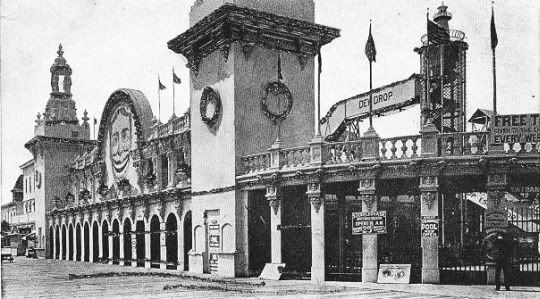
I also can’t help wondering what happened when they headed out to Coney Island. I guess they took a 5th Avenue BMT express out over Brooklyn Bridge but what did they get up to once they arrived at the oceanside resort? Did they head over to West 10th St and check out Luna Park, in the company of its usual 90,000 daily visitors? Did they take its Trip To The Moon, a dream of space travel in a dark theatre? Maybe they went to Dreamland instead, watching a chariot race round its lagoon or its Fighting Flames show — real women and real children being rescued from real fires in pretend houses by make-believe fireman. I can see Freud might have had thoughts about that.

Maybe they took a walk on the beach and saw some Coney Island whitefish — local slang for used condoms left over from the previous night’s sandy adventures. Perhaps they reflected on the name of the place. Coney is an old word, descended from the Latin cunniculus and a close relative of the Spanish conejo . It meant rabbit, a word which originally referred only to the young of the species but which, from the 16th century onwards, edged coney out of the language. Why? Because of the way coney was then pronounced. Which was? You can figure that out by the fact that it originally rhymed with another word for the same animal, bunny. In fact, bunny is probably a rhyming euphemism for coney, consciously created on account of the pronunciation problem — like, say, rollocks .

A similar thing happened in French — connil was replaced by lapin. In Spanish, a Playboy Bunny is a conejita, both a young female rabbit and deliberately close to coño. All those years, I’d thought how strangely innocent Hugh Hefner had been in calling his hostesses Bunny girls. All those years, how wrong I was. Why and how did the pronunciation of coney change? Money and honey didn’t change their sound — something taken rhyming advantage of by both Edward Lear (The Owl And The Pussycat, 1867) and Jesse Stone (Clyde McPhatter and The Drifters’ Money Honey, 1953).

It was the bible that made coney to rhyme with pony. There were lots of coneys in it: rabbits are middle Eastern thing. There were no rabbits in Britain till the Normans brought them over, which is why there is no Old English word for them. The Bible and coney problem was a reading-out-loud problem. Preachers just didn’t like to get up of a Sunday morning and inform their congregation about the habits and lifestyle choices of things whose name sounded just like the name of another thing. Or, to put it the OED way, ‘the desire to avoid certain vulgar associations with the word in the cunny form, may have contributed to the preference for a different pronunciation in reading the Scriptures.’

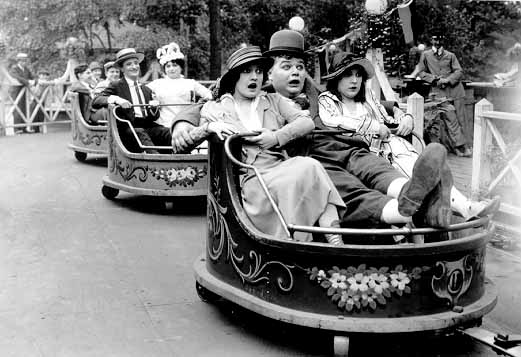
So what exactly did Freud and his fellow rubberneckers get up to that day in Coney Island. Myself, I like to think they hiked over to Steeplechase Park on West 17th, took a whirl on the mechanical horse race round the Pavilion of Fun, examined themselves in the full-size distorting mirrors and had a disbelieving, Mittel European gawp at what happened as jets of air — they were all over the park — squirted out through gratings and blew women’s dresses up around their hips. Not so much a day of fun by the ocean, then, as the field work for an entire psychoanalytic conference.

And so to the music link. It’s a song by Jackie Wilson and Lavern Baker.

Thursday, 10 July 2008

Tunnel vision

I’ve been in a tunnel. I did my exams, the first exams for about a third of a century. Three exams, nine papers in all, 45 minutes for each, hand-written.

All but one of my guesses about what would come up were right, even the one I wished I’d been wrong about. I predicted the Lacan and other Frenchman paper would offer a Hobson’s choice between a question on the one seminar I missed (‘The unconscious is structured like a language’ — discuss) and one I wished I had (Andre Green’s dead mother — what do you reckon?).

I went to an Andre Green lecture last autumn, at the Institute of Psychoanalysis, in Shirland Road, just down the road from what was, a lifetime or two ago, the Charlie Pigdog club, where I first saw Joe Strummer strum and drang, as a 101er.

I’ve no idea how long Green’s lecture lasted. A month? I phased in and out so it could have been longer. I’m told it was in English but my ears and brain indicated otherwise. I practised what analysts refer to as free-floating attention. I heard him say something about Melanie Klein. She died in 1960. That didn’t stop him being angry about her and all her works. I also think him I heard him say something about Lacan — dead these past 27 years. Lacan took a couple of sharp Green jabs to the brain-box, too.

It was the kind of evening that would confirm all the most negative views of psychoanalysis and psychoanalytic thought. It was tedious, tendentious, schismatic, pompous, drowning in its own jargon and delivered in a stage-foreigner accent. At best, I guess it was a kind of Camp Lejeune moment for prospective analysts. If you can survive an evening with Andre Green, after that anything life may throw at you will seem like a walk in the park.

So I couldn’t answer the Andre Green question — even though I knew the answer, in outline anyway. I just couldn’t forgive him for that decade in Shirland Road. He’s an old man, I know. I’ve read a really interesting dialogue between him and Gregorio Kohon, a north London Argentinian analyst. In it, Green is clear, insightful, bright, original, engaging. I’ve also read his own writing. It’s not. True, it’s not as hilariously terrible as Lacan’s but then what is?

Which left me having to answer a question on something I understood — I think — but had only ever read about. I can only hope that what I wrote wasn’t too stupid.

PS Green’s dead mother thing? His own mother did die when he was young but it’s not about that. It’s about deadened mothers placing that deadening in a child — who then grows up to seek out and recreate that deadening in other relationships. A kind of succulent presence of absence.

Still, that’s about all I can remember about it. And if that’s all I wrote, I certainly would have failed.

PPS Before posting this blog, I emailed it to my wife (in the next room). Here’s what she replied: ‘It made me laugh. But, do you want to make an enemy?’

Good question. What would it be like to have Andre Green as an enemy? I’ll tackle it in my next posting.

Linkstuff

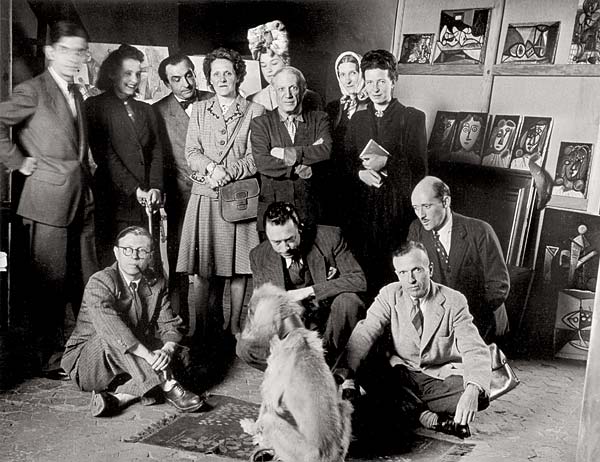
This Lacan hotlink takes you to a photograph of Lacan with — deep breath — Pablo Picasso, Simone de Beauvoir, Jean-Paul Sartre, Albert Camus (he's the one petting the dog). Which one's Lacan? I'll tell you next time.

This Lacan hotlink takes you to a painting. Why? I'll tell you that next time, too.

Wednesday, 30 January 2008

Les conneries de Jacques Lacan

I was worried. I really was. But I needn’t have been.

The worry was this: I’m old enough to have only caught the first waves of the French invasion of British academia. I was there for Albert the compulsive philanderer and Louis the wife-killer. But the deconstructionists and post-modernists didn’t cross La Manche till after I’d left university. The author may have died in Paris (and Aspen) in 1967 but his obituary hadn’t made it to south-east London by mid-1974.

I knew little or nothing about the next wave of French thinkers: Jackie le pied noir, Paul the anti-semitic collaborationist, Henri VI (number of wives), Michel the AIDS victim or Roland the laundry van victim.

So when I started thinking about a masters in psychoanalytic stuff, I hopped and skipped right past the MA in Psychoanalysis at Middlesex when I read that it was ‘largely Lacanian’. I wasn’t sure I could face two years of Jacques-Marie-Émile the bent cigar smoker. I tell a lie. I was sure I couldn’t.

So I worried about the unit on him — Jacques Lacan, that is, the French psychoanalyst who might or might not have had really profound things to say. It’s really hard to tell, particularly when you read him — or rather try to read him. As he himself agreed, admitting that his Ecrits — which are his only substantial writings — were not meant to be understood as such. They were, he said, meant to be comprehended, or at least absorbed, in some kind of non-cognitive, mystical way. So, so far, I had him marked down as the Kahlil Gibran of psychoanalysis.

As it turned out, I needn’t have worried. The first Lacan seminar began with a joke. A good one, too, if martini dry. The lecturer arrived 15 minutes late, with no explanation or justification. Usually, I guess, this would be a result of heavy traffic, signalling problems at Edgware Road or a family row — something like that anyway.

This, though, was something else. Quite obviously, this was a gag — a witty associative link to Lacan’s ‘controversial indeterminate-length sessions’, for which he both charged a full fee and sometimes took the opportunity to have his hair cut.

Having opened with this gag, the lecturer (who’d clearly already had his hair cut) went straight into explaining and didn’t let up till the clock called time. It was everything I didn’t expect — clear and straightforward, with more gags, sideswipes at Lacan’s terrible, French sense of adventurous dressing and the fact he was always an editor or two short of being able to write French. There was even a pointed reference to the expensive Cubanity of his cigars — though no explanation of their peculiar shape, as curlicued as a pig’s penis.

All that was missing was anything about how to pronounce his name. The lecturer, being a Lacanian — French, too — had no problem with it, naturally. But it does cause problems in the anglophone world.

This is how it should be pronounced. The first syllable is pure Scouse, as in ‘alright, la.’ The second is pure criminality, as in ‘con trick’. Just nasalize the final consonant and you’re there.
English speakers — or at least those who’ve never sat through a Lacan seminar — don’t generally pronounce it that way. If they know no French, they tend to rhyme him with, say, Suzi Quatro’s 1973 chart-topper, Can The Can — a hit when he himself was in his fullest pomposity.

If, however, they think they know French, they often have the amusing — at least to my infantile mind — habit of trying to make his name at least sound French. So they rhyme him with Simon Le Bon. As someone who’s writing a book about swearing, I am only too aware that this turns him into a French word that can be translated both directly and indirectly into English, neither of them complimentary.

This pronunciation makes him either a fool (as in the comedy flick Le Diner Des Cons) or a charlie or a berk (as in the body part euphemised in both those pieces of truncated rhyming slang). I’ve never seen a French person impolite enough to point this out to someone who insists on talking about Jacques le con.

Of course, if natural gender rules were in operation, this most feminine of things would be la con — ie as the great analyst’s surname is actually pronounced. But they’re not, it’s a masculine noun. As it is in Spanish. It’s just one more thing the Romans did for us: stupid cunni (second declension masculine nominative).

And yet, and yet . . .there were those who thought that pronunciation was a fair pronouncement on Lacan. I was told this by someone with close links to the camp of that other French philosophe, Henri Lefebvre — who died at the age of ninety, in the arms of his sixth wife.

‘Lefebvre felt Lacan’s analytic treatment had really harmed a friend of his,’ said my informant. ‘So he told Lacan he was un con. In response, Lacan told Lefebvre he was une clune. A clown.’

Ah, the heights and wonders of French philosophy. Still, it could have been worse. Lefebvre could have called Lacan une con — ie used the feminised version. But he wouldn’t have done that. That implies homosexuality. One French thinker would never do that to another French thinker. He’d sooner call him an Anglo-American empiricist — much the same thing in French intellectual eyes.