Wonders of the modern world, ten . . . When dinosaurs roamed north London Other places have gnomes in their front gardens. Primrose Hill has dinosaurs.
It reminded that the great ice age stopped at Finchley Road station. Honest. Back then, there was a great ice cliff, a couple of miles high – half way down where the platform is now, I think.
One day I’m going to walk that boundary — where the ice stopped and the dinosaurs began. (Okay, I may have got my pre-history a little messed up there. But . . .)
Which leads me back to Freud . . .
I hear that Lucien — sorry, Lucian — Freud’s nephew Matthew is moving into the area, following in his great-grandfather’s steps. Elsworthy Road was the psychoanalyst’s first home in exile. Matthew isn’t living there, though. From what I hear, he’s on the other side of the park. Not exactly where Sidney Bechet or Roger Fenton lived but not far. Nor from where Sylvia Path killed herself. I think of Matthew Freud’s forebear, Edward Bernays. He was the son of the marriage between Sigmund’s sister and his wife’s brother. Vienna-born, Bernays emigrated with his parents, becoming a true New Yorker — a top-dollar pitchman, the PR rep for the Wilson government, Lucky Strike cigarettes and, later, anti-smoking campaigners.
He either did invent both the phrase ‘public relations’ (a replacement for the word ‘progaganda’, made unpalatable by German use of it in WW1) and the practice of public relations — or, by claiming he did, Bernays convinced everyone he actually did it, even if he didn’t. Now that’s what I call public relations, volume one.
Just the kind of thing that it looks like Matthew Freud’s in-laws could do with right now, I find myself thinking.
Thursday, 1 September 2011
Lucian Freud and me, part two
One Yes, I know I spelled Freud’s first name wrong in the previous posting. I realised that before I posted it but decided to leave it in because I always seem to spell it wrong. I don’t really know why.
It’s not that I don’t know I do it. The only possibilities I can think of are that it’s because I have the spelling stuck in my head from the singer John Lucien. Or even Jon Lucien. Or it’s just a — wait for it — Freudian slip.
Okay, but if it is a slip, what does it reveal? The only think I can think of is that I link his name not with its real, classical Roman forebear — the satirist Lucian, probably — but with that familial derivation of Lucien, from the Latin lucius. Which, suitably for a painter, comes from lux, Latin for light. Which leads to . . .
Two In the aftermath of Freud’s death, my local paper had a reminiscence from an ex-lover. (That’s the kind of gossip you have to put up with in your local paper if you live round my way.) She said that her name for him — others used it, too — was Lux.
Three I had a thought about Freud’s nudes — most of his recent work, after all. What is so unusual (and to my mind original) about Freud’s nudes is their almost complete disconnection from/with sexuality. And whether it’s honest enough to own up to it or not, a lot of nude painting is some kind or other of sexual desire.
Not Freud’s work, though. Which, given the way he carried on, is a bit odd. Worthy of remark even. A renowned real-life skirt-chaser who doesn’t even seem, in his painting, to lust after Kate Moss — who I have seen in person and she really is gorgeous.
So? So there is something plain and ordinary and quotidian about his nudes. They’re not nudes even, really. They’re nakeds. And what I thought is this: there is something about them that reminds me of simple basic photographs of ordinary people, naked — ie not pornography or its ten-bob cousin, erotica.
And I found myself thinking of WW2 camp photographs — the violent intrusions of Nazi pictures of camp inmates etc. How this was another degradation. And I found myself wondering if at some level, conscious or unconscious, the banal demoticness of Freud’s nudes/nakeds is, in part, a way of reclaiming ordinary naked humanity from the grip of Nazi violence.
Which, surely, must have had a place in his memory. He was born in 1922. Hitler came to power in January 1933. Freud saw the Reichstag born — and was ‘excited’ by it The same year, his family moved from Berlin to St John’s Wood. Five years later, in the wake of Kristallnacht (Germany) and the Anschluss (Austria), his grandfather and his family joined them. (He long refused to show his paintings in Berlin and to this day there has never been a show in Vienna.)
Given what then came to pass, he must certainly have seen in those Nazi photographs a future of his own that never came to pass. And by painting the way he did, he kind of stole those horrific images back and reclaimed them — or rather what they showed — for their rightful owners. Their subjects, that is. All of us, by extension, perhaps. PS After I’d written this but also after I’d put up my first Lucian Freud post, I was contacted by someone I know a little — little enough, in fact, not to know that she’d been painted by Freud. She was pissed off at me for spelling the name wrong. I hope she’s unpissed by my explanation.
Some distraction?
One I was in Cornwall for a bit, caught the riots. See here . . .
Not an a obituary or an assessment of the newly dead painter, just a recounting of an encounter. Well, one and a half encounters. Or maybe one and one-tenth.
I did once have a conversation with Lucien Freud. I can remember exactly nothing of what was said. I can, though, remember its tenor and ending. (I’m sure that says something about memory — both mine and in general. But this is not the time or place to consider that. I’ll maybe come back to it some time in the future. If I remember. Boom, boom.)
It was in the mid-1990s, in a then newly fashionable (in certain circles) bar/club/restaurant, Green Street in Mayfair. An alternative (of sorts) to the Groucho, it was — as you’d expect of somewhere favoured by Freud — a louche establishment. The chef was Peter Gordon, the pan-Asian gay New Zealander later in charge of the Sugar Club etc. Regulars included Toby Young, Jay Jopling and the whole YBA crowd.
One night, my friend Tim and myself found ourselves alone at the bar ordering a drink when Freud appeared next to us. I’d seen him there several times before. He’d put good energy into convincing another friend’s girlfriend to have lunch with him. I have two memories of what happened next, either of which might be true.
One, she agreed, he propositioned her, she was upset, her boyfriend was thrilled.
Two, she declined, her boyfriend (possibly knowing what was in store) persuaded her, she went to lunch, he suggested she pose for him (and propositioned her), she declined both offers, her boyfriend (probably thrilled by the prospect of a kind of post-modern troilism with Lucien Freud) was upset and tried to convince her to change her mind but failed.
I’d never stood so close to Freud or seen him outlined against a wall. He was tiny, I remember thinking. Astonishingly vulpine and beautifully suited. Exactly the kind of aged man you’d expect to be still propositioning young girls — he was then in his mid-seventies.
So Tim and Lucien and I talked a bit about whatever. Then the owner of the club emerged from somewhere, came over to us and greeted all three of us warmly. Then he said to Freud: ‘Lucien, I see you’ve met my friends Tim and Pete, a pair of the finest journalists in London.’
At which point, the laws of physics were ruptured. Freud disappeared in front of our eyes. He was there and then he was not there. There was no stage of transition. In the face of journalistic enquiry, he had, quite magically, de-substantiated. Why? Well, a general desire for distance from journalistic enquiry — bordering on distaste for journalism and journalists.
Oh, how conflicting it must have been for him to have enjoyed himself chatting to us then discovered we were the enemy. As it happens, neither of us had any designs beyond a chat and wouldn’t, I’m sure, have repeated anything in print — at the time, anyway.
He didn’t, of course, disappear from existence. I remember seeing him at the club, in fact. But we never had another chat.
The one-tenth of an encounter was not long after the first. It was outside the Cafe Rouge in Kensington on a Saturday lunchtime. I was eating with my friend Paul. Perhaps Freud was eatint there, too. All I remember was that he became upset about something. I have two memories of what it was, both probably false — another rejection by a young woman or a betting slip torn up and thrown down.
Whichever it was, what I do remember is that he launched himself into his car, a vintage Bentley, I think, of some distinctive colour — deep blue or perhaps powder blue. He span the wheel, u-turned in the face of oncoming traffic and disappeared up Kensington High St in the direction of Hyde Park.
This time, I didn’t see him again. Ever.
Next part two of me and Mr Freud
Tuesday, 26 October 2010
Where was I?
Oh, yes. In Exhibition Rd, heading north towards Hyde Park and a talk at the Royal Geographical Society — I’d never been there before.
It was by the analyst Ron Britton and it was entitled Between Brain and Mind? I had no idea of the meaning or significance of that question mark at the end of the title before the lecture. And I was no wiser after the lecture. Obviously, it was about the relationship between physical structure etc and consciousness etc. But, basically, as he had no interest in the former, he had nothing to say about its relationship to the latter.
The only point I really took away was his distinction between comprehending and understanding. That is, in a way, a version of the second two-thirds of the Confucian maxim: I hear and I forget, I see and I remember, I do and I understand. He used the phrase ‘getting it’. I got it
I remembered a bit about Ron Britton from my course, but not much. He was a Kleinian, I remembered. And he’d written about Wordsworth’s early poetry — the Prelude and Ode: Imitations of Immortality. These poems are, as you might guess if you’ve read them, big in the analytic world.
I quoted him in my dissertation, in fact. I could repeat what I wrote but I won’t. You wouldn’t like the language. I’m not sure I did. The gist, though, was that he came up with a smart idea about how art was arrived at/created: by a continual feedback loop between the two Kleinian ‘positions’ — mental states, that is. I’m not sure if it’s right — or even necessary — but it’s smart and fun.
Which his lecture wasn’t. It rambled. It missed the point. It ignored the subject of the title. It asserted where it should have argued. It went on and on.
I dozed a little, I must admit. So it’s possible that I missed the good bits, though I doubt it.
There was a good bit during question time, however. Someone from the audience challenged his lack of interest in — and understanding of — neuroscience. He — and his fellow panellist, Peter Hobson — took umbrage, albeit in a very academia-ish way, smooth and accepting.
Essentially, they asserted their position: that neuroscience offers nothing of interest to our understanding of mind. That is, of ourselves. Psychoanalysis: that’s the thing. Of that, they are certain. Of that, they sing. True believers.
It’s a row I’ve seen before. In fact, it’s the row going on in psychoanalysis at the moment. In one corner, the neuropsychoanalysts — led by Mark Solms, a South African who also makes wine. In the other, the traditional Kleinians — led by Rachel Blass who, being a suburban New Yorker, also, er, whines. I heard a debate between the pair of them and it was great fun. The Blass position was completely assured in its own logic. It was like Labour activists’ view of the Conservatives. Essentially, she couldn’t credit her opposition with a brain. There was an air of Prime Minister’s Question Time about the way she argued — fabulously well and completely convincing but, ultimately only in the moment.
To me, for what it’s worth, the neuropsychoanalysts seem more, well, measured. An odd choice of word, perhaps, but the one that came straight to mind. They seem more worldly, less propelled by their own logic.
Significantly, there seemed to be very few psychoanalytic heavy-hitters at the evening with Ron Britton. There were also, to my eye, no non-white faces and far more women than men. Is now the place to mention that there is a theory — a suggestion, anyway — that the reason psychoanalysis’ wider social influence has declined is related to the increasing number of women in the profession?
No, don’t hit me. There is an argument to be made. I will come back to it, too. Soon. Well, in time.
It’s just off the main entrance, up a flight of steps. The light is low — giving a sense of the couch and the consulting room. A fine and private place.
The show’s title gives little indication of the contents or approach, though. It is, in fact, a collection of objects which exemplify and dramatise psychoanalytic thought and concepts. So there is stuff from Freud’s room — predictable in essence but given depth by the accompanying exploration of their significance by psychoanalyst David Bell.
An interruption to myself. David Bell is a funny little person, with a beard which perhaps contains a nest or two. He once nearly ran me over, on his bike, as he emerged, inattentively, from cycling through Waterlow Park. He certainly, absent-mindedly, didn’t see me. He always, always, always wears a sleeveless sweater, whatever the weather — which, of course, makes him look like an overgrown schoolboy from the 1950s. Which, I suppose . . .
Anyway, he was scurrying around the show at the preview, explaining things and herding people the way he does. He is also a wonderful speaker, a true believer whose views of psychoanalysis — as the central organising subject of human thought, effectively — are made acceptable — if not true or entirely believable — by his wit and eloquence. Though not charm. I doubt if anyone has ever accused him of that.
Other stuff in the show includes toys — as used to analyse children, by Margaret Lowenfeld and Betty Joseph. Basic idea: children aren’t capable of talking coherently about their inner life — ie via free association — so analyst gets them to play with toys and then analyse the deeper meaning of their play.
There are also drawings made by Melanie Klein’s young boy patient Richard. Pictures of Spitfires and Messerschmidts shooting and burning — it was war time. There are Winnicott’s squiggle pictures. Basic idea: analyst draws squiggly line on paper, child extends it, analyst explains meaning of child’s squiggle. (Put like that, it can sound daft. But I’m not sure it is. In fact, I’m sure it’s not. If we can’t find meaning and emotion in the shape and rhythm of a line, we would never visit art galleries and Picasso would have been out of work straight away.)
And there art works. One is directly sexual. Of course it is. It’s by Tim Noble and Sue Webster — YBAs, famous for their rubbish pieces (description, not judgment). There is an electronic piece. Of course, there is. It’s Arnold Dreyblatt’s The Wunderblock — a tablet screen which displays a paper of Freud’s which compared the way memory works to the child’s toy known, in German, as a Wunderblock. In English, a mystic writing pad — you write on it, you see what you’ve written, you lift the wax sheet you’ve written and it’s all gone. On Dreyblatt’s the text is electronic, speeding and drifting past, constantly rearranging and re-emphasising itself. Unfortunately, it’s the one thing in the show which isn’t well described or explained.
There is also a gorgeous Grayson Perry pot — his wife is, of course, an analytically inclined therapist. There is a ‘Cabinet of wish fulfilment’ — votives and pieces of tattooed skin from the Science Museum’s own collection. (You can imagine the justifying explanation by the curator who collected them, can’t you. Come on, he or she would have said, there’s bound to be a show someday when we’ll need a few ancient small carved penises and hands. Trust me, there will.)
What’s most intriguing about the show, I guess, is its concreteness. Psychoanalysis is the most cerebral — or, perhaps, most mental — of disciplines. It’s about words — silences and gesture, too, but mostly words. This show gives it, I suppose, body.
And, having spent an intrigued and distracted hour at the show, I wandered up towards Hyde Park for the next of the day’s distractions.
But that’ll have to wait for the next posting. Tomorrow. Probably.
Saturday, 10 July 2010
Freud: wrong, right, wrong-headed? The fourth and final part*
A while ago now, I was taken to task about Freud etc by an old friend who has spent many years working as a mental health professional. I, of course, have no such experience. He challenged me to defend the old fella against a 4-D attack, the last of which is . . .
Divination
‘Perhaps I mean divine guidance,’ wrote my friend, adding that he sees Freudian theory as impossible to test or disprove. ‘There’s the impression of depth of insight – but that could be illusory.’
The result of this, he says, is that it ‘tempts practitioners to think they know much better than their clients what’s wrong, while human qualities such as trust and respect can get dissolved away. I’ve seen it happen. Worse, I’ve inflicted it.’
Well, I think there are two questions there — though they are linked. One is about science and knowledge, the other about professionalism and humanity. Deep Freudians would — perhaps defensively — claim that it is only psychoanalytic thought and insight which is capable of resolving the conundrum about handling actual patients, as opposed to just mouthing off about the brain and mind and people (ie what I do).
So, the first question. Again, I can divide this into two answers.
One, yes, there is a tendency for therapists and psychoanalyticisers to worship at their own altar. Or, at least, by worshipping at Freud’s altar, hanging on his every word, use the perceived glories of his thought as mirrors reflecting and focussing their own perceived originality and wisdom.
(During the Freud units of my course, I sometimes felt like I was in a psychoanalytic version of Talmudic exegesis — studying and turning over every word of God’s given texts in search of new levels of meaning. That was on good days. On bad days, I sometimes felt like I was in the ‘meaning of the dropped sandal’ scene in The Life of Brian. Sometimes, I’d point out that this was how I felt. This did not always go down well.)
Actually, to tell the truth, there can be more than a tendency for therapists to worship blindly at their own altar, particularly in the academic world. Research shows — consistently and surprisingly unequivocally — that therapy (of whatever kind) works. (That is, the patients get better/feel better/are more capable of running and enjoying their lives.) But . . . that ‘whatever kind’ is the crucial phrase. The research is quite clear that the therapist’s training background or theoretical stance seems of surprising unimportance.
What does help patients to get ‘better’ is the human relationship with the therapist. (The ‘better’ is in quotes not for any silly, naive relativist reason but to indicate how wide a range of outcomes I am using it to encompass.)
The crucial thing is that the patient likes/respects the therapist. And the crucial thing about that liking/respecting is not abstract. It’s clear and concrete: it facilitates the patient’s capacity to take ‘criticism’. That is, interpretations which, in whatever way, challenge the patient’s view of the world/themselves. In effect, we trust the judgment of those we like**.
The second part of the first-question and answer is about whether Freudian theory is provable or testable. Well, actually and contrary to most statements on the subject, it is. The best comparison is with Darwin’s theory of evolution. To all but religious fundamentalists, it’s clearly true — or, at least, it provides a superior explanation for the world than any alternative. In particular, one that enables predictions to be made. But is it testable or provable in the way chemistry is? No.
Psychoanalytic theory has a similar status. Potentially, at least. Many, if not most, of its supporters are of a non-scientific bent, quite without interest in testing or proving it. They just accept it — the way, say, Othello accepted Iago’s description of reality. (See below for another tragic Shakespearean allusion/illusion.)
That doesn’t mean you can’t demonstrate some elements of psychoanalytic supposition through experiments. Ramachandran’s famous work on stroke patients, for example, can be mined for significance in terms of Freudian conceptions of unconscious processes. A stroke-inflicted patient says her paralysed left hand is not her own but her mother’s. Yet, when asked to touch her left hand against her nose, she uses her right hand to lift her left hand — the one that she says is her mother’s — to her nose. The unconscious and the process of denial seem — to me, anyway — the clearest and cleanest explanation.
The second question is about psychoanalysts’ (and, by extension, all therapists’) essential humanity. Well, that is not easy to answer. My personal experience has been essentially positive. With one obvious exception, therapists I’ve consulted*** have been intelligent, thoughtful and considerate — perhaps overly so, viewed through my tough-hearted view of life.
Yet I’ve heard many horror stories from other people — some, though not all, of which I believe. Therapists often cross boundaries. A 1990 north American study found 'sexual abuse of female patients by roughly 7-10% of male therapists of every stripe and level of experience'. The second husband of the first wife of Freud’s grandson had a quite terrible experience at the hands and couch of one of the eminences of British psychoanalysis. He died recently. I might write about him sometime — in particular, how the psychoanalytic establishment dealt with his story.
Mostly, though, therapists and analysts are in denial about the range, extent and meaning of these failures and failings. Which brings me back to Ramachandran’s stroke-begotten woman. And the tentative suggestion that this also perhaps indicates that psychoanalytic theory can be used, reflectively, to examine psychoanalytic practice. Denial is a human constant, it seems.
It also leads to one of my current obsessions, the Dunning-Kruger Effect. That is, the sad fact that the incompetent are doubly cursed by their incompetence. They are not just incompetent but incapable of recognising their incompetence. They simply can’t see how badly they do things — so they can’t take the steps necessary to improve. The competent, by contrast, are more likely to understate their competence — not out of false modesty but because they compare themselves to the really competent.
A notable study of this phenomenon is of medical students so . . . one, we’re not talking just society’s least able, two, that really makes me worry about an impending routine visit to the doctor.
If you want to read more about this, I suggest a visit here (http://opinionator.blogs.nytimes.com/2010/06/20/the-anosognosics-dilemma-1/). It’s a piece in the New York Times Opinionator by the documentary film-maker Errol Morris. It taught me loads of interesting stuff about Woodrow Wilson, bank-robbers and the strangenesses of the goings-on in the neurology department of Salpetriere in the late 19th century. It’s not a short piece. In fact, it’s five pieces. Set aside an hour or two to make your way through them all.
An extract . . . Errol Morris is talking to Ramachandran. He asks: ‘Do we live in a cloud of belief that is separate from the reality of our circumstances?’
Ramachandran replies: ‘Absolutely, and overall, fortunately, it's a positive cloud in most of us. If we knew about the real facts and statistics of mortality, we'd be terrified.’
Happy reading.
* The first three parts were Determination, Distance and Denseness.
** This is, of course, one of the main motors of life’s tragedies. Macbeth, for example, chose to believe that the judgment of the object of his sexual desire was fully equivalent to an accurate, independent, peer-reviewed, chi-square-tested assessment of the realities of late mediaeval Scottish political interests and alignments.
*** That sentence poses a variant on the Nick Clegg question about sexual experience, doesn’t it. How many analysts/therapists’ couches (or chairs) have you been on? In my case, more than five but less than ten. Being more precise would involve defining what is meant by ‘therapist’. And, of course, by ‘I’.
Next up Vicky Christina Barcelona: what’s that all about, eh? And: who would Freud have supported in the World Cup?
Sunday, 27 June 2010
Six degrees of osteopathy
A follow-up to my last posting. Well, the first of two follow-ups actually. The next I’ll post tomorrow.
I don’t — as regular readers will surely agree — generally do personal health stuff etc here. I did, though, mention that I had a bad knee last week. Not that you probably care — I certainly wouldn’t if it was you — but I no longer have a bad knee.
For which transformation, I have one person to thank. Which is, frankly, only of interest to me and them. But I thought I’d share with you the (brief) story of how I came to find this person . . .
Garry Trainer, that is. He’s an osteopath, based around the corner from me, in Primrose Hill. A burly, middle-aged, twice-married Kiwi who likes a drink and has just taken up surfing again, he has my deep thanks for fixing my knee.
An hour or so on Monday lunchtime. A few needles — he does acupuncture, too. (I’m inherently sceptical but also acceptingly pragmatical.) A little back bending — no crackings, though. A hefty massage of the back and knee tendons.
Right away, I felt better — improved, that is. By the next day, I was limpless. So, for what it’s worth, this free add.
But I also thought I’d share with you how I came to put my body in Garry’s un-tender care in the first place. And how it connects to my (relative) closeness to Adolf Hitler's hand and Oscar Wilde’s penis.
Garry first, though. About two years ago, in the wake of the exams I sat for the first year of my course, my back got really bad. The worst I ever had. I couldn’t walk. I ended up not seeing the local shops — not much more than a hundred metres away — for nearly a month. I couldn’t get from one floor to the next in under five minutes.
I knew I had to get something done. I’d been to an osteopath years before and she’d done the trick. But she’d moved away.
Two new ones came recommended, both by people I respected. Jonathan Le Bon and Garry Trainer. I checked both their websites. I discovered that Le Bon was brother to Simon Le Bon, the popster, while Garry had had his hands on Gwyneth Paltrow. Well, which one would you have chosen to get closer to?
Me and Adolf Hitler? Well, I’ve shaken hands with not just one but two people who, as children, had their hair ruffled by him.
Oscar Wilde’s penis? I’ve shaken the hand of a man who, in pre-war Brighton, had his hair ruffled* by Bosie, Oscar Wilde’s boyfriend, nemesis and, I should guess, penis-handler.
I can also get to the Pope in one. Freud? Loads via London analysts, of course — particularly via Anna Freud. But also via an American cousin who is related to Joseph Paneth — a close friend of Freud’s who lent him the money for his wedding and who died of TB, at 32. Paneth was also a pal of Nietzche’s.
Hence, my personal variant on the classic parlour game. I call it Six Degrees of Separation Anxiety. It's just the same as Six Degrees of Kevin Bacon — only the link (or end-person) should, in some way, be odd or unsettling. I welcome all contributions to my game. Put your own links to the famous on the comments page.
* Hair-ruffling children was once a big thing in Britain — Germany, too, it seems. I was certainly a victim in my own childhood. Fears of hordes of marauding child-abusers seem to have put paid to hair-ruffling — which seems to have gone the way of spats and . . . Gordon Brown. (I can do him in one, too.)
Today, I am mostly listening to . . . Jackie DeShannon (and Jack Nitzche — no relation.)
Next up The other follow-up — something Maggie Alderson didn’t mention in Cambridge.
Friday, 11 June 2010
Freud and the case for the prosecution, part three*
So, after a pause for breath, on to my old friend’s challenge to Freud and Freudian theory.
The third of his four Ds was . . . Denseness.
Not that Freud himself was dense. Rather that so much of Freudian writing reads, in the immortal words of someone-I-can’t-recall’s accurate critique of Iris Murdoch — ‘she writes like a pen dipped in shit’.
My old friend wrote: ‘I’ll just say “Lacan”. But each school has developed its vocabulary, and its own set of brain-twisting concepts. The training is long and arduous, the rivalry fratricidal, the status hard-won, the therapy expensive and professional membership exclusive . . . there are all the hallmarks of the well-known sociological process of profession-formation.’
To which there is only answer. Or, rather six answers, all the same.
Yes, most psychoanalytic writing is barely in English. The fact that for many of them English is not their first language is no excuse. The bits I’ve read in the other languages that I can understand are equally obtuse. (I intended to give an example here but when I skimmed through some potentially dense papers, I found they made perfect — well, reasonable — sense to me. That’s what you happens when you get stuck inside a subject. You find yourself, sadly, understanding the jargon. Trust me, though, you’ll be glad I didn’t find an example.)
Yes, the training goes on forever. Which, though it makes for thoroughness, inevitably excludes those who can’t afford it. As a profession, it is now seriously worried about the lack of a new generation.
Yes, the rivalry is fratricidal. A good number of our lecturers couldn’t stand each other — and would sometimes make this, if not clear, then certainly apparent. To adapt an old Jewish joke: two psychoanalysts on a desert island, how many schools of thought? Three: one for her, one for him and one for both of them to rubbish. (An academic relation of mine said he always invites certain speakers to conferences — much as a sensible emperor would call in a Christian or two for the lions’ dinner.)
Yes, the status is hard-won, the therapy expensive and professional membership exclusive. By the end of the course, my joke was that the whole thing had become a Ponzi scheme. Analytic patients (or analysands, perhaps) are very often — perhaps all too often — trainee analysts. So, at heart, it’s a cross-generational money transfer system. Analyst one pays analyst two lots of money as the essential part of analyst one’s training. Analyst two retires — in part, on the money supplied by analyst one (and other similar trainees). Analyst three — a younger person — then starts paying money to analyst one. In time,analyst one retires — thanks to the money-stream provided by analyst three etc. Now analyst three sets up office and welcomes analyst four’s regular payments. Etc etc.
Yes, it has created a professional exclusiveness. Eventually to its own detriment, in fact. Psychoanalytic ideas and language are ubiquitous, part of everyone’s daily discourse — repression, unconscious motivations, parental influence on our psyche etc etc etc. Somehow, though, psychoanalysis lost control of its own concepts. It’s the exam question we weren’t set: ‘The more popular psychoanalytic ideas became, the less popular psychoanalysis became. Discuss.’ I will. Soon.
So, after a stupidly long gap, I return to my old friend's questionings of the contemporary validity of the old man - Sigmund Freud.
The second of his five Ds was . . . Determination.
He wrote: 'Freud said our actions are often “over-determined” - caused by many psychic influences. So how easy is it for his model to allow for free will, choice, and therefore responsibility?'
On the surface, this is an easy question to answer. When Freud used the word 'over-determined', he was mostly concerned with the content of dreams. He was suggesting that what goes on in a dream (as judged by what we can remember of it and tell Freud about anyway) is a product of a potentially limitless set of influences.
The classic example is Freud's own dream of Irma's injection, which he recounts and deconstructs at some length in The Interpretation of Dreams. Without going into it all, the dream centres on an encounter with a patient - Irma in his telling, Emma Eckstein in real life - who had become ill because of a faulty procedure by Freud's colleague Otto (Wilhelm Fliess, in real life).
The dream and its associations involve the death of a friend from cocaine (which Freud recommended to him and therefore feels guilty about), a clean-shaven man with a limp (who looked like his brother - Freud was angry with him for rejecting a suggestion), a damaged shoulder (an echo of Freud's own rheumatic shoulder) . . . etc etc . . . right through to the question of the fact that the subject of the dream was dressed. 'Frankly, I had no desire to penetrate more deeply at this point,' writes Freud, revealingly, Freudian slippingly. Nor does he make much of the injection thing - though later commentators have.
'The dream acquitted me of the responsibility for Irma's condition by showing that it was due to other factors - it produced a whole series of reasons.' That is, an overdeterminedly overdetermined analysis.
But that doesn't answer the question of free will, does it?
That question is this, I guess: if everything is set in early life, then that's a kind of psychoanalytic version of religious predestination. And it's true that psychoanalytic thought and practice has often been represented this way. You did that because your mum did that. You are this way because your dad did this. Simple, straightforward cause and effect.
But . . . if this ever was what psychoanalysts thought, it's certainly not the case now - though it is true that American analytic papers from the 1950s and 1960s do often read like that's what the writers thought. Modern analysts prefer subtle (perhaps even over-subtle) readings of the relationship between what happened to us and how we turned out. They don't use the word multi-causality, it's not their kind of language but it's what they are getting at.
Yet, of course, science has taught us to distrust the idea of multi-causality. Not totally, of course, but, all too often things that were once seen as multi-causal turn out to be mono-causal - that a single thing is half-hidden by the collection of things. All too often, a verdict of multi-causality is the refuge of the lazy thinker. (See Occam's Razor. 'Shaves closer', claims 14th century monk.)
Which leads back to free will. The problem with the passive model of personality development is not one of causality. Rather, it's that it sees it as a process having only one actor - the parent affecting the child. Whereas, of course, it's always a dialogue. No matter how dominant the parent, the child's response (as guided, at least, by disposition - ie genetics) is the thing that matters. And, of course, the parent's response to the child's response - and the child's response to that parental response etc etc etc etc.
So? So . . . we end up back with narratives of indeterminate complexity. Overdetermined ones, you might say.
PS1'Marriage is like water. You have to drink it. Swinging is like wine. Some people feel it's delicious the first time they try it, so they keep drinking. Some people try it and think it tastes bad, so they never drink it again.' So said Ma Yaohai, jailed in China for wife-swapping or 'crowd licentiousness' as they called it on the charge sheet. Another kind of over-determination, I guess. (His 'orgies' were held in the two-bedroom flat he shared with his mother. She had Alzheimers.)
* The first was Distance. Still to come are Denseness and Divination. Which makes four in all. Previously, I said there would be five. I suppose that fifth would therefore be (my) Dumbness.
Next up What would Freud have thought of Prime Minister's Question Time?
Friday, 21 May 2010
Just shut up, won't you
This is a posting that somehow went missing in my internal post office. I think it's a follow-up to this but it still seems to have an independent life of its own.
As a group, we don't just mark ourselves as separate from the new intake. Like all students, I guess, we also mark ourselves as separate from the lecturers etc. Last year, I tracked this marking by our increasing capacity for silence.
Analysts are comfortable with silence. More so than just about anybody. They are used to having someone in their consulting room who is silent for long periods. Silence is, of course, a communication in itself.
Most other people are uncomfortable with silence. They fill in gaps in the conversation as quickly as they can.
As a group of students, we started out in the second category but, bolstered by each other, moved towards the first. At the start of the course, if a lecturer asked a question, someone would have a go at answering it straight away. Some lecturers, it must be said, were less than generous in their responses to answers and questions. Most of us quickly decided we'd rather not be made to feel stupid so we kept quiet.
Over the weeks and months, we became both more comfortable at asking genuine questions and more comfortable in staying silent when we felt we had nothing to offer - whether because we didn't want our heads bitten off or because we hadn't done the reading or because we weren't particularly interested in the seminar.
As the year passed, our capacity for remaining silent grew and grew. Sometimes it was genuinely productive. We were thinking stuff through, ruminating, wondering. Sometimes, we weren't, though. We were being snotty.
At least once, the whole group seemed to decide - spontaneously and for whatever reason - that we just didn't feel that generously minded towards the lecturer. So when we were invited to join in, we said nothing. Confident in our capacity for silence, most of us didn't even hide our gaze. It wasn't that we didn't understand the seminar or have things to say about it. Just that, collectively, we wanted to withdraw.
It was a kind of strike, I guess. A childish one, I know. But kind of fun in the way childish rebellion can be.
A little something for the weekend Having laughed at Chinglish, now is your chance to sneer at Teabagish.
Next up The second of five big Ds and Freud: Determination (less boring than it sounds, honest)
Tuesday, 18 May 2010
What would Freud have thought of Gordon Brown?
Watching Gordon Brown give his resignation speech in the street, I felt unaccountably uncomfortable. There were obvious reasons for this — inside my head, if not everyone’s.
* I don’t much like Gordon Brown — everyone has their reasons (as the movie has it*) but mine include: his self-martyring manner, unbecoming in the over-12s; his spending my money like a drunken sailor; his centralist, dogmatic micromanagement which has infested so much of government; his use of the word ‘investment’ as a synonym for ‘spend’ (as in ‘we are investing 44 billion pounds in . . .’)
* I don’t much like celebrities parading their children — I didn’t much like Rooney bringing his newborn son on to the pitch at the end of the last game of the season
* I don’t much like the non-separation of the public and the private — I don’t think Sarah Brown should be hidden away in purdah — rather that she should be getting on with her life and work — would Gordon have turned up for her work leaving-do, with kids in tow?
Yet still . . . there was something else that concerned me about the scene. I couldn’t figure out what it was but it hung around, uncomfortably. Then, in another context, I recalled something the pioneering English female psychoanalyst Joan Riviere wrote in a review of Freud's New Introductory Lectures** . . .
'Among all the manifold significances one's child can have, a major one is abundantly clear in all analyses: it represents oneself as a child, one's own id.'
And that was it, for me. What I was seeing was Brown’s use of his own children as representations of his own self — not just his own childhood self but his secret, urge-drenched adult self. (Of course, as a parent three-times over, I know I’ve done this — still do, I’m sure. But even the guilty may point the finger at other sinners.)
So what did I see in that moment that made me uncomfortable? Well, the first thing to consider is that this was the two young boys’ first public appearance — to my knowledge anyway. Previously, they had only two public ‘faces’. One, sheltered behind pixellation. Two, as metaphors used to demonstrate their father’s humanity — eg, the worked-up gag comparing his adversaries’ adult conflict to his two sons squabbling in the bath. Patronising, heartfelt, intrusive, genuine, fake, clunky — so much of Gordon Brown was there in that brief phrase, which probably wasn’t even written by him.
At the leaving moment, though, he (and, I guess, Sarah) did something quite new with their children. He brought them into the public arena. He stood them on his office desk — see the Guardian photograph. He (or someone) bought them new formal jackets. He depixillated them. A bride stripped bare moment.
It was clearly a very deliberate — though, of course, not necessarily fully conscious — act. Why suddenly de-privatise such an essentially private element of his life? No one made him do it. It was clearly his choice to put his boys on show.
What was going on? Starting from Riviere’s observation, what did Brown’s act show us about what she referred to as ‘id’ but I’m quite happy to think of as ‘inner self’ or some such. What part of inner Gordon was he representing? Something fairly basic and simple (not to say universal), I think. He was — though probably better not to tell him this — expressing his inner child.
By using his children as simulacrums of the hidden Brown, he was able to represent all those qualities he (and his pals) claim — tenderness, caring, inherent humanity, sweetness. It was a last, almost desperate attempt to rewrite his public self. See little Gordon, he was saying. I’m just a little boy inside, really. I might be wearing a suit and tie but I feel like I’m wearing a new-bought jacket with my favourite trainers.
More than that, though, he was also — possibly — revisiting his self-pity. Would you throw a child out of his family home? Would you put a young boy through all this misery, all this rejection? You wouldn’t do it with a dog, would you? Why me? I’m a nice little boy really. You’d think that, too, if you got to know me. Which you never will now.
All supposition, clearly. I have only two pieces of back-up. One, the sheer and odd novelty of the event — why depixillate for just that moment? Two, the look on his wife’s face. Of course, there was distress there — a touching level of care about her husband, mostly, I should think. But there was more than that, I think. She looked uncomfortable — in contrast to his almost manic street preaching speech. Is it possible that, at some level, she realised there was something disquieting about this public parading of her two little boys?
* Regle de Jeu: ‘The awful thing about life is this: everyone has his reasons.’
** Being a polite (and orthodox Freudian) sort, Riviere didn’t crack the obvious gag. That is, whatever one may have thought of this late work of Freud’s, he could have been prosecuted under the trades description act for its title. There’s nothing (well, not much) new about it. It’s certainly not introductory. And they’re not even lectures but essays — written to be read and never spoken aloud.
PS2 It turns out that one of the young women playing with yogurt pots in the previous posting is the girlfriend of a friend of my elder son’s.
PS3 Forgive a childish moment of my own but here is something I heard a commentator say of Mark Webber’s placing on the grid for the Monaco Grand Prix: ‘It’s the first time he’s had back-to-back poles.’
PS4 I’m appearing at Women’s Word, a feministish book festival in a few weeks — more details in an on-its-way posting.
Next up The sound of silence — nothing to do with the absence of Gordon Brown in our public life but a little something left over from when I was still on the course.
Saturday, 15 May 2010
What would Freud have said about the Socialist Workers Party?
Of the many small delights and delicacies thrown up and out by the election, my own favourite came during the Liberal-Conservative negotiations.
William Hague emerged from a Whitehall building to give a short press conference. As he stood on the steps of a neo-Classical lovely, some kind of background noise obliterated most of what he was saying. It took time to figure out what the noise was, but I got there in the end.
It was a chanting crowd, I soon realised. They were complaining — obviously — about William Hague and, I guessed, the Conservatives in general. After a little more listening, I was able to make out what they were chanting. It was: Tories out!
I thought: how fantastic is that! (I guess that means I have just used up my annual allocation of exclamation marks. Oh, well. It was in a good cause.) A party that hasn’t even come to power yet is being drowned out by a bunch of chanters who already want them out. That’s not politics, I remember thinking. It’s conceptual art.
Then the camera panned round on to the crowd. There was even a banner. (If I hadn’t used up my exclamation allocation, there would have been one a the end of that sentence, too.) I realised right away that it was the Socialist Workers Party. No one else has that kind of world-class overnight banner delivery system. And I thought: what would Freud have thought about this?
First, though, I should point out that I don’t have a problem with the SWP. For starters, they are a fine part of our national heritage — and should, by now, surely be supported by the Department for Culture, Media and Sport and in line for a substantial National Lottery grant. Consider the SWP’s contributions to modern Britain:
* Those banners, of course, with their distinct modernist typography — a really substantial contribution to the surface of the modern world
* The design of Socialist Worker — one of the all-time best-looking tabloid newspapers
* Rock Against Racism — almost every inch an SWP front organisation — I don’t think it recruited many neophytes to the Trotskyist cause but it did give the world The Clash in Victoria Park and many other wonderful shows.
* Various chants — Maggie, Maggie, Maggie, Out, Out, Out was a hardy perennial (Its only real competitor, I guess, was: What do we want? Revolution! When do we want it? As soon as the pubs have closed!)
Further, not only do I appreciate the SWP’s contribution to English heritage, I was even — briefly — a member of its embryonic predecessor, International Socialists. The brevity of my association was, in good part, because head office (or whatever it was called — the central executive, perhaps, or something similarly Orwellian) disbanded the branch I was in — despite the fact that we sold more newspapers etc than anyone else. The reason given was that we weren’t serious enough. I took this somewhat personally — probably correctly. I never did, though, get to the bottom of what exactly this lack of seriousness involved. Was it . . .
. . . that my understanding and use of the word ‘party’ had un-Leninist ambiguity to it?
. . . that there was an immoderacy to my enthusiasm for the music of James Brown — Nixon voter, owner of several radio stations, ardent proponent of ghetto capitalism?
. . . that I came to realise that my comrades actually meant what they said?* While generally a good thing for the rest of humanity, such directness is necessarily inadvisable in the necessarily disingenuous world of politics.
. . . that, as someone recently reminded me, I was in the habit of pointing out that that in October 1917 a good number of Muscovites woke up and wondered why their bins hadn’t been emptied?
So what would Freud have thought of the SWP? I think he would have considered that mid-negotiations cry of ‘Tories out!’ and decided: repetition compulsion. Or: the compulsion to repeat. His proposition/theory, that is, that seeks to explain the meaning and genesis of neurotic symptoms. It’s the central thing in his 1920 version of his theory, Beyond The Pleasure Principle.
Roughly speaking (very roughly) and taking an everyday example, it’s the matter of why we keep on dating the same girl/boy — or, in David Bowie’s mordant phrase, always crashing the same car. Much beyond that basic point, though, Freud’s theory is somewhat hard to grasp and maybe even, er, incoherent — certainly according to Laplanche and Pontalis’ standard dictionary of psychoanalysis.
Why should we continue to do something that is manifestly unpleasurable for us? Freud’s idea was that it somehow linked with a fundamental urge for non-existence. ‘The aim of all life is death,’ he wrote. No, never really made sense to me, either. Though it must be said, of course, that there is something deathly about the SWP’s chant — or, at least, something that evokes an urge for death to steal over you.
Perhaps a more useful way to think of the chant, though, would be to concentrate on the joy it seems to give its chanters. Banished are those long Labour years when it was forced to lay, unneeded and unloved, in the deep soul of the far left’s memory. Oh, joy of man’s desiring.
I find myself thinking of the tango of sadomasochism. Who needs each other more? Which is the sharper desire, the hitter for the hit or the hit for the hitter? The Tories need for the far left or the SWP’s need for William Hague?
I find myself thinking, too, of some Lucinda Williams’ lyrics . . .
‘If we lived in a world without tears, How would bruises find the face to lie upon? How would scars find skin to etch themselves into? How would broken find the bone?’
* To begin, I don’t think I really realised the comrades were talking literally — much as, when younger, I’d been deeply shocked out of my already vestigial Catholicism when told that transubstantiation wasn’t meant to be symbolic but an actual change of wine to actual blood and little white round biscuit thing to actual flesh. A precociously metaphorical child, I thought: I mean, come on! (Oops, now I’ve got a structural deficit in my exclamation account.)
PS2 I’ve become — immodestly and selfishly — quite taken with this idea of guessing what Freud would have thought of various things. So . . .
Next up What would Freud have thought of Gordon Brown?
Friday, 7 May 2010
Who would Freud have voted for?
As the election was around and about, I found myself wondering about psychoanalysis and politics. Did I learn anything about the juncture between the two? Did the course give me anything special or extra to say about politicians and the political process?
So I thought about things like . . .
Projection and the way leaders' qualities are so easily built out of our own interior worlds - Hitler is the example psychoanalysts generally reach for but the same kind of thing applies to, say, David Cameron (though more obviously to Margaret Thatcher - obviously).
Grandiosity and the almost cute way that some politicians (Gordon Brown, say) have of actually believing in themselves with such certainty.
Narcissism of small difference, of course - to exaggerate tiny differences to the point of bonkersness (technical phrase: look it up in a psychoanalytic dictionary) is essentially and profoundly human. See That's Why I Hate The French by Goodall, Atkinson et al (1980, Belfast). Politicians do take it to new levels, though. Which leads to . . .
Hysteria and a recent conversation with a political activist. I'd said, quite lightly, that I thought change of party was essential to democracy. (If I thought I could have got it right without checking I'd have quoted HL Mencken's guide to voting: Chuck the rapscallions out!) The activist's reply, in all seriousness, was: 'That's what they said in Germany in the 1930s.'
Then? Then I found myself asking a more interesting question - for me, at any rate. Did studying psychoanalytic thought change my political views? To my surprise, I decided it did. Not in any obvious, party-political way but in a subtler and more profound way.
It wasn't just general stuff that made me think and rethink. It was a couple of specific things - one historical and personal, one conceptual and theoretical.
The personal, historical one was Freud's own life. Being immersed in all those details of pre-WW1 Vienna gave me a real sense of how different a society can be from ours while still being culturally rich and - despite there being an emperor on his throne - surprisingly free. Not that that the same thing can't be said of our modern democracies - just that I wonder if we sometimes easily assume that democracy begins and ends with the political process.
Freud's Vienna was structured and corralled and hidebound in all kinds of ways - capital punishment, anti-semitism, minimal suffrage etc etc. But still it gave space and time to not just Freud but Klimt, Schiele and Kokoschka, Brentano and Wittgenstein, Berg, Mahler and Schonberg. The Wiener Werkstätte, too. (Not that Freud took much, if any interest, in any of them.)
I found myself thinking the same when reading 1599, a book about how that year was for Shakespeare and England. That year, he wrote Hamlet and As You Like It - in a city where theatres could be closed down at a monarchical or bureaucratic whim and religious fundamentalists stalked the land, banning ancient celebrations and painting over church wall paintings. I thought of Tehran, of course, and the Taliban. Maybe there could be a Shakespeare there - or at least a Thomas Middleton. Also, naturally, I thought of that fatuous little speech in The Third Man about how all four hundred years of peaceful Switzerland had given us was the cuckoo clock*.
The conceptual and theoretical thing that changed my political underpinnings was Freud's Civilization And Its Discontents, written and published in the shadow of the gathering holocaust. Commentators generally describe Freud's politics as conservative - and it's true that he seems less than overwhelmed by the wonders of communist Russia. Further, he was unconvinced by the belief that universal suffrage was a universal panacea or that heaven would ever descend and merge with our sitting rooms.
It was a specific section in Civilization that stuck in my head, though, and turned it a little - not in a conservative or even cynical direction but certainly in a worldly one, maybe even a slightly world-weary one. A little distance and scepticism before dinner is always a good stomach-settler.
Freud was writing about the Biblical injunction 'Thou shalt love thy neighbour as thyself.'
This is (some of) what he wrote. 'Let us adopt a naïve attitude towards it, as though we were hearing it for the first time; we shall be unable then to suppress a feeling of surprise and bewilderment. Why should we do it? What good will it do us? But, above all, how shall we achieve it? How can it be possible? My love is something valuable to me which I ought not to throw away without reflection . . . If I love someone, he must deserve it in some way . . . my love is valued by all my own people as a sign of preferring them, and it is an injustice to them if I put a stranger on a par with them . . . What is the point of a precept if its fulfilment cannot be recommended as reasonable?
'On closer inspection, I find still further difficulties. Not merely is this stranger in general unworthy of my love; I must honestly confess that he has more claim to my hostility and even my hatred. He seems not to have the least trace of love for me and show me not the slightest consideration . . .
'The element of truth behind all this, which people are so ready to disavow, is that men are not gentle creatures who want to be loved, and who at the most can defend themselves if they are attacked; they are, on the contrary, creatures among whose instinctual endowments is to be reckoned a powerful share of aggressiveness.' I think he included women in his ungentle humanity. 'As a result, their neighbour is for them not only a potential helper or sexual object, but also someone who tempts them to satisfy their aggressiveness on him, to exploit his capacity for work without compensation, to use him sexually without his consent, to seize his possessions, to humiliate him, to torture and to kill him.'
A bleak, depressive reading of the human psyche. But, in the lead-up to the Nazification of Europe, not an inaccurate one. You could say that its that view of mankind underpins the creation of the EU - an elaborate supra-national structure designed to protect us all from that reality. You could disagree with Freud entirely - whether or not you believe in the possibility of big rock candy mountains.
But you can't dispute its power as a guide to humanity. At least, I can't. Still, as Romain Rolland had it, pessimism of the intellect, optimism of the will. Or, in the words of Hill Street Blues, be careful out there.
PS So who would Freud have voted for? Well, he liked his cigars and was a big believer in the basic rules of capitalism - see his guide to how analysts should deal with getting money out of their patients. So I reckon Cameron - though he'd have been deeply wary of all that 'Big Society' and 'Change' stuff. Still, like the rest of us, he knew you always have to hold your nose at the ballot box.
Next up Freud and free will - at overlong last
* Yes, I know the cuckoo clock is actually German. Though I guess the person who first made the gag didn't. That was Ruskin, the 19th century art critic. Graham Greene borrowed it - in a last minute panic. Then, embarrassed (and worried about being rumbled), he let Orson Welles and his unfeasibly large ego convince themselves that the great big actor had written it himself.
Monday, 15 March 2010
Oedipus at Waterloo
To the theatre again, the National this time. Somehow I'd managed to book tickets for a play that I'd not even heard of, let alone knew anything about: London Assurance.
It is, I learned, a mid-19th century comedy - fantastically, dizzily funny, too, in this version. Also that, according to an old Guardian article that I read after the event, it is 'the missing link between restoration comedy and Oscar Wilde's witty comedies of manners'. Its writer, Dion Boucicault, was, like Wilde, Anglo-Irish - though hetero rather than homo and bigamous than monogamous(ish). In this production, the lead character, Sir Harcourt Courtly, is played as Oscar Wilde - fat and bisexual with a flapping handkerchief.
In fact, it's even Wilder than that. It's clearly an uncanny kind of precursor to The Importance of Being Earnest. It has a cigar-smoking, dominatrix of country wife called Lady Gay Spanker - who is a kind of Lady Bracknell on a foxhunter. It's about being one thing in the country and another thing in town. It has the same struggle with the meaning of identity:
Courtly: Will you excuse an impertinent question?
Dazzle: Certainly.
Courtly: Who the deuce are you?
Dazzle: I have not the remotest idea.
What's it got to do with this blog, though? Well, London Assurance reminded me that, for one of my essays on my MSc, I considered the Importance of Being Earnest from a Freudian perspective - as Oedipus Rex reconstructed as farce.
One of Freud's 'proofs' - or, at least, indicators - of the validity of his Oedipal theory was the fact that audiences were still going to see the Sophoclean tragedy two and half millennia after it was written. He reckoned this was because the motherfucking fatherkilling narrative dramatised universal fantasies and hidden desires. I suggested that the same could perhaps be said of the enduring popularity of The Importance of Being Earnest.
Still and all, though, there is no direct mother-son liaison in Wilde's play. London Assurance, however, centres - via the usual ridiculous and delicious complexities of farce - around the possibility of a young man desiring a woman who could well become his mother. Maybe that's why the laughter was so, so loud - an escape of hidden repressive desire. Maybe.
Next up The second of those four questions about Freud's validity and what I might or might not have learned on the course: determination and the place of free will in a Freudian universe
Wednesday, 10 March 2010
Back on the chain-of-thought-gang
Something of a break since I last updated this, no? Why? Thinking mostly - wondering how to progress with this series of self-questionings, about Freud and why I did the course etc?
What gave me pause for thought were comments posted on my last posting. (You can look them up a little further down the page - and add your own views if you want.) They were smart and intriguing and worthwhile comments and questionings of what I'd written. They raised really interesting points, some of which I felt I could answer easily and others which I thought would inevitably raise other questions - which, in turn, might be best resolved with more evidence etc.
Which is what gave me pause (nearly a month of it) for thought. It wasn't that I wasn't willing to engage in the discussion and debate. I was fine with it. Relished it, in fact. As anyone who has known me for more than, oh, thirty seconds can confirm, I rarely shrink from an argument. As some gamblers will bet on raindrops progress down a wet window, so I'll easily slip into a debate on why that might be happening. Too easily, I guess.
And that was the trouble. As much as I itched to get into a nitty-gritty, down-on-the-mat, punch-them-in-the-kidneys 'discussion', I knew that, very soon, there would be no one left in the room watching or listening. It would alienate just everyone - except car-crash fanciers.
Which led to another problem. I thought the questions raised deserved to be answered. I didn't want to seem to be avoiding them. So . . .
That's why I shut up for a bit. And?
Rather than not answer the questions, I'll just not answer them on the blog. I'll do it either directly on the comments - which means you can have a look if you want but it's not in-your-face. Or, if I think it's too detailed/boring even for the comments section, I'll answer my inquisitors directly. (They are not unknown unknowns. They have previous. They are, of course, friends of mine.)
Meanwhile, I'll just plough on with answering my old friend's challenges here on the main page. Which is what I'll be doing next here. Well, almost. First, there will be a little something else . . .
* Despite her name, she's a Londoner, by the way - and a serious artist, too, of course. Which puts me in mind of those great chroniclers of modern manners, Chas 'n' Dave: 'I've been to the east and I've been out west And I've been the world around But I ain't seen none come anywhere near The girls from London town.'
Thursday, 11 February 2010
Freud and the case for the prosecution, part one*
So, in the words of my old school pal, what do I think about the old boy now? Do Freud's thoughts and writings still have anything to offer me or anyone else? Having spent two years reading and discussing an enormous pile of his writings, what do I reckon? What have I learned?
My pal put the counter-case to me about Freud, organising it under headings, all of them starting with a D, the first of which was . . .
Distance
My pal wrote, of Freudian thought and practice: 'It can make people think too much of what happened long ago in childhood, and especially in their relationship with parents. Unfortunately, the events are fixed, and it's easy to spend too long blaming one's family and one's upbringing.'
My answer Yes, but.** There are two questions here, I guess. One, do our early years and relationships have long-term, central impact on our adult life? Two, if they do, can we do anything helpful with that knowledge?
One There is, quite clearly, ample evidence of various kinds about the impact of early experience. (Not that I'm excluding genetic factors, of course. There is ample evidence for them, too.)
The clearest, simplest evidence is probably from attachment theory - not Freud, I know, but he didn't quote it, I think, mostly because it wasn't around in his day. There's a thing called the Adult AttachmentInterview (AAI).
It's twenty questions and lasts about an hour. Get a pregnant woman to answer it and you can predict with astonishing accuracy the emotional tenor and psychological make-up of her unborn child - as a toddler, anyway. If you want to guess how the child will fare as a teenager, you do the AAI on the prospective father.
Two Yes, but, again. Events are rarely 'fixed' - certainly not in the realms of our inner life. Our memories are many layered things - as experiments of all kinds show. We create and construct our past in much the same way as we create what we think of as our vision - out of the same rag bag of bits of sequential realities, memories, general knowledge, our innate drive to find patterns, our predictions and, of course, our desires. Which is why optical illusions work. They screw not with our eyes but with our perceptual organisational system. Our eyes' eyes, perhaps.
As eyes are not movie cameras, so our past is not a movie. Our pasts have a relationship to reality but it's a complex, tangential one. Freud had a word for this: Nachträglichkeit***. There's no accepted English translation for it. Mine is: afterwardsness****. The past is not so much a foreign country as a collation of reality and layers of memories and constructions - some of which will be based on memories which are themselves constructions.
Confused? We all are. That's the point.
Freud didn't think of analysis as blaming the parents. He wrote something like: neurotics (ie all of us - though more you than me, of course) suffer from memories. Not events, that is, but memories. To him, analysis was a kind of reality-testing endeavour - a matter of challenging the fantasies (and hence symptoms) by which we lead our lives.
So Larkin was wrong. It's not that your mum and dad fucked you up - though they may have. It's your memory of your mum and dad that fucked you up. Johnny Thunders was right, though: you can't put your arms round a memory. Well, best not to. That way, you can change your past*****.
Next up Determination - is there any free will in Freud?
** Still my default answer to too many things, I know. I try hard to remind myself to say 'Yes, and' instead but I often fail.
*** It sounds like a 50 Crown word but it isn't. It's quite standard German. They just like their words long. It's the way their language works.
**** The fashionable one in London Freudian circles is 'après coup' - borrowed from the French psychoanalysts who have been making a big noise about it since the 1960s. It's a rotten, inaccurate translation even in French, though. Whatever Freud meant it to be, it wasn't 'after shock'.
***** Time travel movies are, to my puckish mind, essentially populist Oedipal wish fulfilments. As action movies allow us to murder and mutilate (in fantasy) so movies like Back To The Future allow our secret inner world to vicariously flirt with the idea of . . . fucking (up) mum and dad.
Monday, 14 December 2009
Knees-up, Mother Freud, knees-up, Mother Freud, how about a knees-up? Knees-up, knees-up, knees-up, knees-up, knees-up, Mother Freud
So, to answer your question, Flea, why didn’t Freud go to his mother’s funeral? Particularly, as the year before her death, he wrote, in condolences to a colleague whose mother had died: ‘the loss of a mother must be something quite remarkable, not to be compared with anything else, and awaken excitations that are hard to grasp.’
What excitations, you ask? I don’t know. Hard to grasp? Perhaps the usual elision that awoke in Freud any time he came near to discussing his own undergrowth. We do, though, know he recalled seeing his mother naked on a train — in her sleeping compartment, nothing untoward.
It happened on what the Encyclopedia Britannica describes as the ‘fateful overnight train trip when the family moved to Vienna’ — his father’s (mostly fruitless) attempt to improve on his life in the tiny Moravian town of Freiberg (nowPribor in the Czech Republic).
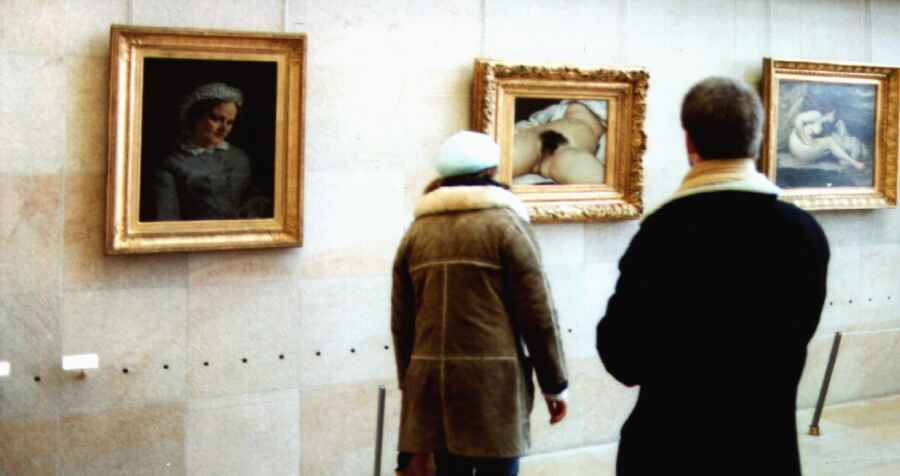
He was four years old at the time — though, when dating his later, profound train phobia to this encounter with the topography that Courbet’s painting categorises as L’Origine du Monde, he remembered it as happening when he was two. A not insignificant change, to my mind — both in his life story and to his Oedipal theories.
Why did he say he didn’t go to her funeral. He told his brother he didn’t like ceremonies and, besides, he was iller himself than people thought (with the cancer that would kill him, nine years later). He also contented himself with the thought that at least he didn’t die first so she was spared the pain of his death. I think there was some vanity going on. He really, really didn’t like people seeing how he looked with his mouth prosthesis and the way it affected his voice.
Still and all, not going to your mother’s funeral? I think he was even more honest than he realised when he wrote to Ernest Jones about ‘the growth in personal freedom I have acquired’ since her death.
And so to today's Advent goodies . . .
One If you want to know how to swear in ASL, watch this.
Two There is a section in my book, Filthy English, about Jackie Wilson and Lavern Baker's . . . alternative version of Think Twice. Now I've found this cute picture of the two of them together.
Three As there are rules for a bride's outfit (old, new, borrowed, blue) and a cocktail (sour, sweet, strong . . . *), so I have developed rules for creating Christmas (plus Hannukah) CD compilations. The first rule is: there must be Elvis. Here is the Memphis manchild performing a posthumous duet. NB Pop experts will notice that something has been excised from this recreated version — Elvis shouting 'Play it dirty!' On a Christmas song.
I would, of course, shown off my new YouTube skills by embedding it but that's blocked for this clip. But not for . . .
Four The other week, someone who was talking to me about their personal life said: It's not rocket science, is it. I said: Yes, it is actually. It's rocket science that isn't rocket science. It's people that are rocket science. Then, in a quite different context, I was pointed in the direction of this clip. Which is: a double pendulum. Which is: a physical demonstration of chaos theory (the butterfly effect) by which the tiniest change in the starting point can very quickly produce extraordinarily varied outcomes. Which is: a pretty damn good analogy for the complexity of human beings bumping along with each other.
Next up Dat dissertation (finally)
* Something like that anyway and certainly nothing to do with the 'cocktail rule' about VAT rate for composite items with differing VAT rates — book plus CD, for example.


 Posts
Posts