Tuesday, 19 June 2012

A place of memory and desire, part four

First the memory bit . . .

(Recap for newcomers: I’m writing about Sound City Beat, a new album by the Radiators from Space, a Dublin punk band.)

I was one of the first people to write about the Radiators From Space. Certainly the first in England. They’d been signed to Chiswick records. I was a journalist on Sounds magazine. I was friends with Roger Armstrong and Ted Carroll of Chiswick records. They flew me out to Dublin so I would write about the Radiators.

Corrupt? Well, yes, in a way. But, no, not at all really. Music journalists — in those days, anyway — prided themselves on being able to take the hand that fed them and chew it right off, up to the elbow and beyond.

I wouldn’t have gone if I hadn’t thought it was worth going and the magazine wouldn’t have agreed to it if they didn’t think it was worth a shot.

So I saw the Radiators play at . . . well, I think it was in Bray but I can’t quite remember where in that seaside town. I do remember, though, that it was a Sunday afternoon gig and I’m fairly certain it was arranged entirely for my benefit.

Or rather for the benefit of someone who was representing a London music paper that could — and did — regularly transform the careers and lives of pop musicians. We didn’t create their talent but we did turn a light on them. Sometimes we were right. Sometimes we were wrong. Sometimes the public agreed with us. Sometimes they disagreed with us. Sometimes the public was wrong. Sometimes they were right.

I wrote enthusiastically about the Radiators. Economists put incentives at the heart of human motivation. So, however right I might think (and still do think) my judgment was, it would be wrong of me not to acknowledge that such positivity was also a logical response to incentives. Simply, if you enthused about a band, you had more chance of it being a big story in the paper, maybe even a cover story.

I meant what I wrote, though. They really were worth enthusing over. They were one of the first Irish punk/new wave bands. At this distance, I can’t remember for certain whether this was before or after I saw the Boomtown Rats play in, I think, the basement that became the Arts Theatre — drawn there by their quite wonderful PR BP Fallon*. The timings were close, though. And I’m sure I’ll be corrected by someone.

The Radiators made one lively punk album which didn’t really sell what they’d hoped. Probably, it was neither simplistic nor arty enough for the contemporary market. It wasn’t yet another Ramones-based thrash or suburban rant. Punk’s first rank aside, that is pretty much what was selling then.

So they did a poppier and smarter record with Bowie’s producer Tony Visconti but that didn’t work either. I remember being in the studio and feeling there was something wrong with it but I couldn’t say what. I just knew that it would be lucky to find much a wide audience. I couldn’t explain why — then or now. So I shut up. For once.

Then things fell apart. I don’t know how or exactly why. Though I’d become friends with Phil Chevron, we didn’t see each other much around this time. Most of the band, I think, drifted back to Ireland. He stayed around and, in time, took a place at the heart of the Pogues — and, by extension, in the hearts of Pogues fans.

* Former Led Zeppelin PR, semi-professional Irishmen (only semi because it was mostly instinctive rather than considered — mostly anyway), he later took to walking up behind you in a club, hooking an arm round your neck, causing you to gasp in surprise and sniff up the popper he’d just cracked under your nose. Now there’s charm for you. He’s not a big fella, either.

Next More memory. Some desire, too.

Monday, 18 June 2012

A place of memory and desire, part three

Surely, being beyond memory and desire is to cease being human. Dead, that is. To nick a line from — to nick a Bob Dylan encomium — def poet Andrew Marvell, it might well be a fine and private place but none, I think, do there embrace.

At the very least, the only route to that place beyond memory and desire is via memory and desire. Or, to put it another way, the only possible way to frame and explore what you might see or hear or smell in that place beyond memory and desire is through the prism of your memory and desire — if not necessarily in that order.

And so — obviously — to Sound City Beat by the Radiators From Space. It’s an album on Chiswick Records and, to declare an interest, I offered to part fund it. Or rather when they were looking for part-funders, I put my hand up, modestly. They didn’t call in the cash, though. They found another way to raise the money.

Some questions you might want to see answered . . .

Who are the Radiators From Space? An Irish punk-period pop band. They made a couple of albums then . . . well, you know how things go.

Should I know anything else about them? Guitarist and songwriter Philip Chevron was an important Pogue.

What’s so special about Sound City Beat? It’s a collection of their versions of tracks made by Irish groups in the 1960s and early 1970s.

Isn’t that rather dull sounding, academic even? I understand your worries, of course, but actually it’s wonderful. None of the tracks are recreations. They are all re-creations.

Er? Take the first track. It’s one of the best, of course. First tracks always are. They take the Movement’s Head For The Sun — no, I’d never heard of band or song, either — and they dip it in a pond of Ramonesness. So you have a 1970s punk group some 35 years on looking back at 1960s Dublin through the prism of mid-1970s Manhattan — and mid-1970s Dublin visions of that American dream.

A mix of memory and desire? Exactly.

Other examples? Rory Gallagher’s It’s Happened Before stripped of its progressive framing and recast as a beat group song. Thin Lizzy’s Dublin — which highlights Phil Lynott’s real, if modest, qualities as a poet — is given new poignancy with the words read by someone whose name I can’t recall for the moment . . . I left the CD in another part of the country so, in writing this, I’m relying on those two trusted tools, memory and desire. But sometimes, of course, particularly as you get older, they can’t help but let you down.

Any songs on the album that I might actually know?
Yes. Them’s Gloria. It’s not an original take on it or anything but, cut live, it does reflect something of the younger Radiators. There is also, their take on Ian Whitcomb & Bluesville’s You Turn Me On. Though it doesn’t mean much to English listeners, it was a big hit in the US — number eight in 1965, I’m informed. The Radiators refract it through their memories of Whitcomb’s true desires. Or, at least through their knowledge of Whitcomb’s true love, early 20th century music — I have a CD of his recreations of what the bands would have been playing on the Titanic. So they play Whitcomb’s US rocker hit on a ukulele — as an imaginative leap of how he might himself have first played it in his rooms at Trinity College, Dublin.

Again, doesn’t that sound somewhat academic?
Trust me, it isn’t. Like I said, it’s a wonderful record, not just in its imaginative re-imagining of a lost world of 1960s Dublin popsters but in its own right. Plus everything is so capably explained and explored in sleeve notes by Phil Chevron (qv) and Ted Carroll.

Aren’t they friends of yours? Er, yes. But don’t hold that against them. Or set that fact against my judgment of the record.

Is that, as Leiber & Stoller had it, all there is? No . . .

Next up The Radiators, my memories and my desires

Friday, 15 June 2012

A place of memory and desire, part two

What is this place of memory and desire? Dublin in the 1960s.

But I’ll leave that for a moment and make a couple of points about the phrase itself. Bion’s version anyway. That’s the one about entering a place between memory and desire.

Point one
Not that it should stop anyone using or abusing the phrase — that’s democracy, progress and fun — but Bion was using it in a very specific technical sense. He was describing the ideal mental and emotional stance of a psychoanalyst towards his/her patient/client. It was effectively the same thing Freud called free-floating attention or reverie. The idea is that then, quite simply, you are freed to notice stuff you wouldn’t normally notice — essentially, by putting off structuring it or analysing it. Bion wasn’t suggesting that we spend our whole lives in a place beyond memory and desire.

Point two Actually, maybe he was saying — or, at least, thinking — exactly that. The more I read/heard about Bion, the more I became convinced/concerned that he was part of the mystical wing of psychoanalysis. There is, isn’t there, something inherently, well, puffed-up about the phrase ‘beyond memory or desire’. Bit too mystical and eastern and, yeeeeugh, holistic for me. I’m all for a bit of yoga and that but, honestly, frankly, aren’t emptied heads nearly always empty heads.

Next I turn Bion upside down — and steal what falls out of his pockets.

Thursday, 14 June 2012

A place of memory and desire, part one . . .

One of pop’s small but consistent pleasures is the way intellectual/academic concepts have been grist for its self-regard mill.

The Rolling Stones recasting Bulgakov’s Master & Margarita. Orchestral Manoeuvres in the Dark flipping David Watkin’s 1977 book Morality & Architecture for the title of their second album. Just about anything Green did for/with Scritti Politti — starting with nicking the band name from the collected writings of the Italian neo-Marxist Gramsci.

Or the NME right through the 1980s when it was a rare article that didn’t quote some French structuralist thinker or other. Honestly, there was often as much about Derrida or Kristeva as there was about, say, the Smiths. Now I am far from being an expert on such philosophising but on the few occasions when I did know of what they were writing about, they generally got it somewhat — to drop into technical language, for a moment — arse about face.

Some, therefore, might call these intellectual references as specious or pretentious even. I wouldn’t, though. To me, they were as much a part of the pop game as, say, gold lamé jackets. Not dissimilar, either, in a way. It was a showing-off thing, a peacock display. And all the more wonderful for it. Pop without dumb display would be . . . well, it wouldn’t be pop.

The fact that it was almost invariably done by young men who hadn’t actually done any formal or thorough study of these matters only added to the piquancy of their appropriations. Building songs on a fine-grained appreciation of, say, Lacan’s mirror stage would, frankly, have a limited audience. However, saying that’s what you were doing but — because you’ve never actually really, like, you know, read more than a page or two of Lacan — then just writing a song about your ex-girlfriend and how she liked to look in the mirror, well, that makes sense.

Fine artists get away with that kind of stuff all the time. Read their notes on their shows. It’s like they’ve eaten an intellectual text then regurgitated and put the upthrowings down on paper. Again, I wholeheartedly approve. Just because a joke is on its cracker doesn’t mean it’s not genuinely funny.

Which is all by way of saying that I miss these intellectual sprayings on pop’s simple self. And also by way of justifying the heading for this posting.

I know it’s a misappropriation of something said by Bion — British psychoanalyst who first learned his trade as a WW1 tank officer and went a little Kalifornia kookie in the 1960s. I also know he got it from TS Eliot: ‘April is the cruellest month, breeding. Lilacs out of the dead land, mixing. Memory and desire, stirring . . .’

I also know that it has a history of popular appropriation. Stephen Duffy — once known as Tin Tin, now resident of Falmouth — called his (kind of) greatest hits collection Memory and Desire: Thirty Years in the Wilderness. (Duffy’s band, Lilac Time, didn’t, it seems take their name from that Eliot fragment but from a phrase in Nick Drake’s River Man — though it’s also possible that Drake was himself referencing Eliot.)

Which is . . . pretty much the introduction to my introduction. That’s what happens when I don’t post too often. It’s all too easy to write too much.

Next (and soon) The actual introduction to this posting, followed by the posting itself. And what’s that about? A new record by the Radiators. Come back tomorrow.

Monday, 30 April 2012

Something for everyone . . . Well, most of us

I realised that, over time, I'd built something of a horde of links to interesting (or stupid) stuff that I'd meant to post. So here they are . . .

One Never again will you be able to say Italian pop doesn't have something to offer the world.

Two Think of all the people in the world you would rely on to steer you in the direction of a good bottle of wine. Thought it through? Right, you must have come to the same conclusion as you'll find here: ask that dirty, smelly, long-haired blog in the corner of the bar with a Marlboro Red in one hand and the fruit machine in the other. That's right. Fine wines the Lemmy way.

Three If in 1974, you'd asked some an old bloke in a suit about the future of computing for the 21st century, how good would his guessing be? What if he were the bloke who wrote 2001?
Four Something completely daft (and promotional) about Pringles. The ones you wear, that is, not the ones you eat.

Five Just admit it. You know you always wanted to learn how to dance like a Goth . . .

Six If only this really was how you flew into Heathrow, every time.


See you soon . . .

Monday, 23 April 2012

A mindbending evening

If you’ve ever wondered what they get up to in Penzance of a Friday night . . .

Not exactly a pressing question, I’d guess. But still . . .

There, by myself, I saw in the local paper that the Mindbenders were playing in a local pub, the Dock Inn. The Mindbenders, I thought, that can’t really be the same ones I vaguely remember from the 1960s, can it?

Wayne Fontana and the Mindbenders, I seem to remember they were called. What a great name: a collision of aspirant 1960s working class first name, a record label title for a surname and a hint of drugginess in the backing band’s name. I also seem to recall their hit was A Groovy Kind of Love and that the band later split from Mr Fontana.

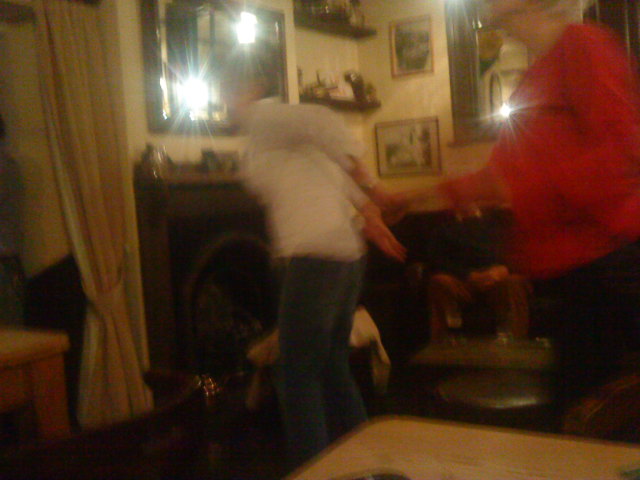
So I went. And this is what I saw, in all its are bure boke reality.


It’s an archetypal West Cornwall scene. Older women, often divorced, looking out for themselves. Many of them found their way there in search of a new life. New agey stuff, often. They completely outnumber the men of their age and income group. And they remember their younger selves, it seems, by dancing to a group from that period.

What was the Mindbenders’ performance like? As you might expect, there were now just two of them — a pair of old geezers. Bass and guitar, plus drum machine. 

 
I didn’t stay for much more than half an hour but they didn’t play a song I didn’t know — though none of them were Mindbenders songs. One of them, the bassist, I think, introduced each song with the name of its original performer/writer and a little story about it. There, I thought, is someone who long ago grasped the import of a PRS statement. I quite liked their attempt at Robert Parker’s Barefootin’ — though nothing, of course, could ever match the fizz of the original.

Having written all that, I googled and wikied. I now know these things:

* Mr Fontana was born Glyn Geoffrey Ellis.

* Even though he and his band were on the Fontana label, he actually got his surname from Elvis Presley’s drummer, DJ Fontana. 
* Fontana is a town in California. Beyond that, I can’t find out what it means or why Philips picked it for one of their record labels.

* Mr Fontana now seems to have mental health issues — court appearances in weird costumes, setting fire to his own car.

* The two hits he had that I do remember from the list are Um etc, a cover of a Major Lance tune, and Game of Love.

* The Mindbenders’ name had nothing to do with drugs. It came from a Dirk Bogarde movie The Mind  

Benders.

* I was right about A Groovy Kind of Love. Written by Toni Wine and Carole Bayer Sager (Burt Bacharach’s ex-wife among other things), it’s apparently based on a piece of classical music — the Rondo of Clementi’s Sonatina in G. Not that I’ve actually heard it.

* It was originally done by Diane and Annita. I actually have that version on a wonderful Ace compilation, You Heard It Here First! The originals of I Feel Good, My Boy Lollipop and Wild Things are also gorgeous surprises.

* Later Mindbenders included Eric Stewart and Graham Gouldman, future members of 10CC. I don’t think they were the ones in the Dock Inn, Penzance version. Graham Gouldman did, however, write this song, for the Yardbirds.

Also . . .


Another Cornish scene.

A little something about the significance of pop.

Sunday, 22 April 2012

Oh, nothing significant at all. Just a silly picture

Here it is . . .


That's it.

Next Cornish stuff — no pasties, though