K is for Kalamazoo
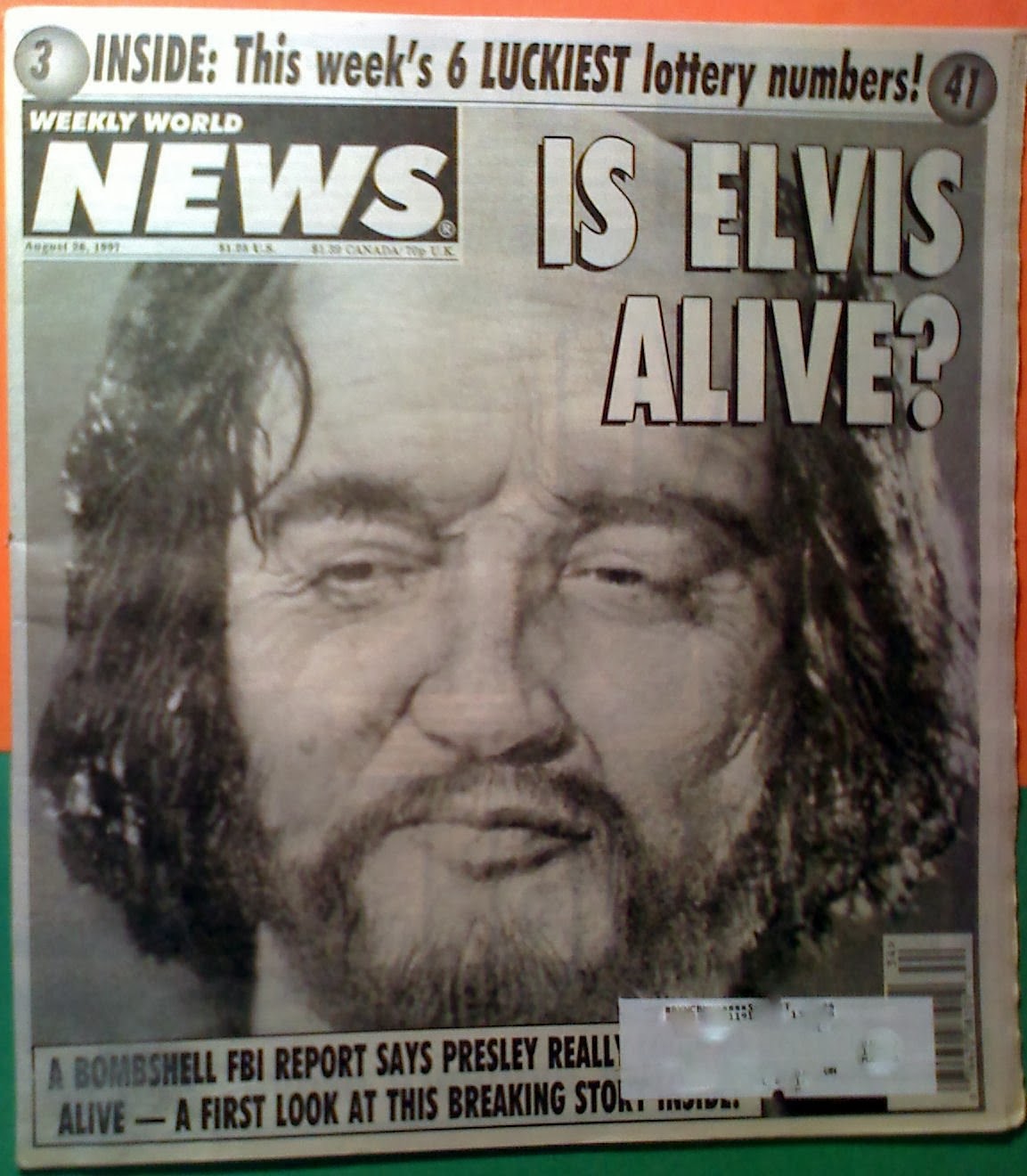
The first place Elvis was spotted after he died was Kalamazoo, a small city in south West Michigan. According to the Weekly World News, that is. The American tabloid reported the sighting by 50-year-old ‘mother of five’ Louise Welling, non-Elvis fan and wife of a car assembly worker. She saw him twice, first in a grocery store, then, with her daughter and grandson, outside a Burger King restaurant. Having eaten, Elvis ‘put on a pair of dark glasses, got into a small, light blue car and took off real fast.’ Mrs Welling then added: ‘Other people have seen him, but they are afraid to say anything.’
Tomorrow The Leg Wiggle Controversy
J is for June Juanico
June Juanico was a woman Elvis Presley nearly married — they dated for most of 1956. Four decades later, she published a sweet memoir Elvis: In The Twilight Of Memory. The night before I interviewed her about it, I got talking to a man named Bayard in a bar in Oxford, Mississippi. A student at the university, born to wealth in Memphis, Bayard told me his aunt had dated Elvis. Doubtful, I asked him for how long. ‘One night,’ he said. Why only one night? ‘She didn’t enjoy the experience.’ Why? ‘White trash,’ said Bayard.
I repeated this exchange to June over coffee at the Casino restaurant in Biloxi on Mississippi’s Gulf Coast, where she was working as a meeter and greeter. She was a good-looking woman, then 59, with a raucous smoker’s laugh and a Mickey Mouse watch. She peered at me over half-moon glasses. ‘He was not white trash,’ she said, firmly.
I asked her what people did when people they found out she dated Elvis. Mostly, she told me, they asked two questions: Can I touch you? and Did you sleep with Elvis?
‘I tell ‘em: yes to the first, no to the second,’ said June.
Those who read her book will discover that her answer to the second question is both disingenuous and dependent on a definition of ‘sleep with’ as synonymous only with ‘have full penetrative sex with’. For more details, see the section in Essential Elvis on his last great Leiber and Stoller song Don’t.
Tomorrow Ascension Day in Kalamazoo
I is for the first person singular
‘I’ suggests two questions about Elvis.
One like all Mama’s boys and all pop stars, Elvis was strikingly self-centred, but exactly how self-centred was he?
Two is there an objective psychometric tool that could be used to measure this?
I reckon there is: a simple mathematical calculation which I will call the Solipsism Index™. First take the total number of songs recorded, divide it by the sum of titles including a first person singular pronoun then express the result as a percentage.
So, according to The Elvis Encyclopaedia, the King recorded 657 different songs. Of these, 61 start with the first person singular and 30 more include it elsewhere in the title. A further 80 feature the first person accusative, genitive or dative. This gives a total of 171. (Five songs, by the way, include more than one first-person word. One features ‘me’ twice.)
Performing the psychometric analysis on this data gives a figure of 26 per cent. Thus, Elvis’ Solipsism Index™ is 0.26. In other words, Elvis was just over one quarter self-centred. By comparison, Frank Sinatra’s Solipsism Index™ is 0.28.
Tomorrow One degree of Elvis. I kiss a woman who had (almost) sex with the king
H is for Harrelson
Woody Harrelson, actor and Elvis fan. His life story sounds like it just climbed out of a Jerry Lee Lewis song. It’s possible that there is very little character acting in his portrayals of a (very) simple country boy in the TV sitcom Cheers or a sleaze-pit of a pornographer in The People Vs Larry Flynt. He was the son of a bible-bashing Presbyterian mother and father who was a Texan good ol’ boy turned contract killer and received two life sentences in 1979.
Woody’s first acting role was the Elvis impression he used to impress his classmates at school. Like Jerry Lee himself, Harrelson went for a dual career path — studying theology and chasing women. At one time, he reckoned he was racking up three women a day. ‘I was like a kid in a candy store.’ Like Elvis, he later found solace in the spiritual, doing yoga eight hours a day.
Another actor, Eddie Murphy, is an even bigger Elvis fan. But, for an obvious reason, it’s unlikely he’ll be playing Elvis in any biopic. Mr Murphy is from New York, you see.
Tomorrow Elvis and I
G is for Gates
Bill Gates, founder of Microsoft, posted an e-mail communication at www.elvissightings.com on Monday, 24 February, 1997 at 13:00:40 (EST) — as Bgates@microsoft.com. This is how it read: ‘Elvis was never alive, he was a computer-generated figure, and his voice was the work of Creative labs. In 1977 Microsoft decided to put all of our focus on Windows, and the Elvis project was dropped. Sorry.’
Tomorrow Elvis and the bloke who was once in Cheers
F is for Fred
Fred was my guide on the tour of the Sun Studios in Memphis. I took it on a bleak November morning and fortified myself for the trip with breakfast in the attached cafe, third booth from the window — which is where Sam Phillips used to conduct his business in the early days of Sun when it was known as Miss Taylor’s Restaurant.
I ate — of course — a fried peanut butter and banana sandwich. Truly, ‘a breakfast fit for a king’. (Anyone interested in repeating the experience in the privacy of their own home should consult one of the Elvis recipe books: Are You Hungry Tonight? by Brenda Arlene Butler, say, or Fit For A King by Elizabeth McKeon. Or go to Higella's version here.)
I laughed as I ordered it from the waiter. He gave me a dishwater look. ‘Do people always laugh when they order that breakfast?’ I said. ‘Yes,’ he said, resignedly.
Because of the earliness of the hour and the chill of the day, I was the only one making the tour. I had Fred all to myself. But he did the whole thing as if there were a big crowd. He is, after all, an actor of sorts. The story he told is really a script he’d learned. But he’d learned it well and spoke it with surprising freshness.
It was a very good story, anyway, a well-constructed history — from Sam Phillips starting the label right through to U2 using the tiny studio to record When Love Comes To Town with BB King.
Fred outlined the social background, told me about the musicians, played snatches of songs, showed me the instruments and the equipment used. It’s literate, accurate — and honest. At one point, Fred stood in the corner by the door to the control room and grabbed hold of a big old microphone, a great hunk of time-dulled stainless steel. You think: I know that microphone, I’ve seen it in pictures, it’s the one Elvis used when he recorded at Sun. And Fred said: ‘This is a microphone just like the one Elvis used when he recorded at Sun. Not the real one. But one just like it.’
Thanks, Fred.
Tomorrow Bill Gates and the untold secret truth about Elvis
E is for Enquirer
Elvis was one of the tabloid National Enquirer magazine’s main men. Before his death, it ran a five-part version of the Elvis — What Happened? revelations. It also paid Elvis’ cousin Bobby Mann $75,000 to take a secret photograph of Elvis in his coffin — though some say Elvis looks too young in it for it to be anything but a fake. It was published on the cover dated 6 September, 1977. The sales of that issue were a record-breaking 6.5 million.
A year later, on 20 September, 1977, the Enquirer also published the final photograph of Elvis alive — taken on the eve of his death by a fan as he drove into Graceland at 12.28am.
Some of the many Elvis appearances in the National Enquirer . . .
Tomorrow I breakfast like a king, in the king's chair - well, close enough anyway.


 Posts
Posts