Showing posts with label Photography. Show all posts

Wednesday, 29 January 2014

The best of Elvis books, number three

Graceland: The Living Legacy Of Elvis Presley, by Chet Flippo

The Homes & Gardens version of the King’s life. Lavishly lifeless photographs of Graceland’s decor and the contents of the Elvis collections on the other side of Elvis Presley Boulevard. An excellent reminder of the truly fabulous vulgarity of Graceland, with scalpel-sharp text by Flippo. Just one little detail is missing. A picture of the toilet where he died. 


There are cod and funny pictures of Elvis' toilet all over but you won't find a real one. In fact, there has never been a posthumous picture published of not just Elvis' toilet but of the whole upstairs, private section of Graceland. It remains sacrosant and unseen, not just by the 600,000 annual visitors but by non-civilians ones, too. Their requests for tours of Elvis' home quarters are always rebuffed. Even President Clinton was turned down.

There are, though, pictures that were taken before his death — and, apparently, it has been left just as it was. Perfectly. Here is an old shot of the bathrooom. Still no toilet, though.


And here is a different kind of private Elvis picture instead . . .


It was taken by Jane Rule Burdine, an artist from the Mississippi hill country where Elvis was born.


Now . . . buy the essential Elvis book, mine. 'An absolute must for any fan of the King.'
 
Next Elvis talks (posthumously)

Friday, 13 July 2012

Xmas comes earlier and earlier . . .

I know it doesn't feel or look like it out of the window but it is still six months to Christmas but . . .

Spotted in Mayfair in early July. I eventually figured out it was the Marks & Spencer's buyer (or something) preview but still . . . they didn't have to have a snowman on public display. They could have been a bit more discreet.


Did you see that snowman move between the two pictures? I think you did.

To cheer you up and away from the bad side of Xmas in July, here is the good side . . . mambo, animation, reindeer, Billy May, what's not to like?

Sunday, 22 April 2012

Oh, nothing significant at all. Just a silly picture

Here it is . . .


That's it.

Next Cornish stuff — no pasties, though

Friday, 20 January 2012

Flash, bang, wallop . . .

Bang goes Kodak. Two thoughts etc . . .

One Think Cunard and White Star Line. With the early 20th century success of their Atlantic passenger lines, they thought they were in the boat business. When actually of course they were in the people-moving business. So when long-distance flight became possible, they kept on with their ships and, eventually, disappeared as businesses.

Two I was actually looking to buy some printers yesterday. One, to trial. Maybe three or four more if that one did the job. So I did a little online research. Conscious that the real cost of printing - particularly if you need, as I do in this case, to print a lot of photos - is the ink, I was taken by Kodak's regular boast that its inks were cheaper than anyone else's. So I checked out all the reviews I could find. 

The Kodak printer of choice seemed to be the one called Hero. (Yes, I know I should have set my own alarm bells then but I didn't.) I scanned the reviews and they seemed to be pretty damn positive. So I decided I might well buy one. I went to Amazon to start the process. Then I saw one bad review and it said: actually, you know what the worst thing about this printer is, that it is really not very good at printing photos. So I went back over the other reviews and I saw lines like: well, yes, it is really good but the photo-printing is not what you hope for, particularly from Kodak etc etc

So I cancelled the order and will switch to Canon. Let's see how that goes.

Which is an object lesson in company decline and failure. As Xerox developed the personal computer (mouse, icon interface etc etc), then let Apple steal it, so Kodak developed the digital camera then hid it, in case it cannibabilised its own business. Instead, it got eaten by the Japanese. 

So, I guess, the moral is this. It's better to eat your own leg and survive than let someone else eat it for you. I'm sure it says that somewhere in the Bible or Koran.

Actually, one more thought. People are always saying Britain should do more manufacture. I'm not sure about that. Manufacturing was a blip in the national history. Mostly, we've been traders. An obvious choice given our geographical position. And traders are, by nature, wide boys (and girls). They go where the action is, shamelessly. Trading is never out of fashion. It's subject to technological change, true. But, at its best, most purest, it is quite uninterested in either the object being traded or the method of trade. Cash is the king in this realm. Always. So . . . while I'm not exactly standing up for bankers and incomprehensibly complex derivatives trading, I do think there is a question here somewhere. And another one: if there is not something in what I'm saying, why does our pantheon of national heroes include Francis Drake, Arthur Daley and Del Boy Trotter?

PS I will put up the sleeve notes for the Xmas compilation. I decided to make them longer than I first intended. I'll be posting them one a day, starting early next week.

Friday, 6 January 2012

Eve Arnold (1912-2012) RIP

The great Magnum photographer has died just short of her 100th birthday. Here is an article I wrote about her a couple of years ago.

PP_May10_EveArnold
PS If you want to read more of my writings, on photography in particular, there are more in scribd. Try here. I'll be uploading more in the near future, including old pieces on a variety of subjects — though not music. For my music pieces, you need to go to rocksbackpages.com.

Tomorrow Those promised Xmas music sleevenotes

Wednesday, 4 January 2012

On the eleventh day of Christmas . . .

A walk along the Thames at Mednenham. There's a long, flat stretch between an old, now disused ferry point and the locks below Henley. It curves slowly. 

I've walked it in sun and gloom and cold – though not in the rain, it's true. I've shared the early morning with caravanners and watched a stunt flier practise in a sharp blue sky, rolling and tumbling. I've done the whole walk without seeing anyone else. And I've walked back through the fields when you can't see past the crops and when the earth has been cleared for the winter.

It's a completely humanized landscape. There is no trace of what might have been there before our ancient ancestors moved in. But still, in the way the whole of the Thames Valley does, it has a deep, sharp sense of, well, nature. Not the real thing, of course, but certainly the 'real' thing – and that, being a human, is what I'm after. Reality is for animals. 'Reality' is what us princes want and cherish.

PS It's also possible that my thoughts and feelings are coloured and shaped by the fact that my father spent the war based at Danesfield House – which still forms an impenetrable riverside barrier at one end of the walk. It was the base for aerial reconnaissance intelligence. He looked at photographs, in pairs, and turned them into maps. I should think my parents walked this walk, a decade and more before I was born. When the fliers would have been practising for a different kind of show.

Till tomorrow . . .

Tuesday, 3 January 2012

On the tenth day of Christmas . . .

Valerio Spada's Gomorrah Girl. A photobook. A chronicle of a death in a southern Italian ghetto. Two visual narratives physically interleaved in one book. In a time where the book as object is clearly changing dramatically, Gomorrah Girl is something that could not exist in any other form. A Kindle, it could not be.

It was put together by Dutch designer Sybren Kuiper. And that is a not insignificant factor in its triumph.

It won a prize. But, not to show off or anything, I'd bought it some time before that. I was writing a piece about photobooks. This piece (which you can download if you want, as a pdf) . . .

PP Jul11 Bookshelf

Writing the piece, I became increasingly enamoured of a new wave of almost handmade and almost self-published photobooks. All are, of necessity, limited editions. This was one of the ones I bought. It was in an edition of 500 and came out early last year.
And that's another reason to think about it. I paid 30 Euros for my copy. That edition sold out. Then, recently, a second edition was published, at 39.50 Euro. That, too, has sold out. A copy of that second edition is available on Amazon.com for 150 dollars. 

If I can't have Gomorrah Girl, then I'll have Happy Birthday To You, made in psychiatric units by Anouk Kruithof. That cost me 20 Euros, I think. That did well, too. There don't seem to be any copies around. Last time I looked one would cost you more than 150 dollars.

Now, I'm not suggesting you (or I) buy these books for investment. They are objects that are worth their own existence and a place in your/my place. Nor will all such books rise in value. And you are also providing an income source for artisans/artists whose photography work was ceasing to do so. Be a patron. Buy now. Buy several. Enjoy them. Maybe make a few shekels.

And if it can't be a self-published book, then I'd have Simon Norfolk's most recent work on Afghanistan, in which he paired (well, kind of) his own photographs with a 19th century record of the benighted land, made by John Burke. There was a (great) show at the Tate. The lavish pale light of the images set up challenging duologues with the original black and whites — orthochromatic, so the colour representation was quite different from our modern panchromatic world. Afghanis, for one, appear far darker than they are - technical considerations inducing ideological outcomes.

The book is even better. The portraits make sense, to me, in a way they didn't in the gallery. There are more pictures, too

Till tomorrow

Tuesday, 27 December 2011

On the third day of Christmas . . .

Bruce Davidson's Subway, a reissue of a 1986 original (by Steidl, reliably gorgeous photo and art books). A memory of a New York so different it's hard to realise it's only a couple of decades ago. Look at the graffitied subway cars and think: how come? well, how come and why did no-one remove it? it wasn't because they thought them beautiful . . . it was a kind of social stuckness, an inability to wrest control of the environment.

The more you look at the pictures, the more you realise how smart they are. Davidson is describing a world that he knows is terrifying. He got mugged doing it.

Like everyone else I know who knew the city in that time, it's hard not to feel, well, not nostalgia but a sense of change so sharp as to have its own pain. It was frightening, dirty, threatening, dysfunctional - particularly on the subway at 3.30 in the morning. Yet . . .

PS1 Below, you will find my interview with Davidson from earlier this year. You can download it as well as read it onscreen.

PS2 I also think it's highly likely that it will sell out, sooner rather than later, and therefore hold its value, maybe even increase. But more of investing in photobooks for fun and profit on another of the twelve days . . .
See you tomorrow . . . 


PP_May11_BruceDavidson


Monday, 8 August 2011

Art appreciation

One evening, two openings.

One, in Camden Town, near Mornington Crescent. Part of the London Street Photography Festival. Photos taken of people on buses — who didn’t know they were being photographed.

I think: Walker Evans taking secret pictures on the New York subway. I think: this would be illegal in France because of their privacy laws. I think: I shall take a photograph of the photographer with his photographs. He’s the blur, obviously. Time passes.

Two, in Kentish Town Road, at the Zabludowicz Collection.

I see a golden urinal and think: it’s nearly a century since R Mutt took the piss.

Eating and drinking reviews

Street Photography two bars, Ketel vodka (sponsor), either truly horrible special cocktails or neat on ice; nothing to eat.

Zabludowicz one bar, waiters and waitresses in black and white, wine, beer, espresso machine coffee; tea-cup sized portions of Polish-ish food (esp potatoes).

Friday, 7 January 2011

Une comte d'un con et de M Lacan, le troisième

It's often said that the model for Courbet’s painting was Joanna Hiffernan. The lover of James Whistler (and others), Jo was an Irishwoman with long, flaming red hair - which, yes, does conflict with the colour and texture of the hair we see in the painting. She is, though, certainly the woman in both Courbet's La belle Irlandaise (Portrait of Jo) - which is in the Met in New York - and in Whistler's Symphony in White, No 1: The White Girl - in the National Gallery, Washington.

But in truth, given the evidence before your eyes, Jo is an unlikely candidate. An improbable one, in fact. Rather, the painting's extreme, 19th century realism - hyper-realism before its time, even - is not just an extension of Courbet's general pursuit of the real and everyday. It's clearly photographic in composition, tone, colour balance, size even - it's far, far smaller than Courbet's usual giant canvases.

More than that, there's a photograph that is a more-than-fair candidate for its, well, origin. It's by one of the first photographers of pornography - or, at least, of naked female bodies, with the aim of awakening male (and perhaps female) imaginations. Though he traded under the name Billon, he was in fact the Auguste Belloc, the great, innovatory photographer of mid-19th century Paris. He photographed the great and good of the Second Empire. He invented the wet collodion process - which Sally Mann has recently re-put to good purpose photographing her children naked.

(The reason we know Billon and Belloc were the same man, by the was, is because the forward-looking but statist French state had decided that photographs should have the same copyright status as paintings etc. So photographers established their rights by sending copy prints to a national agency - which held them in store, whether they were of great men's bearded faces or young women's unshaven vulvas. Oh, and there is no link at all between Auguste Belloc and his near namesake and fellow photographer of unclothed women, EJ Bellocq who captured the pre-First World War New Orleans brothel world that gave us jazz, probably, and Jelly Roll Morton, certainly.)

The particular image that Courbet most likely used as a basis was one of a series of hand-coloured stereoscopes. There is the same pale-skinned, generously haired young woman, the same headlessness and rumpled white linen and a very similar pose. It's true, though, that Courbet removed the stockings and added breasts — well, an edge of one.

It was the mid-1860s, photography had only been around a few years and already there was both colour and 3D. (I'd have put an exclamation mark at the end of that sentence if I didn't have a lifelong aversion to their, inevitably cheap, excitement.) The first photograph of a (clothed) human was taken in 1838. In 1860, a police raid on Belloc's stock netted 4,000 erotic images. As so often, the desire to satisfy human desire is a motor for invention. Now, if only we could find a way to monetise it sexually, the solution to global warming would be round the corner.

Next up A Turkish gentleman makes a proposition to a French painter.

Thursday, 9 December 2010

Un conte d'un con et aussi de M Lacan, part one

First to the National Portrait Gallery*. A couple of months ago, I was writing a piece on 'sexy vs sexist' for Professional Photographer. (I write a monthly column for the magazine, on a legendary photographer. Here's one on Robert Frank. I'll put a fuller list in a future posting. I also write longer pieces.

As part of that sexy vs sexist piece, I sent out an email to all of you on my blogmail list. (If you want to be added, post a comment or email me.) It contained links to various photographs and asked you to rate them as sexy or sexist. As I hoped and expected, the responses were thoughtful and widely varied. One man's urge to goose is rarely another woman's desire for a gander. And, most strikingly, vice versa.

Among the images - and, in a way, the thing that made me think of doing the email - was a photograph that had been shortlisted for the National Portrait Gallery's Taylor Wessing portraiture prize. Titled My British Wife, it is . . . well, I'll quote from the piece I wrote . . .

'a portrait by Greek photographer Panayiotis Lamprou, of his real wife. Unnamed, she is sitting in the sun, at an outdoor table. Behind her is a half-open Mediterranean blue door. Beside her is a cooking pan, with a little food still clinging to its edges - an omelette, we are told. She has finely shaped eyebrows, an aquiline nose, grey-blue eyes and a wide, pale pink-lipped mouth. Her hair is tousled and falls messily over the top of her halter-topped sundress. You can see a light touch of hair in her left armpit. She sits, looking directly at the camera/viewer, her legs apart, on a chair cushion almost the same colour as the door. She has no knickers on.

She also has no pubic hair - shaved, I guess - and a notably expressive vulva. Context and intent aside, it is the stuff - the raw material, anyway - of pornography. Or, at least, what is usually meant when people use the word, pornography. Certainly, the NPG was worried enough about it to crop the picture in half for its website, turning it into a plain and almost unexplicable image of the top half of an attractive young woman.'

So, when invited to the press show, I made sure I went. The picture didn't win. It was a runner-up**. The photographer was there - though not his British wife. I talked to him briefly but his English (not fluent) and my Greek (non-existent) weren't really up to a meaningful conversation, particularly in a room where everyone was acting as if there wasn't something notably notable about the convergence of the image of his wife, him and a shuttle of artsy journalists.

I did think of asking him: how's the wife? But I wasn't sure the humour would translate. He did, though, hand me a leaflet, the press release for his picture, written by the art critic of the Greek broadsheet Kathimerini. It's a not unthoughtful piece, if marked by the rhetoric of art-speak and Mediterranean journalism - 'condensation of beatitude and lightweight materialism'. It describes the picture as 'a rather delicate, unpretentious requiem for femininity, a reminder of the self-esteem of the naked body before the fall and sin . . .' Myself, I think that's a naïve, unhistorical approach - once the fall has happened, it can't be unfalled, so to speak, its tragic irrevocability is the trade-off we made for self-knowledge. But still . . .

Its writer continues: 'but also a reminder of the admiration of a man towards a woman, a prompt to the classical work of art of . . .' I should have seen this coming but didn't . . . 'Gustav Courbet, The Origin of the World.' And then, of course, he references this painting's last private owner, the French psychoanalyst Jacques Lacan. He poses a question: can we accuse 'Lacan for voyeurism, the man who changed the course of psychoanalysis and modern thinking'? He clearly thinks not. I'm not so sure.

I've been thinking about Lacan's ownership of that painting for some time now but had somehow never quite got round to posting the blog about it that I intended to write. Ever since I'd learned that he'd owned the picture, I'd been intrigued by that fact. I already knew the painting but . . . well, there was something odd about his ownership. It was, apart from anything else, such a, well, French thing to do.

I wondered how that had come about and looked it up. It's a story. I'll tell it in the next blog or two.

* Site of one of the world's great escalator journeys. (For some years, I have been making a small collection of them.) It begins in the modern day and takes you back to the 16th century.

** Nothing was said but there had been a similar picture in the show a few years ago. The differences are notable, though.

Meanwhile, a little French? (I knew the song already but found this video because it’s in the new Martin Scorsese film, a documentary about Fran Lebowitz.)

Next up Some music writing of mine, occasioned by the arrival of Theme Time Radio Hour Three

Soon Part deux of this conte (in which a Turk tempts a desperate man)

Wednesday, 9 December 2009

Free gifts

It being the time of year that it is, I thought I should make out like other bloggers do and give you stuff — links etc, that is. I briefly — very briefly — considered a whole advent calendar of goodies but settled — realistically — on just putting a few in here.


I've already gifted some people Bessie Banks' studio tapes and Jerry Lee Lewis as Iago. (If both of those two things don't quicken your pulse just reading about them, you wouldn't have been interested in them anyway.)

Here, though, I offer, for this ninth day of Advent, a few little things. (Also, I get to display my eventual and tardy mastering of embedding YouTube postings.)


First Many of you might already have seen the Taiwanese TV news recreation of the Tiger Woods event. But it's surely worth another look. If you haven't seen it, think Grand Theft Auto. Wouldn't it be great if all TV news was like this? Who wouldn't want to watch a recreation of the Brown-Blair Granita dinner? Or what went on that night at OJ Simpson's?


Second In another part of my life, I write about legendary photographers for Professional Photographer magazine. This month, the editor got me to put my index figure where my words are and arranged a spot for me in the photographers' pit catwalk show in London Fashion Week. See how I dealt with it. (It's where the image above was taken.)

Third The Word magazine published a piece of mine about my book, Filthy English, and invited me in to talk dirty with them on their monthly podcast. Which four of us did, for an hour. It's got a parental advisory on it. The comments on it (which are many) contain excerpts from the Troggs tapes ('why don't you just fucking do what you fucking started doing?') and performances of some of the songs I write about in my book.

Fourth My word for the day: callipygian. You'll find it on the second page of this New York Times review of the Knee High production of Brief Encounter — which, being much impressed by other Knee High shows, I meant to see in London but, being somewhat busy with my course and book etc, never did get round to doing.

Next up Freud: if it's not one thing, it's his mother

Friday, 31 July 2009

Self and others

I’ve made a few small changes to the way this blog looks and is arranged.

One I’ve added a new photo of myself. I’ve already asked some of you this question but no-one has got it right yet: who took the photo? There’s a prize for a correct answer — and it’s not a signed copy of the picture. Clue one: he’s not unknown (actually, that’s two clues, isn’t it). Clue two: there’s another clue lower down in this post.

Two I’ve added a link to rocksbackpages (rocking writing under free-ish associations below). It’s an archive of all kinds of pop music writing. There’s loads of my stuff there. I think you might have to pay for some of it but it is also available free via some local libraries. There is a link on the rocksbackpages home page to something called Freekly. The idea here is that you sign up — for free — and the site interrogates your iTunes, then sends you links to pop music stories, old and new, that you might be interested in. If you then buy stuff on click-through, I get money. That is the idea anyway. I find it quite fun: it’s even recommended my own writing to me. So it clearly has taste.

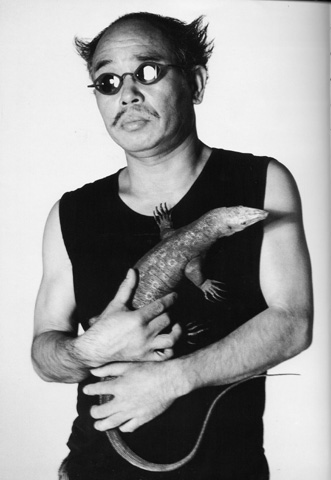
Three I’ve added a link to Professional Photography magazine (legendary photography, under free-ish associations below). I’ve been writing a series for them, on . . . legendary photographers. I’ve done a dozen or so far, including Guy Bourdin, William Eggleston, Herb Ritts and Deborah Turbeville. As soon as I’ve done posting this, I’m off to finish one on Araki.

Next up Shhhh