

 Posts


Origin of the World, an extended footnote, part four
Terrified by the death and destruction in besieged Paris, Wallace moved back to England and took his collection with him. (The family had also previously returned to London, briefly, during the 1848 uprising.) Things were never much good again for him. His marriage soured. He became depressed and listless to the point where, although he kind of intended to bequeath his collection to the nation, he could never quite stir himself to do it. It was eventually done by his wife, a Frenchwoman, who never quite got round to learning English.
His son - who was a French army officer during the siege - broke with him and returned to Paris and his four illegitimate children, by a woman 'of the theatre'. Wallace is reported to have said: 'Mon Dieu, est-ce que nou n'aurons jamai fini de bâtards?'. Good God, will there ever be an end to bastards?
Father and son died without reconciling. Wallace did, though, himself acquire a young man as a secretary, then adopt him. It was Sir John Murray Scott, Vita Sackville-West's father.
So who was Richard Wallace then? Well, the surname was his own choice. He switched to it, legally, from his given surname Jackson, in 1842, having himself rebaptised in an Anglican church in Paris. (By which time, he already had a seven-month-old son by his mistress, Julie Castelnau - who he later married and stayed with, after a fashion, till his death.)
His father? Well, one idea is that it was not the fourth Lord Hertford but the third - Mie-Mie's husband-back-in-London. One account describes that Lord Hertford as a man who 'begat more than one illegitimate child and who acquired across the years a very unsavoury reputation.'
Another theory - and this is the one in the Dictionary of National Biography - is that he was, in fact, Mie-Mie's son. Which would have made him the half-brother of the man who was - to most accounts, anyway - his father.
Whatever, it's hard to imagine that Wallace didn't have a look at Khalil Bey's Courbet. It could have ended up in Manchester Square.
Next up I’m taking a break from Courbet etc to ask: What’s so funny about (What's So Funny About) Peace, Love and Understanding?
Showing posts with label L'Origine du Monde. Show all posts
Showing posts with label L'Origine du Monde. Show all posts
Thursday, 10 March 2011


Friday, 4 March 2011
Origin of the World, an extended footnote, part three (with not just one but four footnotes of its own)
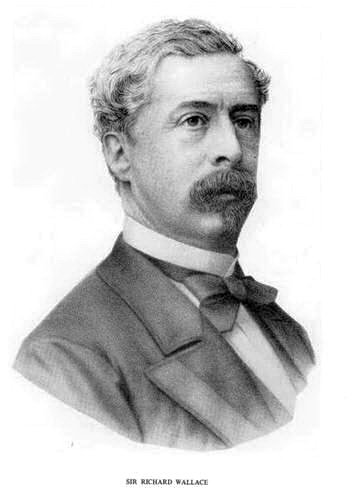
Back to Sir Richard Wallace . . .
I'll get to his paternity in time but there is also doubt about his mother. The likeliest candidate was a woman born Agnes Wallace, a descendant of Scots independence leader Sir William Wallace. Born in 1789 - to a friend of Lord Hertford's - Agnes married a Mr Bickley, bore him a couple of children, then ran off to Brighton, where she hung out with soldiers. In particular, with the 10th (Prince of Wales's Own) Regiment of (Light) Dragoons (Hussars). Which is where she would have met the future fourth Lord Hertford - he was an eighteen-year-old officer in the regiment (and ten years her senior). By now she was Agnes Jackson - though there is no record of a Mr Jackson. Or of any dalliancing between Agnes and that Lord Hertford.
There was a child, though, and the guess is that when Agnes returned to her husband - by whom she would go on to have two more children - he didn't want her illegitimate son. So Agnes took him to Paris and left him with her hussar friend's mother.
The boy and Mie-Mie became close. He called her aunt. She called him her beloved nephew. He grew up something of a playboy, running up tabs and bills he couldn't pay. Though declining to buy Richard a commission in the navy, the third Lord Hertford did pay off his regular debts - £100,000 over two years*. He also took him on as his secretary - on £1,000 a year. He was responsible for the art collection and making additions to it. In 1865 alone, he bought 34 pictures, spending a million francs**. All that armour in the Wallace Collection was mostly his choice.
He also bought some art for himself. And got into debt again - speculating on the Paris bourse. Lord Hertford wouldn't pay his debts this time, told the lad he'd have to auction his collection. Which he did and . . . Lord Hertford bought his best five paintings. Which, of course, Wallace ended up inheriting back. Not that he knew he would. When Lord Hertford died in 1870, just as the Prussian guns were threatening Paris, the fact that Richard Wallace was the heir came as much a surprise to him as it did to the cousin who inherited the title and a couple of estates but not the cash to support them.
He was, surprisingly, something of a hero during the 1870-71 siege of the city, putting his inheritance to immediate charitable use. He spent perhaps £500,000 on medical relief and arranged for the care and repatriation of the 4,000 British exiles caught in the city. For a while, he was 'the most talked about man in England'.
For which kindnesses, he had a boulevard named after him. It's near La Défense, on the north west of the city itself, just beyond the Péripherique. A pleasant, tree-lined street with an iron-railinged park, it's considered 'the Champs-Élysées of Puteaux'. George Simenon lived there 1936-8 and — a fan website informs — there are several scenes set there in Maigret novels. Wallace was buried, in the family tomb, in Père Lachaise.
His mark is still there all over Paris proper, too. Those black cast-iron drinking fountains, with their maidens-in-drapery caryatids, they were commissioned and paid for by him. Known as Wallace Fountains, there are still 66 of them around the place. There's also one outside the Wallace Collection in London. Oh, and Brigitte Bardot has one, too.
* In current terms? Well, if you take just inflation as a measure, it comes out at about £7million. But if you take it as a percentage of GDP, it comes out at nearly £150 million***.
** As far as I can figure out, there were at that time roughly 25 francs to the pound. So, using the same formula as above, that would today equate to either £2.8 million or £60 million. Given current art prices, that seems really cheap - it wouldn't even get you four major Freuds or Bacons.****
*** How could he afford it? The family had large estates, producing big rents - £60,000 a year in 1841.
**** Apropos of irrelevance, as an editor, I once arranged for an art review to be tweaked so we could use the headline 'Bacon and two Freud eggs'.
Next up 'Mon Dieu, est-ce que nou n'aurons jamai fini de bâtards?'
Back to Sir Richard Wallace . . .
I'll get to his paternity in time but there is also doubt about his mother. The likeliest candidate was a woman born Agnes Wallace, a descendant of Scots independence leader Sir William Wallace. Born in 1789 - to a friend of Lord Hertford's - Agnes married a Mr Bickley, bore him a couple of children, then ran off to Brighton, where she hung out with soldiers. In particular, with the 10th (Prince of Wales's Own) Regiment of (Light) Dragoons (Hussars). Which is where she would have met the future fourth Lord Hertford - he was an eighteen-year-old officer in the regiment (and ten years her senior). By now she was Agnes Jackson - though there is no record of a Mr Jackson. Or of any dalliancing between Agnes and that Lord Hertford.
There was a child, though, and the guess is that when Agnes returned to her husband - by whom she would go on to have two more children - he didn't want her illegitimate son. So Agnes took him to Paris and left him with her hussar friend's mother.
The boy and Mie-Mie became close. He called her aunt. She called him her beloved nephew. He grew up something of a playboy, running up tabs and bills he couldn't pay. Though declining to buy Richard a commission in the navy, the third Lord Hertford did pay off his regular debts - £100,000 over two years*. He also took him on as his secretary - on £1,000 a year. He was responsible for the art collection and making additions to it. In 1865 alone, he bought 34 pictures, spending a million francs**. All that armour in the Wallace Collection was mostly his choice.
He also bought some art for himself. And got into debt again - speculating on the Paris bourse. Lord Hertford wouldn't pay his debts this time, told the lad he'd have to auction his collection. Which he did and . . . Lord Hertford bought his best five paintings. Which, of course, Wallace ended up inheriting back. Not that he knew he would. When Lord Hertford died in 1870, just as the Prussian guns were threatening Paris, the fact that Richard Wallace was the heir came as much a surprise to him as it did to the cousin who inherited the title and a couple of estates but not the cash to support them.
He was, surprisingly, something of a hero during the 1870-71 siege of the city, putting his inheritance to immediate charitable use. He spent perhaps £500,000 on medical relief and arranged for the care and repatriation of the 4,000 British exiles caught in the city. For a while, he was 'the most talked about man in England'.
For which kindnesses, he had a boulevard named after him. It's near La Défense, on the north west of the city itself, just beyond the Péripherique. A pleasant, tree-lined street with an iron-railinged park, it's considered 'the Champs-Élysées of Puteaux'. George Simenon lived there 1936-8 and — a fan website informs — there are several scenes set there in Maigret novels. Wallace was buried, in the family tomb, in Père Lachaise.
His mark is still there all over Paris proper, too. Those black cast-iron drinking fountains, with their maidens-in-drapery caryatids, they were commissioned and paid for by him. Known as Wallace Fountains, there are still 66 of them around the place. There's also one outside the Wallace Collection in London. Oh, and Brigitte Bardot has one, too.

* In current terms? Well, if you take just inflation as a measure, it comes out at about £7million. But if you take it as a percentage of GDP, it comes out at nearly £150 million***.
** As far as I can figure out, there were at that time roughly 25 francs to the pound. So, using the same formula as above, that would today equate to either £2.8 million or £60 million. Given current art prices, that seems really cheap - it wouldn't even get you four major Freuds or Bacons.****
*** How could he afford it? The family had large estates, producing big rents - £60,000 a year in 1841.
**** Apropos of irrelevance, as an editor, I once arranged for an art review to be tweaked so we could use the headline 'Bacon and two Freud eggs'.
Next up 'Mon Dieu, est-ce que nou n'aurons jamai fini de bâtards?'
Monday, 28 February 2011
Origin of the World, an extended footnote, part two (with a footnote of its own)
Again, it's more complicated than that. Whoever Sir Richard Wallace was, that's not what it said on his birth certificate. He was born Richard Jackson, in London, in 1818 - and, in later life, often said he didn't know who his father was. We do know, though, that he arrived in Paris in 1925 and was moved into the house of the Countess of Yarmouth, the wife of the third Lord Hertford - ie the putative father of Sir Richard. This Lord Hertford, by the way, as well as being a libertine, was the son of the mistress of the Prince of Wales - the future George IV, that is. (There's a picture of Lord Hertford's mother in the National Portrait Gallery collection. Her full name was Isabella Ingram-Shepheard. She has very big hair.)
Known as Mie-Mie, the Countess of Yarmouth/Marchioness of Hertford - the wife of the third Lord Hertford, that is - was herself the illegitimate daughter of a former dancer (or perhaps an Italian marchesa) and, it is said, the Duke of Queensbury. Known as 'Old Q', for the giant letter on the side of his coach, the Duke's entry in the Dictionary of National Biography describes him as a 'sybarite and politician'. A cartoon of him in the NPG captures him at his two favourite pastimes. Titled 'Quiz-zing a filly', its caption describes him as 'rake and patron of the turf'. Another NPG cartoon calls him 'the old goat of Piccadilly'. He was supposed to have a 'harem' in his Piccadilly house - see orientalism peek over the bannister.
Or perhaps Mie-Mie's father was the Satanic Hellfire Club member George Selwyn. Both Queensbury and Selwyn certainly thought they were her father and both left her big money in their wills. Or perhaps her father was Selwyn's butler - who didn't leave her big money.*
Mie-Mie was a contraction of her given names, Maria Emily. Estranged from her husband, Mie-Mie had lived in Paris since 1802 - eventually in the Rue Taitbout apartments that Khalil Bey would later take. French Wikipedia: 'In the nineteenth century, the Taitbout street is where the rich financial lodge their courtesans.' (A Google translation, not mine.) A one bedroom apartment there will currently set you back €1800 or so a month.
In his madness, George III said he'd like to take Mie-Mie as his mistress - she was, of course, the daughter-in-law of his son's mistress. While in Paris, she had another child. As Lord Hertford was back in London, it is unlikely he was the father. That was probably Casimir de Montrond, a French diplomat who is said to have first coined the aphorism 'Mistrust first impulses; they are nearly always good.'
It's beginning to make sense, isn't it, why all these titled English chose to hang out in the relative anonymity of Paris.
* While the Wallace Collection may once have been, well, discrete about its origins, it now trumpets them. In October 2010, it hosted a lecture entitled 'The Scholar and the Star: The Wit, The Rake and the Italian Dancer's Daughter'. Selwyn was the wit, Queensbury the rake and Mie-Mie the daughter.
Next up Wallace, man of art — and drinking water
Again, it's more complicated than that. Whoever Sir Richard Wallace was, that's not what it said on his birth certificate. He was born Richard Jackson, in London, in 1818 - and, in later life, often said he didn't know who his father was. We do know, though, that he arrived in Paris in 1925 and was moved into the house of the Countess of Yarmouth, the wife of the third Lord Hertford - ie the putative father of Sir Richard. This Lord Hertford, by the way, as well as being a libertine, was the son of the mistress of the Prince of Wales - the future George IV, that is. (There's a picture of Lord Hertford's mother in the National Portrait Gallery collection. Her full name was Isabella Ingram-Shepheard. She has very big hair.)
Known as Mie-Mie, the Countess of Yarmouth/Marchioness of Hertford - the wife of the third Lord Hertford, that is - was herself the illegitimate daughter of a former dancer (or perhaps an Italian marchesa) and, it is said, the Duke of Queensbury. Known as 'Old Q', for the giant letter on the side of his coach, the Duke's entry in the Dictionary of National Biography describes him as a 'sybarite and politician'. A cartoon of him in the NPG captures him at his two favourite pastimes. Titled 'Quiz-zing a filly', its caption describes him as 'rake and patron of the turf'. Another NPG cartoon calls him 'the old goat of Piccadilly'. He was supposed to have a 'harem' in his Piccadilly house - see orientalism peek over the bannister.
Or perhaps Mie-Mie's father was the Satanic Hellfire Club member George Selwyn. Both Queensbury and Selwyn certainly thought they were her father and both left her big money in their wills. Or perhaps her father was Selwyn's butler - who didn't leave her big money.*

Mie-Mie was a contraction of her given names, Maria Emily. Estranged from her husband, Mie-Mie had lived in Paris since 1802 - eventually in the Rue Taitbout apartments that Khalil Bey would later take. French Wikipedia: 'In the nineteenth century, the Taitbout street is where the rich financial lodge their courtesans.' (A Google translation, not mine.) A one bedroom apartment there will currently set you back €1800 or so a month.

In his madness, George III said he'd like to take Mie-Mie as his mistress - she was, of course, the daughter-in-law of his son's mistress. While in Paris, she had another child. As Lord Hertford was back in London, it is unlikely he was the father. That was probably Casimir de Montrond, a French diplomat who is said to have first coined the aphorism 'Mistrust first impulses; they are nearly always good.'
It's beginning to make sense, isn't it, why all these titled English chose to hang out in the relative anonymity of Paris.
* While the Wallace Collection may once have been, well, discrete about its origins, it now trumpets them. In October 2010, it hosted a lecture entitled 'The Scholar and the Star: The Wit, The Rake and the Italian Dancer's Daughter'. Selwyn was the wit, Queensbury the rake and Mie-Mie the daughter.
Next up Wallace, man of art — and drinking water
Tuesday, 15 February 2011
Origin of the World, an extended footnote, part one
As I was saying before I interrupted myself . . .
But first, be warned that this tale is only tangentially connected Courbet's Origin of the World. Hence the post's title/headline. If you're not interested in the comings and goings of the English aristocracy, you might want to skip away now. On the other hand, I'm not generally that interested in that kind of thing and I did find myself drawn in.
Think of it as an intermezzo - a kind of the link between Courbet's painting and the Wallace Collection in Manchester Square. It's just one of those intriguingly complicated family stories that are irresistible but don't really lead you anywhere. Not anywhere clear anyway, just somewhere interesting: to a family which has been described as having pursued 'art with great dedication, while leading the most confused and odd private lives.'
The art collection that we know as the Wallace Collection was started by Lord Hertford - the Lord Hertford who died in 1870, that is. His non-noble name was Richard Seymour-Conway. In an 1843 probate action, 'he was exposed as a libertine and a constant consort of prostitutes.' This then was the man who let rooms to Khalil Bey.
He, too, liked pictures - and also had distinct, not to say peculiar, tastes. His collection was put together according to an idiosyncratic - if all too human - paradigm. He would only buy pictures he found 'pleasing'. Or rather, of subjects he found 'pleasing'. He wouldn't, for example, buy any pictures of old men. So that was quite a few Rembrandts out.
But the Wallace Collection (ie the one in Manchester Square) was set up by Sir Richard Wallace. Generally said to be Lord Hertford's illegitimate son - but I'll be coming back to that general belief - this Wallace was also employed as his lordship's secretary. A secretary in the older sense, that is - as in secretary of state. He looked after Lord Hertford's business affairs, in particular what has been described as 'the finest private art collection in the world'.
Next up Family affairs, including those of ‘the old goat of Piccadilly’
Wednesday, 26 January 2011
The story of Courbet’s Origin of the World, part seven

I finally found a picture of the man who commissioned and paid for Courbet’s Origin. There’s no date on it but it looks like it was taken around the time of the picture. There’s no photographer’s name on it, either, so it probably wasn’t by Auguste Belloc, who took the picture that Courbet based his painting on.
It’s not the original image, I’m fairly sure. I also have a very grainy photocopy of a far grainier original — in which Bey’s hand is on the left. So it’s probably been flipped. The curtain has been moved, too — and retouched to green. Which is the colour of the curtain with which, it’s said, he concealed his painting. The colour of Islam, of course. Théophile Gautier described Bey’s collection as ‘the first ever to be formed by a child of Islam’.
So we have a Muslim — in contradiction to his religion’s eternal ban on representational art — collecting the most modern versions of representation. ‘A magnificent gallery of pictures despite the law of the Prophet which forbids the representation of figures,’ L’Artiste magazine commented in January 1868 — when Bey’s collection came to auction, with the introduction to the catalogue written by Gautier.
In particular, of course, Bey’s magnificent gallery contained one image which represented something which had never before been represented in a public form — well, semi-public. Then he hid that representation with an abstract representation of his own religion — which notably sought (seeks, come to that) to forbid it.
One could read that symbolic act as a deliberate irony: the curtain itself as an enactment of Islam’s censorship of the human (or godly) form. An irony which was, in turn, compounded by the picture’s title, itself a challenge not just to Islam but to all religions — all of which, in my experience, posit far less visceral origins of the world.
If that makes Bey sound like a conscious radical, he was — certainly in his politics. ‘While in Paris he had been planning the extreme liberal reforms which he felt had to be put in effect if the Ottoman Empire was to be preserved . . . a constitution and an egalitarian regime,’ according to the fullest account I’ve found of Bey and his art, a 1982 piece by Francis Haskell in the Oxford Art Journal.
In Paris, by the way, Bey lived near the new Opera. He would, though, have departed the city — to become the Ottoman ambassador in Vienna — before the ink was spilt on the La Danse sculpture (then expended on it by newspapers). He rented rooms from Lord Hertford whose own gallery of paintings became the Wallace Collection — housed in the former family town home in Manchester Square, London W1.
Actually, it’s more complicated that that . . .
Next up A break from Courbet and a one-shot return to alleys etc
Thursday, 13 January 2011
Courbet’s Origin of the World, sixth part
Not that we can be at all certain about where Bey kept Courbet’s L’Origine du Monde - or if it's true, as is generally said, that he kept it hidden behind a green velvet curtain. In fact, we only know anything about the painting's early existence because of a couple of passing references in contemporary accounts. Which does, of course, confirm one thing - that it was hidden, elided, shielded from public view.
If such prudishness seems surprising for the supposedly licentious 19th century Paris of our understandings, that's a reflection of our lack of understanding. It's true that this was the first heyday of the can-can - then a working-class dance of sexual directness, legs lifted high in a pre-knickers world.
Yet Napoleon III's Second Empire was not a liberal place. (That and some of the other facts above and below come from Rupert Christiansen's Tales from The New Babylon: Paris 1869-75.) The Marseillaise was banned - yes, that one, the one they sing in Casablanca. It had been outlawed for fifteen years or so and wouldn't be unbanned for a couple of years more.
When La Danse, a sculpture of naked women was put up outside the new Opera house, outraged attackers sprayed it with ink — and railway companies offered special, cut-price return tickets to suburbanites anxious to see for themselves the terrible, terrible havoc ink can wreak on naked young female flesh (well, stone).
The tensions that were pulling French society in two directions were there in one of the two near-contemporary accounts of Courbet's painting. On the one hand, there was Ludovic Halévy in his memoirs. 'A nude woman, without feet and without a head. After dinner, there we were, looking and admiring . . . We finally ran out of enthusiastic comments . . . This lasted for ten minutes. Courbet, he never had enough of it.'
On the other hand, there were the less-enthusiastic comments made in a late 1870s attack on the Commune by right-wing journalist Maxine du Camp. This is what he wrote . . .
'To please a Moslem who paid for his whims in gold, and who, for a time, enjoyed a certain notoriety in Paris because of his prodigalities, Courbet, this same man whose avowed intention was to renew French painting, painted a portrait of a woman which is difficult to describe. In the dressing-room of this personage, one sees a small picture hidden under a green veil. When one draws aside the veil, one remains stupefied to perceive a woman, life-size, seen from the front, moved and convulsed, remarkably executed, reproduced con amore, as the Italians say, providing the last word in realism. But, by some inconceivable forgetfulness, the artist who copied his model from nature, had neglected to represent the feet, the legs, the thighs, the stomach, the hips, the chest, the hands, the arms, the shoulders, the neck and the head.'
It’s not that accurate a description of the picture, though, is it? It’s true that there are no legs, feet or head in it. But there are certainly thighs, hips, stomach and a touch of chest. My guess is either du Camp never actually saw the picture and so was relying on a second-hand account or when he did see the picture he couldn’t, so to speak, see the wood for the bosky grove. Maybe he was shocked into only being able to see one thing. Maybe he was only interested in one thing.
By the by, I see no visual evidence in the picture of the orgasm that he alludes to either. Then, according to Rupert Christiansen's book, mid-19th century (male) France was stupefiedly fascinated by its new-found discovery, the female orgasm - to the point of cataloguing its supposedly different manifestations in thin and fat women.
Next up The Turk loses his chemise . . . and his femme sans culottes
Sunday, 9 January 2011
Un conte d'un con et de M Lacan, épisode cinq
By all accounts, Bey kept his Origine hidden in a secret cabinet - or back room or bathroom/toilet. My guess is that it’s the last. Though I’ve not found the French original text, my guess is that the word used is cabinet — short for cabinet de toilette. Which phrase was shorted to cabinet in French — and to toilet in English.
Which was? Not a toilet in the English sense, nor a cabinet in the English sense, nor what we think of today as a bathroom etc. It was a room where you made your toilette — washing, getting ready etc. That is, an equivalent of an English dressing room, with a washbasin — and a bidet, I guess.
Cabinets could be quite grand. This one, in a painting by Lobre, has a fireplace and a decent-sized art collection.

(There's a lot more to the picture, by the way, including a young girl leaving the room. But for some reason I can't manage to upload the whole image.)
This one is Louis XVI’s.

This one, by Bonnard, has a woman in slippers, a day bed and the usual spectacular Bonnard wallpaper.

(Bonnard really liked painting in the cabinet/toilet. He even did a naked self-portrait sitting at his sink, facing his mirror. You do find yourself wondering where he put the easel and paint pots.)
And here is the one used by Napoleon III’s wife, Princess Eugénie, in the 1850s. I should imagine Bey’s cabinet was at least as lavish — if not as, to re-turn a phrase of Alfie’s, poncified.

Next up A quick break from Courbet for a true story about the wonders of modern airline security checks.
By all accounts, Bey kept his Origine hidden in a secret cabinet - or back room or bathroom/toilet. My guess is that it’s the last. Though I’ve not found the French original text, my guess is that the word used is cabinet — short for cabinet de toilette. Which phrase was shorted to cabinet in French — and to toilet in English.
Which was? Not a toilet in the English sense, nor a cabinet in the English sense, nor what we think of today as a bathroom etc. It was a room where you made your toilette — washing, getting ready etc. That is, an equivalent of an English dressing room, with a washbasin — and a bidet, I guess.
Cabinets could be quite grand. This one, in a painting by Lobre, has a fireplace and a decent-sized art collection.

(There's a lot more to the picture, by the way, including a young girl leaving the room. But for some reason I can't manage to upload the whole image.)
This one is Louis XVI’s.
This one, by Bonnard, has a woman in slippers, a day bed and the usual spectacular Bonnard wallpaper.
(Bonnard really liked painting in the cabinet/toilet. He even did a naked self-portrait sitting at his sink, facing his mirror. You do find yourself wondering where he put the easel and paint pots.)
And here is the one used by Napoleon III’s wife, Princess Eugénie, in the 1850s. I should imagine Bey’s cabinet was at least as lavish — if not as, to re-turn a phrase of Alfie’s, poncified.

Next up A quick break from Courbet for a true story about the wonders of modern airline security checks.
Saturday, 8 January 2011
Un conte d'un con et de M Lacan, part four
Courbet’s L’Origine du Monde was painted to commission, for Khalil Bey, a Turkish diplomat and gambler with a taste for paintings of unclothed women. He also suffered from some kind of eye ailment and so wore blue spectacles, a fact much commented on by gossip columnists. He was a big figure in Second Empire Paris, big enough, in fact, to rate a passing mention in Stephen Frears' recent film, Chéri, from Colette's novel about an ageing courtesan - which is set nearly half a century after Bey's heyday.
It's possible that Bey and Courbet met at the funeral of Proudhon - the first man to call himself an anarchist and who came up with the phrase 'property is theft'. (Well, of course, what he actually said was: La propriété, c'est le vol!) Courbet was a social radical, set on depicting life beyond 'bourgeois' propriety and reinvigorating French painting. Along with Manet, he was the first shapers of our modern visual world. He painted giant, life-sized paintings of workers and peasants and naked women.
It was his impulsive politics that was finally to undo him, though, rather than his pictures. At the height of the Commune, set up by radical Parisians in the wake of France's collapse in the face of Prussia's 1971 invasion, Courbet was the main advocate of the column in the Place Vendôme which commemorated Napoleon I's achievements. For which, in the counter-revolutionary aftermath of the Commune, Courbet was sentenced to six months and fined 500,000 francs (500, according to Wikipedia). So he fled to Switzerland where he died, of the drink, aged 58.
I’ve no idea how much that was in 2011 euros but, by way of comparison, I’ve seen the price Bey paid Courbet for L’Origine quoted as 25,000 francs It was far from his only purchase. Bey was a major collector — and inspirer — of contemporary artists, many of whom would lay the foundation for Paris’s emergence as the world centre of art for the next half-century at least.
Over three years or so, he bought 124 paintings, including six by Delacroix. He also commissioned Ingres' Bain Turc and Courbet's Le Sommeil (Musée du Petit Palais, Paris) - in which Jo Hiffernan is also supposed to be one of the two sleeping women, the dark-haired one on the left.
According to his - excitable - obituary in the London World, he also pressed tea sets on women he met - 47 in that three-year stretch. A seduction technique, I assume. It must have worked sometimes. His mistress, Jeanne de Tourbey was previously mistress of Prince Napoleon. (I assume the similarity of his and her surnames — Bey/Tourbey — was coincidence, though possibly remarked upon by gossips.) When people talk of the courtesans of late 19th century Paris, it’s her they mostly have in mind.
She is generally described as 'the illegitimate daughter of an illegitimate waitress' - which sounds like the title of a Danny Kaye song and makes me, at least, wonder how you might distinguish between legitimate and non-legitimate waitressing.
Napoleon arranged for her to be given a polish of education by his friend Sainte-Beuve, a leading literary critic, who is also said to have been responsible for introducing Bey to Courbet. Thus polished, she married a comte, becoming comtesse de Loynes. Once free of the comte, she set up a literary salon, the model for Madame Swann's in Proust's big, big book - which I haven't read, of course. Later in life, she became a fervid reactionary, a leading anti-Dreyfussard and a major funder of Action Francaise — in time, a major backer of the Vichy regime. There is a painting of her in the D'Orsay. She looks trouble.
The first recorded reference to Courbet’s painting as L'origine du Monde is late, very late — 1935, in a piece by a Courbet scholar It’s generally said, though, that the title was Bey's idea - as was, perhaps, the small size of the canvas, quite unlike Courbet's usual giant paintings. All the better to conceal it.
PS My Occitanian correspondent Richard pointed out that there was a typo in the heading for the last couple of Courbet postings. I actually meant to write ‘conte’ — story or tale, in French. In fact, I typed ‘comte’ — French for count.
And . . . well, and here is a sentence from my book, Filthy English. ‘It is claimed that English counts were renamed earls because of their titles’ homophonic closeness to the word.’ The word, of course, was cunt.
Next up What a Turk hides in his toilet
Friday, 7 January 2011
Une comte d'un con et de M Lacan, le troisième
It's often said that the model for Courbet’s painting was Joanna Hiffernan. The lover of James Whistler (and others), Jo was an Irishwoman with long, flaming red hair - which, yes, does conflict with the colour and texture of the hair we see in the painting. She is, though, certainly the woman in both Courbet's La belle Irlandaise (Portrait of Jo) - which is in the Met in New York - and in Whistler's Symphony in White, No 1: The White Girl - in the National Gallery, Washington.
But in truth, given the evidence before your eyes, Jo is an unlikely candidate. An improbable one, in fact. Rather, the painting's extreme, 19th century realism - hyper-realism before its time, even - is not just an extension of Courbet's general pursuit of the real and everyday. It's clearly photographic in composition, tone, colour balance, size even - it's far, far smaller than Courbet's usual giant canvases.
More than that, there's a photograph that is a more-than-fair candidate for its, well, origin. It's by one of the first photographers of pornography - or, at least, of naked female bodies, with the aim of awakening male (and perhaps female) imaginations. Though he traded under the name Billon, he was in fact the Auguste Belloc, the great, innovatory photographer of mid-19th century Paris. He photographed the great and good of the Second Empire. He invented the wet collodion process - which Sally Mann has recently re-put to good purpose photographing her children naked.
(The reason we know Billon and Belloc were the same man, by the was, is because the forward-looking but statist French state had decided that photographs should have the same copyright status as paintings etc. So photographers established their rights by sending copy prints to a national agency - which held them in store, whether they were of great men's bearded faces or young women's unshaven vulvas. Oh, and there is no link at all between Auguste Belloc and his near namesake and fellow photographer of unclothed women, EJ Bellocq who captured the pre-First World War New Orleans brothel world that gave us jazz, probably, and Jelly Roll Morton, certainly.)
The particular image that Courbet most likely used as a basis was one of a series of hand-coloured stereoscopes. There is the same pale-skinned, generously haired young woman, the same headlessness and rumpled white linen and a very similar pose. It's true, though, that Courbet removed the stockings and added breasts — well, an edge of one.
It was the mid-1860s, photography had only been around a few years and already there was both colour and 3D. (I'd have put an exclamation mark at the end of that sentence if I didn't have a lifelong aversion to their, inevitably cheap, excitement.) The first photograph of a (clothed) human was taken in 1838. In 1860, a police raid on Belloc's stock netted 4,000 erotic images. As so often, the desire to satisfy human desire is a motor for invention. Now, if only we could find a way to monetise it sexually, the solution to global warming would be round the corner.
Next up A Turkish gentleman makes a proposition to a French painter.
Thursday, 6 January 2011
Une comte d'un con et de M Lacan, part deux
First a recap. This is the second in a series of blogs about - or, at least, occasioned by - a painting by Courbet, L'Origine du Monde. I've been planning - or, perhaps, threatening - to write about it ever since I learned that the French psychoanalyst Jacques Lacan had been the painting's last private owner.
I can't remember when I first indicated I was intending to write something but it was long enough ago that the material I accumulated to the point where I realised it was not so much a potential blog as the basis for something more - though quite what I still don't know, which is why I'm blogging it now. C
It was certainly long enough ago that my Anglo-French correspondent Paul jogged my typing elbows by sending me his Christmas greetings on a card featuring the painting. It's the second biggest seller at the giftshop in its current home, the Musee D'Orsay. (The biggest is Renoir's Bal du Moulin de la Galette, I think.)
How big has it got? Well, looking at what I’ve written so far, it’s far, far longer than a couple of blogs. I’ll break it up and post one new section a day over the next week or so. It could be as many as ten postings, I reckon. A whole of blogging, I know, and the final posting will, I guess, be about why so much writing.
If you want to read the whole first part, it's here. If not, you might like to know that my thoughts about the Courbet were rejogged by the comments of a Greek art critic who referenced the painting in his comments on a gynaecologically inclined photographic portrait, entitled My British Wife, which is currently on show at the National Portrait Gallery.
So . . . (this is where it originally — ha, ha — started) . . .
I can't remember where and when I first saw Courbet's L'Origine du Monde. But I can remember what I thought. And I think most people thought the same kind of things.
One I was struck by the wit of the title - not at all what you expect of a French painter.
Two I thought it was a modern painting - perhaps a work by a late 1970s American or German hyper-realist.
Three When I saw the name Courbet on it*, I decided I must have seen it before, that it was part of the established canon of western nudes. Only it isn't - or rather wasn't when I first saw it. I was quite wrong about that. Though now on display at the Musée d'Orsay, in the same room as another picture that shocked 19th century Paris, Manet's Le Déjeuner sur L'Herbe, it's only been there since 1995. Most of its life it's been cloistered away — which is mostly
Four It was a really odd painting, poised between realism and pornography - deliberately, I guess. And then, of course, there was its subject matter . . .
Five Its title is, I guessed, was related to the Latin saying, inter faeces et urinam nascimur.
* On the label, not on the painting itself. It is unsigned and undated.
Next up In time, a return to Freud (and, in Hamlet’s phrase) country matters. But first, a return to 1860s Paris.
Subscribe to:
Posts (Atom)