Monday, 30 April 2012

Something for everyone . . . Well, most of us

I realised that, over time, I'd built something of a horde of links to interesting (or stupid) stuff that I'd meant to post. So here they are . . .

One Never again will you be able to say Italian pop doesn't have something to offer the world.

Two Think of all the people in the world you would rely on to steer you in the direction of a good bottle of wine. Thought it through? Right, you must have come to the same conclusion as you'll find here: ask that dirty, smelly, long-haired blog in the corner of the bar with a Marlboro Red in one hand and the fruit machine in the other. That's right. Fine wines the Lemmy way.

Three If in 1974, you'd asked some an old bloke in a suit about the future of computing for the 21st century, how good would his guessing be? What if he were the bloke who wrote 2001?
Four Something completely daft (and promotional) about Pringles. The ones you wear, that is, not the ones you eat.

Five Just admit it. You know you always wanted to learn how to dance like a Goth . . .

Six If only this really was how you flew into Heathrow, every time.


See you soon . . .

Monday, 23 April 2012

A mindbending evening

If you’ve ever wondered what they get up to in Penzance of a Friday night . . .

Not exactly a pressing question, I’d guess. But still . . .

There, by myself, I saw in the local paper that the Mindbenders were playing in a local pub, the Dock Inn. The Mindbenders, I thought, that can’t really be the same ones I vaguely remember from the 1960s, can it?

Wayne Fontana and the Mindbenders, I seem to remember they were called. What a great name: a collision of aspirant 1960s working class first name, a record label title for a surname and a hint of drugginess in the backing band’s name. I also seem to recall their hit was A Groovy Kind of Love and that the band later split from Mr Fontana.

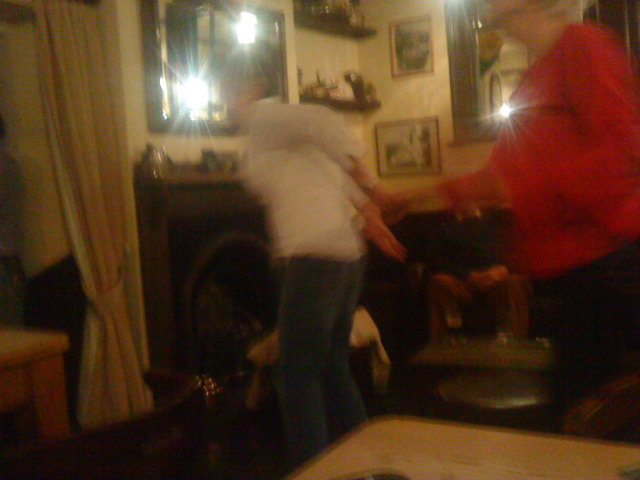
So I went. And this is what I saw, in all its are bure boke reality.


It’s an archetypal West Cornwall scene. Older women, often divorced, looking out for themselves. Many of them found their way there in search of a new life. New agey stuff, often. They completely outnumber the men of their age and income group. And they remember their younger selves, it seems, by dancing to a group from that period.

What was the Mindbenders’ performance like? As you might expect, there were now just two of them — a pair of old geezers. Bass and guitar, plus drum machine. 

 
I didn’t stay for much more than half an hour but they didn’t play a song I didn’t know — though none of them were Mindbenders songs. One of them, the bassist, I think, introduced each song with the name of its original performer/writer and a little story about it. There, I thought, is someone who long ago grasped the import of a PRS statement. I quite liked their attempt at Robert Parker’s Barefootin’ — though nothing, of course, could ever match the fizz of the original.

Having written all that, I googled and wikied. I now know these things:

* Mr Fontana was born Glyn Geoffrey Ellis.

* Even though he and his band were on the Fontana label, he actually got his surname from Elvis Presley’s drummer, DJ Fontana. 
* Fontana is a town in California. Beyond that, I can’t find out what it means or why Philips picked it for one of their record labels.

* Mr Fontana now seems to have mental health issues — court appearances in weird costumes, setting fire to his own car.

* The two hits he had that I do remember from the list are Um etc, a cover of a Major Lance tune, and Game of Love.

* The Mindbenders’ name had nothing to do with drugs. It came from a Dirk Bogarde movie The Mind  

Benders.

* I was right about A Groovy Kind of Love. Written by Toni Wine and Carole Bayer Sager (Burt Bacharach’s ex-wife among other things), it’s apparently based on a piece of classical music — the Rondo of Clementi’s Sonatina in G. Not that I’ve actually heard it.

* It was originally done by Diane and Annita. I actually have that version on a wonderful Ace compilation, You Heard It Here First! The originals of I Feel Good, My Boy Lollipop and Wild Things are also gorgeous surprises.

* Later Mindbenders included Eric Stewart and Graham Gouldman, future members of 10CC. I don’t think they were the ones in the Dock Inn, Penzance version. Graham Gouldman did, however, write this song, for the Yardbirds.

Also . . .


Another Cornish scene.

A little something about the significance of pop.

Sunday, 22 April 2012

Oh, nothing significant at all. Just a silly picture

Here it is . . .


That's it.

Next Cornish stuff — no pasties, though

Wednesday, 18 April 2012


Park benches and the people who break them

First, a warning: this blog is at risk of being gommy. Grumpy old man-y, that is.

It’s about my local park benches. See, I told you it was a GOM thing.

For some time, I’d noticed that there seemed to be far more broken benches than there used to be. A lot of them also seemed to be somehow bent at the front.

If I thought about it, I think I must have thought it was a result of the park’s increased popularity and its now regular swamping by non-locals. Probably, the young and boisterous among them were, well, smashing up the benches.

Just so you know — if you don’t already — that it’s Primrose Hill park I’m talking about. Not the badlands under any circumstances.

But now I’ve discovered I was wrong. Those park benches weren’t being destroyed by young people — to whom I apologise, unreservedly.

No, they are being broken carelessly but knowingly by the rich and affluent. Simply, personal trainers are encouraging their charges to use the benches as something to jump on and off. It’s some kind of fitness thing. And it’s a completely shit piece of behaviour by people who should know better.

How do I know? I’ve seen it. On many occasions. I’ve even said something. And not been responded to with the, well, politesse, one might hope for.

There was a complete disconnect. No understanding that by improving themselves they were degrading the lives of others.

As a GOM, part of me (at least) felt, as did an automobilistic GOM under different circumstances, that they should — both trainer and trainer — be taken out and shot in front of their children. Slowly.

This time is different, though. I took a photo of the trainer and trained doing it. Here it is. I’ve also sent it to the Royal Parks people.

And next time I see it, I’ll take another picture. Only closer.

Aaaah, that’s better. Thank you for bearing with me.

Now I will GOM off.

Next I don’t know what exactly I will post next but I do promise it won’t be gommy.

Friday, 23 March 2012

I want my own revenge! And I want it in the Old Vic!

I went to see Eve Best
in The Duchess of Malfi the other evening. Don’t.

Or, at least, if you do, laugh. It is truly terrible. She’s as good as you’d expect, given her CV. But everything else was bad, bad, bad.

As my wife said, you knew it was really bad as soon as the actors came onstage in a kind of choreographed procession. She’s a dancer and movement teacher so she’s knows about these things. But even I . . .

In fact, I should have been tipped the wink even earlier, by the set  — which must have cost a lot but which didn’t really leave much room on the stage for the actors. So they spent all their time in the middle of the stage.

They shouted a lot, too. I know that shouting is one of the prime rules for actors in Shakespearean and Jacobean drama and I wish they’d simply stop it. But this was really shouty. No rhythm to the speeches either — Eve Best aside.

So far, so quite completely awful. My wife left at half-time but I stayed on, as I’d never seen a staged version of the play before, only read it.

I’m glad I did. Not because it improved. It didn’t. It went the other way. But . . .

It gave me a Springtime For Hitler moment. Well, a potential one, anyway. If only I’d had the guts to start laughing out loud and honking the way the first-night audience do in Mel Brooks’ great comedy, The Producers.

What happened was Eve Best died, with extreme slowness. Or rather the Duchess of Malfi did. (Why? I can’t be bothered to remember.) It took minutes of groaning and moaning. Then she revived and did it all again — though making it a little shorter for this second going.

It was like something out of, say, a Morecambe and Wise version of Shakespeare. Ludicrously protracted death played for laughs.

I remember wishing I had laughed and being a little surprised there weren’t more sniggers around me. Particularly when there were several more deaths along the same lines.

It was only today, though, after a suitable break from it that I realised that I’d probably misunderstood. I think Eve Best knew what she was doing — but we the audience had let her down.

She had realised that she was in a real stinker. With her Nurse Jackie experience of how to handle mordant comedy, she’d decided the production’s only possible salvation was to play it for laughs — make it a Jacobean revenge tragedy rival to Brooks’ Nazi musical comedy.

But we the audience just didn’t get it. So, what can I say? Eve, I’m sorry, really sorry, I failed you. Next time, I promise, I’ll laugh and laugh and laugh at your Duchess of Malfi.

Thursday, 22 March 2012

Who put the bermp?

An old article of mine, entitled Who Put The Bomp?, has just been published in French. Hence the silly approximation of a Clouseau accent in the heading above.

It’s in a Parisian magazine, Feuilleton — a quarterly, I think, and something like McSweeney’s. This issue, Spring 2012, also includes, among many other things, a piece by Murakami Huraki, with illustrations by Robert Crumb.

It’s one of the best-looking wordy magazines I’ve ever seen. The design for my article/essay, which stretches over eighteen pages, is just gorgeous. The piece appeared twice before in English (The Observer and Mojo magazine) but it’s never looked this good.

Nor has it previously been graced by footnotes — eg explaining that a Geordie is ‘Surnom donnĂ© aux habitants de Newcastle’. Nor, dipping into false modesty, have I ever been flattered by a biographical note describing me as a ‘figure parmi les grands noms du journalisme rock anglais’.

So what is the piece about? It’s an attempt to answer the question in the title — which was posed in a minor 1960s pop hit written and sung by Barry Mann. He was the husband half of the Mann-Greenwich partnership — writers of You’ve Lost That Lovin’ Feeling etc etc etc etc etc (plus a few more et ceteras).

My answer runs to about seven thousand words and takes in not just Geordies but Manchester City fans, Baltimore, the building at the junction of Gloucester Avenue and Regent’s Park Rd, Elvis Presley and the early 16th version of spaghetti al burro e formaggio.

How did I make these links? You’ll have to read the piece. You’ll find the magazine here. It’s 15 euros.

Don’t read French and want to read it? Well, you could find an old copy of Mojo/The Observer. Or you could wait till I finish the book I’m working on (hard) and read a new version of it there.

How did I come to think of such a mad topic and write such a mad-sounding piece? Ah, you’ll have to wait for the book to find that out, too

Next My Springtime for Hitler moment.
http://www.boutique-feuilleton.fr/vente-au-numero-xsl-351.html

Sunday, 11 March 2012

And finally . . . a happy twenty-first

21 Jingle Bells Bing Crosby

More than ten years ago now, I wrote a long piece about Christmas — facts mostly. Facts like the fact that there are 140 towns and cities in the USA that have the word Christmas in their names. And the fact that, back then anyway, Britain’s top five best loved Christmas carols were Silent Night, Away In A Manger, Little Donkey, Good King Wenceslas and . . . Jingle Bells.

Which is kind of odd as it began life as a Thanksgiving song, entitled The One Horse Open Sleigh. Published in 1857, it was written by James Pierpont, uncle of the famous financier JP Morgan, whose business is still around under a similar name. The legend says Pierpont first played Jingle Bells in Simpson’s Tavern, Medford, Massachusetts — an hour or so’s walk up the Mystic River from downtown Boston. There’s a plaque to that effect on the building that’s replaced the ale house.

(I looked up Mystic River, too. It has nothing to do with the supernatural. It’s an Anglicising of its Wampanoag name. It’s also an extremely short river, just seven miles long. The things I’ve learned getting this stuff ready.)
Pierpont’s song became such a favourite at his church that they kept playing it right through till Christmas. The lyrics have changed somewhat since the original version. There are several verses, too, though no one sings them much anymore.

I’ve got a dozen or so versions of it, including a hi-energy instrumental by the Pet Shop Boys — a Christmas gift to their fanclub members. Camp as Christmas? Oh, yes.

I think this is my favourite, though. It has the Andrews Sisters on it — the flip side of the original 78 was Santa Claus Is Coming To Town. It really swings. It has that pause thing when they all stop and stay silent for a beat. They do the same trick on their version of the country murder rocker Pistol Packin Mama. And it reminds me of my childhood. My father was a big, big Bing Crosby fan. And Bing is, after all, Mr White Christmas to Charles Brown’s Mr Black I’ve no idea how many Christmas songs Crosby recorded. I’ve certainly got more than a dozen.

A grammatical (or syntactical, perhaps) point. According to James J Fuld, in The Book of World-Famous Music, the word ‘jingle’ is here being used not as an adjective, as you probably thought — I certainly did. Rather, it is an imperative verb — ie it’s telling sleigh drivers to jingle their bells, as a way of reducing the seasonal sleigh accident rate (and insurance premiums — see Rudolph, above). I’m sure he’s right, too. It makes far better sense of that ‘jingle all the way’ line.

Next Normal non-seasonal service will finally be resumed