I’m probably well behind the loop on this but I’ve recently become a big fan of the podcast What The Fuck. I load it on to my phone and listen to it while walking the dog etc. If you see me laughing to myself with those black wires hanging from my ears, that’s why.
It’s done by an American comic who I’d never heard of before, Marc Maron. He’s been around for years and is now in his mid-forties. He’s had the divorces, the drug habit, the alcoholism and all that classic comic stuff. He’s angry and twisted and bitter and worried and self-hating and self-doubting. Imagine Woody Allen without pretension and without being a pain in the arse.
The show is just him and another comic, mostly. They talk for an hour or so, sometimes even two hours. I find it fascinating for two reasons.
One, the content and the quality of the conversation. He and the comics — most of whom he knows, if only a little — talk openly and in great detail about their lives. (The language and subject matter is not for the knock-kneed but then you could guess that from the podcast title.) If you ever thought it was a cliche that comedy comes out of pain — painful childhood, in particular — this is proof that cliches are cliches because they’re true.
Two, the relentless detail of the conversation. Not about that emotional stuff. Interesting as that is, it’s not exactly unique. What is special about WTF is its focus on comedy. It delineates and dissects the world of American comedy — stand-up, radio, sitcoms, sketch shows — with fabulous detail. It’s always fascinating to hear the real deal details of a profession. And this is presented by compulsive talkers and explainers and joke-makers. Smart ones, too, all of them. I must have listened to twenty or so shows now. Only another 50 or so to go. Sorry, that’s all, folks, go to go pod.
PS I also had a look at and listen to some of the stand-up performances of Maron and his guests. I was less impressed. Stick with the podcast.
Wonders of the modern world, number seven . . . Samuel Smith’s pubs
Yes, that’s right, a pub chain.
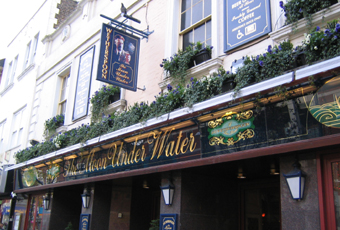
The other week I was taken for a drink by an American cousin. He told me his favourite beer was Samuel Smith’s. I vaguely remembered that the Swiss Cottage pub was a Sam Smith’s house. I also vaguely remembered being invited along for a drink at a Sam Smith’s by my fellow students on my MSc course — and that it was oddly cheap, which is why they chose it, I guess.
So I found myself in the pub that’s marooned in the middle of the gyratory/urban race oval at the south end of Finchley Rd. And fascinated. So fascinated that I paid a return visit the other Saturday afternoon to meet up with one of my oldest friends.
What’s so fascinating about Sam Smith’s pubs? That everything is Sam Smith’s. Not just the beer and the lager and the stout but the soft drinks and the hard liquor, too. Even the crisps and nuts are Sam Smith’s. A kind of integration, vertical and horizontal, that you just don’t see in that trade anymore — though obviously you do in food outlets like, say, Pret A Manger.
It feels almost Soviet or Stalinistic in its consistency and lack of choice — as I pointed out to the eastern European barman, to his amusement and agreement. My friend asked for a packet of Uncle Joe’s nuts.
Imagine a world where socialism had got its act together — cheap, good beer and chilli nuts for all! That’s a Sam Smith’s pub. Not very exciting and full of cheap-date alcoholics, of course. But you can’t have everything.
There’s a suitable touch of puritanism, too. Mid-1950s era decor — dark, fake wood panelling, that kind of thing. No music or one-arm bandits or TV. In fact, now I think of it, the Sam Smith’s pub remind me of two other things.
One, the old Yates wine lodges. Not so much the London ones — which were full of people like me drinking the excellent cheap champagne. Nor the classic Liverpool ones, full of students on the Blob and stuck into the cheap Aussie white (wine, Jim, but not as you know it — think sherry . . . ish). Rather, the ones that had a counter where you queued up with a tray like in a cafeteria. You’d tell them what you wanted — which might include a cup of tea, Yates having been founded as part of the temperance movement. Then you’d pay for it at a till point. Municipalised socialism with a sloshed smile.
I even thought up a slogan . . . Sam Smith’s: it’s as if modern capitalism never happened!
Then I wikipedia-ed Sam Smith’s and discovered that it’s not at all socialist in intent but tight corporate branding — and they took the music out because they didn’t want to pay the PRS levy. Oh, well.
PS While I was there, a ten-or-so-strong group of mid-late twenties came in, all dressed in bobble hats, big glasses and red-and-white striped tops. Where’s Wally, I asked, of course. You tell me, they said, we’re looking for him. They were on a pub crawl along the Jubilee line — on a Saturday when it’s suspended for rebuilding. How English a weekend hobby outing is that? Another wonder of the modern world, I’d say.
Next up What the fuck? (And what the fuckericans.)
Thursday, 10 March 2011
Origin of the World, an extended footnote, part four
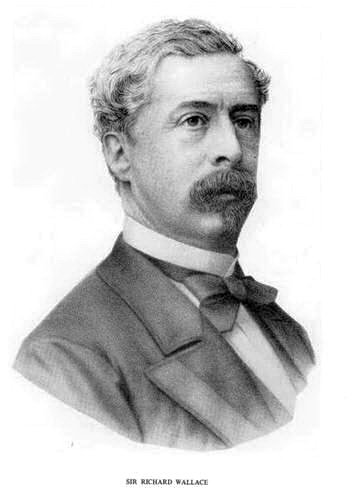
Terrified by the death and destruction in besieged Paris, Wallace moved back to England and took his collection with him. (The family had also previously returned to London, briefly, during the 1848 uprising.) Things were never much good again for him. His marriage soured. He became depressed and listless to the point where, although he kind of intended to bequeath his collection to the nation, he could never quite stir himself to do it. It was eventually done by his wife, a Frenchwoman, who never quite got round to learning English.
His son - who was a French army officer during the siege - broke with him and returned to Paris and his four illegitimate children, by a woman 'of the theatre'. Wallace is reported to have said: 'Mon Dieu, est-ce que nou n'aurons jamai fini de bâtards?'. Good God, will there ever be an end to bastards?
Father and son died without reconciling. Wallace did, though, himself acquire a young man as a secretary, then adopt him. It was Sir John Murray Scott, Vita Sackville-West's father.
So who was Richard Wallace then? Well, the surname was his own choice. He switched to it, legally, from his given surname Jackson, in 1842, having himself rebaptised in an Anglican church in Paris. (By which time, he already had a seven-month-old son by his mistress, Julie Castelnau - who he later married and stayed with, after a fashion, till his death.)
His father? Well, one idea is that it was not the fourth Lord Hertford but the third - Mie-Mie's husband-back-in-London. One account describes that Lord Hertford as a man who 'begat more than one illegitimate child and who acquired across the years a very unsavoury reputation.'
Another theory - and this is the one in the Dictionary of National Biography - is that he was, in fact, Mie-Mie's son. Which would have made him the half-brother of the man who was - to most accounts, anyway - his father.
Whatever, it's hard to imagine that Wallace didn't have a look at Khalil Bey's Courbet. It could have ended up in Manchester Square.
Origin of the World, an extended footnote, part three (with not just one but four footnotes of its own)
Back to Sir Richard Wallace . . .
I'll get to his paternity in time but there is also doubt about his mother. The likeliest candidate was a woman born Agnes Wallace, a descendant of Scots independence leader Sir William Wallace. Born in 1789 - to a friend of Lord Hertford's - Agnes married a Mr Bickley, bore him a couple of children, then ran off to Brighton, where she hung out with soldiers. In particular, with the 10th (Prince of Wales's Own) Regiment of (Light) Dragoons (Hussars). Which is where she would have met the future fourth Lord Hertford - he was an eighteen-year-old officer in the regiment (and ten years her senior). By now she was Agnes Jackson - though there is no record of a Mr Jackson. Or of any dalliancing between Agnes and that Lord Hertford.
There was a child, though, and the guess is that when Agnes returned to her husband - by whom she would go on to have two more children - he didn't want her illegitimate son. So Agnes took him to Paris and left him with her hussar friend's mother.
The boy and Mie-Mie became close. He called her aunt. She called him her beloved nephew. He grew up something of a playboy, running up tabs and bills he couldn't pay. Though declining to buy Richard a commission in the navy, the third Lord Hertford did pay off his regular debts - £100,000 over two years*. He also took him on as his secretary - on £1,000 a year. He was responsible for the art collection and making additions to it. In 1865 alone, he bought 34 pictures, spending a million francs**. All that armour in the Wallace Collection was mostly his choice.
He also bought some art for himself. And got into debt again - speculating on the Paris bourse. Lord Hertford wouldn't pay his debts this time, told the lad he'd have to auction his collection. Which he did and . . . Lord Hertford bought his best five paintings. Which, of course, Wallace ended up inheriting back. Not that he knew he would. When Lord Hertford died in 1870, just as the Prussian guns were threatening Paris, the fact that Richard Wallace was the heir came as much a surprise to him as it did to the cousin who inherited the title and a couple of estates but not the cash to support them.
He was, surprisingly, something of a hero during the 1870-71 siege of the city, putting his inheritance to immediate charitable use. He spent perhaps £500,000 on medical relief and arranged for the care and repatriation of the 4,000 British exiles caught in the city. For a while, he was 'the most talked about man in England'.
For which kindnesses, he had a boulevard named after him. It's near La Défense, on the north west of the city itself, just beyond the Péripherique. A pleasant, tree-lined street with an iron-railinged park, it's considered 'the Champs-Élysées of Puteaux'. George Simenon lived there 1936-8 and — a fan website informs — there are several scenes set there in Maigret novels. Wallace was buried, in the family tomb, in Père Lachaise.
His mark is still there all over Paris proper, too. Those black cast-iron drinking fountains, with their maidens-in-drapery caryatids, they were commissioned and paid for by him. Known as Wallace Fountains, there are still 66 of them around the place. There's also one outside the Wallace Collection in London. Oh, and Brigitte Bardot has one, too.
* In current terms? Well, if you take just inflation as a measure, it comes out at about £7million. But if you take it as a percentage of GDP, it comes out at nearly £150 million***.
** As far as I can figure out, there were at that time roughly 25 francs to the pound. So, using the same formula as above, that would today equate to either £2.8 million or £60 million. Given current art prices, that seems really cheap - it wouldn't even get you four major Freuds or Bacons.****
*** How could he afford it? The family had large estates, producing big rents - £60,000 a year in 1841.
**** Apropos of irrelevance, as an editor, I once arranged for an art review to be tweaked so we could use the headline 'Bacon and two Freud eggs'.
Next up 'Mon Dieu, est-ce que nou n'aurons jamai fini de bâtards?'
Monday, 28 February 2011
Origin of the World, an extended footnote, part two (with a footnote of its own)
Again, it's more complicated than that. Whoever Sir Richard Wallace was, that's not what it said on his birth certificate. He was born Richard Jackson, in London, in 1818 - and, in later life, often said he didn't know who his father was. We do know, though, that he arrived in Paris in 1925 and was moved into the house of the Countess of Yarmouth, the wife of the third Lord Hertford - ie the putative father of Sir Richard. This Lord Hertford, by the way, as well as being a libertine, was the son of the mistress of the Prince of Wales - the future George IV, that is. (There's a picture of Lord Hertford's mother in the National Portrait Gallery collection. Her full name was Isabella Ingram-Shepheard. She has very big hair.)
Known as Mie-Mie, the Countess of Yarmouth/Marchioness of Hertford - the wife of the third Lord Hertford, that is - was herself the illegitimate daughter of a former dancer (or perhaps an Italian marchesa) and, it is said, the Duke of Queensbury. Known as 'Old Q', for the giant letter on the side of his coach, the Duke's entry in the Dictionary of National Biography describes him as a 'sybarite and politician'. A cartoon of him in the NPG captures him at his two favourite pastimes. Titled 'Quiz-zing a filly', its caption describes him as 'rake and patron of the turf'. Another NPG cartoon calls him 'the old goat of Piccadilly'. He was supposed to have a 'harem' in his Piccadilly house - see orientalism peek over the bannister.
Or perhaps Mie-Mie's father was the Satanic Hellfire Club member George Selwyn. Both Queensbury and Selwyn certainly thought they were her father and both left her big money in their wills. Or perhaps her father was Selwyn's butler - who didn't leave her big money.*
Mie-Mie was a contraction of her given names, Maria Emily. Estranged from her husband, Mie-Mie had lived in Paris since 1802 - eventually in the Rue Taitbout apartments that Khalil Bey would later take. French Wikipedia: 'In the nineteenth century, the Taitbout street is where the rich financial lodge their courtesans.' (A Google translation, not mine.) A one bedroom apartment there will currently set you back €1800 or so a month.
In his madness, George III said he'd like to take Mie-Mie as his mistress - she was, of course, the daughter-in-law of his son's mistress. While in Paris, she had another child. As Lord Hertford was back in London, it is unlikely he was the father. That was probably Casimir de Montrond, a French diplomat who is said to have first coined the aphorism 'Mistrust first impulses; they are nearly always good.'
It's beginning to make sense, isn't it, why all these titled English chose to hang out in the relative anonymity of Paris.
* While the Wallace Collection may once have been, well, discrete about its origins, it now trumpets them. In October 2010, it hosted a lecture entitled 'The Scholar and the Star: The Wit, The Rake and the Italian Dancer's Daughter'. Selwyn was the wit, Queensbury the rake and Mie-Mie the daughter.
Next up Wallace, man of art — and drinking water
Tuesday, 15 February 2011
Origin of the World, an extended footnote, part one
As I was saying before I interrupted myself . . .
But first, be warned that this tale is only tangentially connected Courbet's Origin of the World. Hence the post's title/headline. If you're not interested in the comings and goings of the English aristocracy, you might want to skip away now. On the other hand, I'm not generally that interested in that kind of thing and I did find myself drawn in.
Think of it as an intermezzo - a kind of the link between Courbet's painting and the Wallace Collection in Manchester Square. It's just one of those intriguingly complicated family stories that are irresistible but don't really lead you anywhere. Not anywhere clear anyway, just somewhere interesting: to a family which has been described as having pursued 'art with great dedication, while leading the most confused and odd private lives.'
The art collection that we know as the Wallace Collection was started by Lord Hertford - the Lord Hertford who died in 1870, that is. His non-noble name was Richard Seymour-Conway. In an 1843 probate action, 'he was exposed as a libertine and a constant consort of prostitutes.' This then was the man who let rooms to Khalil Bey.
He, too, liked pictures - and also had distinct, not to say peculiar, tastes. His collection was put together according to an idiosyncratic - if all too human - paradigm. He would only buy pictures he found 'pleasing'. Or rather, of subjects he found 'pleasing'. He wouldn't, for example, buy any pictures of old men. So that was quite a few Rembrandts out.
But the Wallace Collection (ie the one in Manchester Square) was set up by Sir Richard Wallace. Generally said to be Lord Hertford's illegitimate son - but I'll be coming back to that general belief - this Wallace was also employed as his lordship's secretary. A secretary in the older sense, that is - as in secretary of state. He looked after Lord Hertford's business affairs, in particular what has been described as 'the finest private art collection in the world'.
Next up Family affairs, including those of ‘the old goat of Piccadilly’


 Posts