

 Posts
Posts


Origin of the World, an extended footnote, part four
Terrified by the death and destruction in besieged Paris, Wallace moved back to England and took his collection with him. (The family had also previously returned to London, briefly, during the 1848 uprising.) Things were never much good again for him. His marriage soured. He became depressed and listless to the point where, although he kind of intended to bequeath his collection to the nation, he could never quite stir himself to do it. It was eventually done by his wife, a Frenchwoman, who never quite got round to learning English.
His son - who was a French army officer during the siege - broke with him and returned to Paris and his four illegitimate children, by a woman 'of the theatre'. Wallace is reported to have said: 'Mon Dieu, est-ce que nou n'aurons jamai fini de bâtards?'. Good God, will there ever be an end to bastards?
Father and son died without reconciling. Wallace did, though, himself acquire a young man as a secretary, then adopt him. It was Sir John Murray Scott, Vita Sackville-West's father.
So who was Richard Wallace then? Well, the surname was his own choice. He switched to it, legally, from his given surname Jackson, in 1842, having himself rebaptised in an Anglican church in Paris. (By which time, he already had a seven-month-old son by his mistress, Julie Castelnau - who he later married and stayed with, after a fashion, till his death.)
His father? Well, one idea is that it was not the fourth Lord Hertford but the third - Mie-Mie's husband-back-in-London. One account describes that Lord Hertford as a man who 'begat more than one illegitimate child and who acquired across the years a very unsavoury reputation.'
Another theory - and this is the one in the Dictionary of National Biography - is that he was, in fact, Mie-Mie's son. Which would have made him the half-brother of the man who was - to most accounts, anyway - his father.
Whatever, it's hard to imagine that Wallace didn't have a look at Khalil Bey's Courbet. It could have ended up in Manchester Square.
Next up I’m taking a break from Courbet etc to ask: What’s so funny about (What's So Funny About) Peace, Love and Understanding?
Thursday, 10 March 2011


Friday, 4 March 2011
Origin of the World, an extended footnote, part three (with not just one but four footnotes of its own)
Back to Sir Richard Wallace . . .
I'll get to his paternity in time but there is also doubt about his mother. The likeliest candidate was a woman born Agnes Wallace, a descendant of Scots independence leader Sir William Wallace. Born in 1789 - to a friend of Lord Hertford's - Agnes married a Mr Bickley, bore him a couple of children, then ran off to Brighton, where she hung out with soldiers. In particular, with the 10th (Prince of Wales's Own) Regiment of (Light) Dragoons (Hussars). Which is where she would have met the future fourth Lord Hertford - he was an eighteen-year-old officer in the regiment (and ten years her senior). By now she was Agnes Jackson - though there is no record of a Mr Jackson. Or of any dalliancing between Agnes and that Lord Hertford.
There was a child, though, and the guess is that when Agnes returned to her husband - by whom she would go on to have two more children - he didn't want her illegitimate son. So Agnes took him to Paris and left him with her hussar friend's mother.
The boy and Mie-Mie became close. He called her aunt. She called him her beloved nephew. He grew up something of a playboy, running up tabs and bills he couldn't pay. Though declining to buy Richard a commission in the navy, the third Lord Hertford did pay off his regular debts - £100,000 over two years*. He also took him on as his secretary - on £1,000 a year. He was responsible for the art collection and making additions to it. In 1865 alone, he bought 34 pictures, spending a million francs**. All that armour in the Wallace Collection was mostly his choice.
He also bought some art for himself. And got into debt again - speculating on the Paris bourse. Lord Hertford wouldn't pay his debts this time, told the lad he'd have to auction his collection. Which he did and . . . Lord Hertford bought his best five paintings. Which, of course, Wallace ended up inheriting back. Not that he knew he would. When Lord Hertford died in 1870, just as the Prussian guns were threatening Paris, the fact that Richard Wallace was the heir came as much a surprise to him as it did to the cousin who inherited the title and a couple of estates but not the cash to support them.
He was, surprisingly, something of a hero during the 1870-71 siege of the city, putting his inheritance to immediate charitable use. He spent perhaps £500,000 on medical relief and arranged for the care and repatriation of the 4,000 British exiles caught in the city. For a while, he was 'the most talked about man in England'.
For which kindnesses, he had a boulevard named after him. It's near La Défense, on the north west of the city itself, just beyond the Péripherique. A pleasant, tree-lined street with an iron-railinged park, it's considered 'the Champs-Élysées of Puteaux'. George Simenon lived there 1936-8 and — a fan website informs — there are several scenes set there in Maigret novels. Wallace was buried, in the family tomb, in Père Lachaise.
His mark is still there all over Paris proper, too. Those black cast-iron drinking fountains, with their maidens-in-drapery caryatids, they were commissioned and paid for by him. Known as Wallace Fountains, there are still 66 of them around the place. There's also one outside the Wallace Collection in London. Oh, and Brigitte Bardot has one, too.
* In current terms? Well, if you take just inflation as a measure, it comes out at about £7million. But if you take it as a percentage of GDP, it comes out at nearly £150 million***.
** As far as I can figure out, there were at that time roughly 25 francs to the pound. So, using the same formula as above, that would today equate to either £2.8 million or £60 million. Given current art prices, that seems really cheap - it wouldn't even get you four major Freuds or Bacons.****
*** How could he afford it? The family had large estates, producing big rents - £60,000 a year in 1841.
**** Apropos of irrelevance, as an editor, I once arranged for an art review to be tweaked so we could use the headline 'Bacon and two Freud eggs'.
Next up 'Mon Dieu, est-ce que nou n'aurons jamai fini de bâtards?'
Back to Sir Richard Wallace . . .
I'll get to his paternity in time but there is also doubt about his mother. The likeliest candidate was a woman born Agnes Wallace, a descendant of Scots independence leader Sir William Wallace. Born in 1789 - to a friend of Lord Hertford's - Agnes married a Mr Bickley, bore him a couple of children, then ran off to Brighton, where she hung out with soldiers. In particular, with the 10th (Prince of Wales's Own) Regiment of (Light) Dragoons (Hussars). Which is where she would have met the future fourth Lord Hertford - he was an eighteen-year-old officer in the regiment (and ten years her senior). By now she was Agnes Jackson - though there is no record of a Mr Jackson. Or of any dalliancing between Agnes and that Lord Hertford.
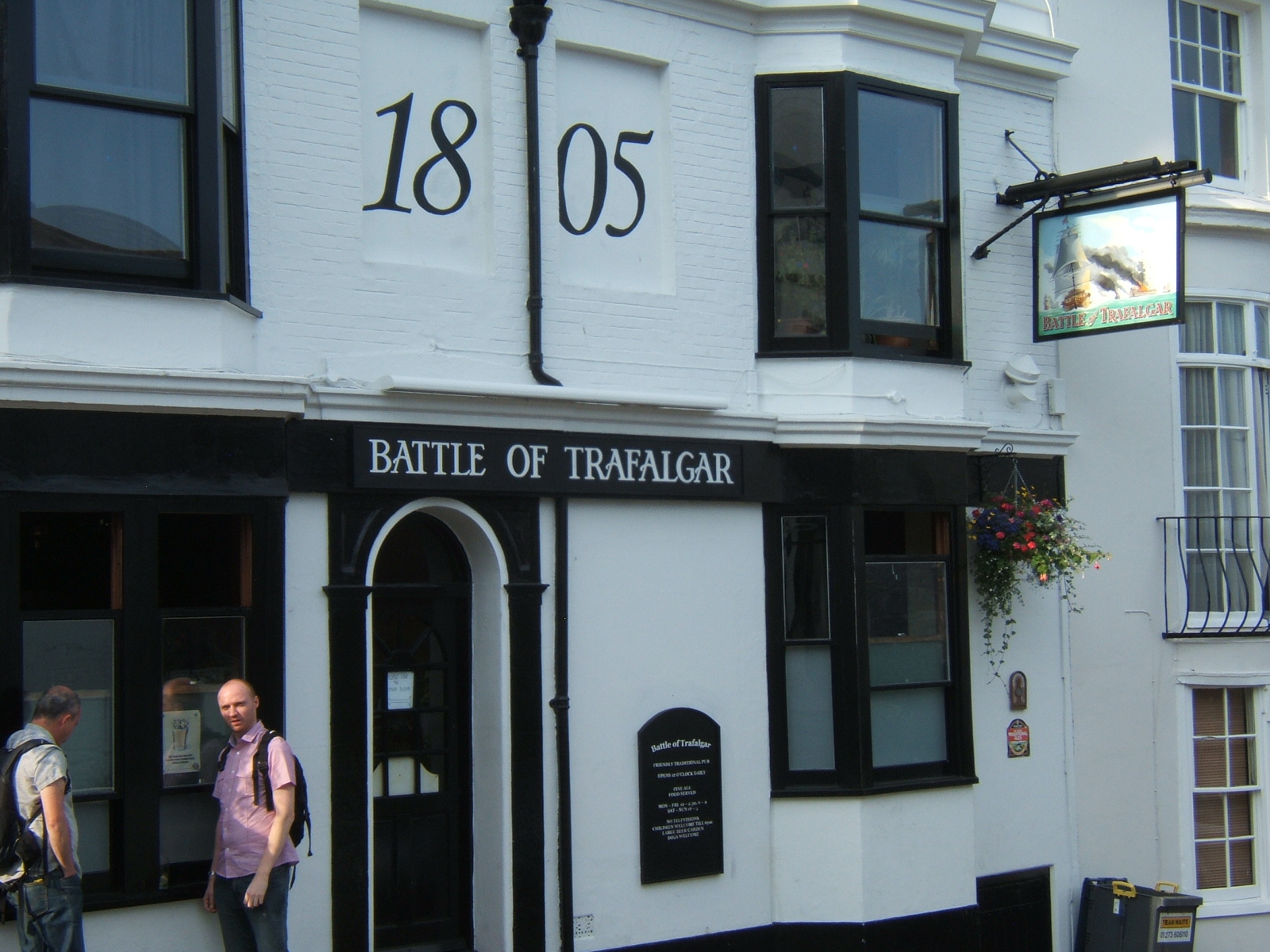
There was a child, though, and the guess is that when Agnes returned to her husband - by whom she would go on to have two more children - he didn't want her illegitimate son. So Agnes took him to Paris and left him with her hussar friend's mother.
The boy and Mie-Mie became close. He called her aunt. She called him her beloved nephew. He grew up something of a playboy, running up tabs and bills he couldn't pay. Though declining to buy Richard a commission in the navy, the third Lord Hertford did pay off his regular debts - £100,000 over two years*. He also took him on as his secretary - on £1,000 a year. He was responsible for the art collection and making additions to it. In 1865 alone, he bought 34 pictures, spending a million francs**. All that armour in the Wallace Collection was mostly his choice.
He also bought some art for himself. And got into debt again - speculating on the Paris bourse. Lord Hertford wouldn't pay his debts this time, told the lad he'd have to auction his collection. Which he did and . . . Lord Hertford bought his best five paintings. Which, of course, Wallace ended up inheriting back. Not that he knew he would. When Lord Hertford died in 1870, just as the Prussian guns were threatening Paris, the fact that Richard Wallace was the heir came as much a surprise to him as it did to the cousin who inherited the title and a couple of estates but not the cash to support them.
He was, surprisingly, something of a hero during the 1870-71 siege of the city, putting his inheritance to immediate charitable use. He spent perhaps £500,000 on medical relief and arranged for the care and repatriation of the 4,000 British exiles caught in the city. For a while, he was 'the most talked about man in England'.
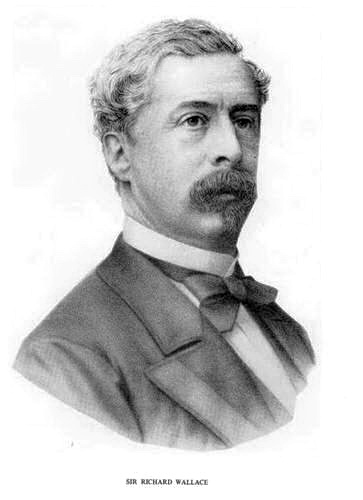
For which kindnesses, he had a boulevard named after him. It's near La Défense, on the north west of the city itself, just beyond the Péripherique. A pleasant, tree-lined street with an iron-railinged park, it's considered 'the Champs-Élysées of Puteaux'. George Simenon lived there 1936-8 and — a fan website informs — there are several scenes set there in Maigret novels. Wallace was buried, in the family tomb, in Père Lachaise.
His mark is still there all over Paris proper, too. Those black cast-iron drinking fountains, with their maidens-in-drapery caryatids, they were commissioned and paid for by him. Known as Wallace Fountains, there are still 66 of them around the place. There's also one outside the Wallace Collection in London. Oh, and Brigitte Bardot has one, too.

* In current terms? Well, if you take just inflation as a measure, it comes out at about £7million. But if you take it as a percentage of GDP, it comes out at nearly £150 million***.
** As far as I can figure out, there were at that time roughly 25 francs to the pound. So, using the same formula as above, that would today equate to either £2.8 million or £60 million. Given current art prices, that seems really cheap - it wouldn't even get you four major Freuds or Bacons.****
*** How could he afford it? The family had large estates, producing big rents - £60,000 a year in 1841.
**** Apropos of irrelevance, as an editor, I once arranged for an art review to be tweaked so we could use the headline 'Bacon and two Freud eggs'.
Next up 'Mon Dieu, est-ce que nou n'aurons jamai fini de bâtards?'
Monday, 28 February 2011
Origin of the World, an extended footnote, part two (with a footnote of its own)
Again, it's more complicated than that. Whoever Sir Richard Wallace was, that's not what it said on his birth certificate. He was born Richard Jackson, in London, in 1818 - and, in later life, often said he didn't know who his father was. We do know, though, that he arrived in Paris in 1925 and was moved into the house of the Countess of Yarmouth, the wife of the third Lord Hertford - ie the putative father of Sir Richard. This Lord Hertford, by the way, as well as being a libertine, was the son of the mistress of the Prince of Wales - the future George IV, that is. (There's a picture of Lord Hertford's mother in the National Portrait Gallery collection. Her full name was Isabella Ingram-Shepheard. She has very big hair.)
Known as Mie-Mie, the Countess of Yarmouth/Marchioness of Hertford - the wife of the third Lord Hertford, that is - was herself the illegitimate daughter of a former dancer (or perhaps an Italian marchesa) and, it is said, the Duke of Queensbury. Known as 'Old Q', for the giant letter on the side of his coach, the Duke's entry in the Dictionary of National Biography describes him as a 'sybarite and politician'. A cartoon of him in the NPG captures him at his two favourite pastimes. Titled 'Quiz-zing a filly', its caption describes him as 'rake and patron of the turf'. Another NPG cartoon calls him 'the old goat of Piccadilly'. He was supposed to have a 'harem' in his Piccadilly house - see orientalism peek over the bannister.
Or perhaps Mie-Mie's father was the Satanic Hellfire Club member George Selwyn. Both Queensbury and Selwyn certainly thought they were her father and both left her big money in their wills. Or perhaps her father was Selwyn's butler - who didn't leave her big money.*
Mie-Mie was a contraction of her given names, Maria Emily. Estranged from her husband, Mie-Mie had lived in Paris since 1802 - eventually in the Rue Taitbout apartments that Khalil Bey would later take. French Wikipedia: 'In the nineteenth century, the Taitbout street is where the rich financial lodge their courtesans.' (A Google translation, not mine.) A one bedroom apartment there will currently set you back €1800 or so a month.
In his madness, George III said he'd like to take Mie-Mie as his mistress - she was, of course, the daughter-in-law of his son's mistress. While in Paris, she had another child. As Lord Hertford was back in London, it is unlikely he was the father. That was probably Casimir de Montrond, a French diplomat who is said to have first coined the aphorism 'Mistrust first impulses; they are nearly always good.'
It's beginning to make sense, isn't it, why all these titled English chose to hang out in the relative anonymity of Paris.
* While the Wallace Collection may once have been, well, discrete about its origins, it now trumpets them. In October 2010, it hosted a lecture entitled 'The Scholar and the Star: The Wit, The Rake and the Italian Dancer's Daughter'. Selwyn was the wit, Queensbury the rake and Mie-Mie the daughter.
Next up Wallace, man of art — and drinking water
Again, it's more complicated than that. Whoever Sir Richard Wallace was, that's not what it said on his birth certificate. He was born Richard Jackson, in London, in 1818 - and, in later life, often said he didn't know who his father was. We do know, though, that he arrived in Paris in 1925 and was moved into the house of the Countess of Yarmouth, the wife of the third Lord Hertford - ie the putative father of Sir Richard. This Lord Hertford, by the way, as well as being a libertine, was the son of the mistress of the Prince of Wales - the future George IV, that is. (There's a picture of Lord Hertford's mother in the National Portrait Gallery collection. Her full name was Isabella Ingram-Shepheard. She has very big hair.)
Known as Mie-Mie, the Countess of Yarmouth/Marchioness of Hertford - the wife of the third Lord Hertford, that is - was herself the illegitimate daughter of a former dancer (or perhaps an Italian marchesa) and, it is said, the Duke of Queensbury. Known as 'Old Q', for the giant letter on the side of his coach, the Duke's entry in the Dictionary of National Biography describes him as a 'sybarite and politician'. A cartoon of him in the NPG captures him at his two favourite pastimes. Titled 'Quiz-zing a filly', its caption describes him as 'rake and patron of the turf'. Another NPG cartoon calls him 'the old goat of Piccadilly'. He was supposed to have a 'harem' in his Piccadilly house - see orientalism peek over the bannister.
Or perhaps Mie-Mie's father was the Satanic Hellfire Club member George Selwyn. Both Queensbury and Selwyn certainly thought they were her father and both left her big money in their wills. Or perhaps her father was Selwyn's butler - who didn't leave her big money.*

Mie-Mie was a contraction of her given names, Maria Emily. Estranged from her husband, Mie-Mie had lived in Paris since 1802 - eventually in the Rue Taitbout apartments that Khalil Bey would later take. French Wikipedia: 'In the nineteenth century, the Taitbout street is where the rich financial lodge their courtesans.' (A Google translation, not mine.) A one bedroom apartment there will currently set you back €1800 or so a month.

In his madness, George III said he'd like to take Mie-Mie as his mistress - she was, of course, the daughter-in-law of his son's mistress. While in Paris, she had another child. As Lord Hertford was back in London, it is unlikely he was the father. That was probably Casimir de Montrond, a French diplomat who is said to have first coined the aphorism 'Mistrust first impulses; they are nearly always good.'
It's beginning to make sense, isn't it, why all these titled English chose to hang out in the relative anonymity of Paris.
* While the Wallace Collection may once have been, well, discrete about its origins, it now trumpets them. In October 2010, it hosted a lecture entitled 'The Scholar and the Star: The Wit, The Rake and the Italian Dancer's Daughter'. Selwyn was the wit, Queensbury the rake and Mie-Mie the daughter.
Next up Wallace, man of art — and drinking water
Tuesday, 15 February 2011
Origin of the World, an extended footnote, part one
As I was saying before I interrupted myself . . .
But first, be warned that this tale is only tangentially connected Courbet's Origin of the World. Hence the post's title/headline. If you're not interested in the comings and goings of the English aristocracy, you might want to skip away now. On the other hand, I'm not generally that interested in that kind of thing and I did find myself drawn in.
Think of it as an intermezzo - a kind of the link between Courbet's painting and the Wallace Collection in Manchester Square. It's just one of those intriguingly complicated family stories that are irresistible but don't really lead you anywhere. Not anywhere clear anyway, just somewhere interesting: to a family which has been described as having pursued 'art with great dedication, while leading the most confused and odd private lives.'
The art collection that we know as the Wallace Collection was started by Lord Hertford - the Lord Hertford who died in 1870, that is. His non-noble name was Richard Seymour-Conway. In an 1843 probate action, 'he was exposed as a libertine and a constant consort of prostitutes.' This then was the man who let rooms to Khalil Bey.
He, too, liked pictures - and also had distinct, not to say peculiar, tastes. His collection was put together according to an idiosyncratic - if all too human - paradigm. He would only buy pictures he found 'pleasing'. Or rather, of subjects he found 'pleasing'. He wouldn't, for example, buy any pictures of old men. So that was quite a few Rembrandts out.
But the Wallace Collection (ie the one in Manchester Square) was set up by Sir Richard Wallace. Generally said to be Lord Hertford's illegitimate son - but I'll be coming back to that general belief - this Wallace was also employed as his lordship's secretary. A secretary in the older sense, that is - as in secretary of state. He looked after Lord Hertford's business affairs, in particular what has been described as 'the finest private art collection in the world'.
Next up Family affairs, including those of ‘the old goat of Piccadilly’
As I was saying before I interrupted myself . . .
But first, be warned that this tale is only tangentially connected Courbet's Origin of the World. Hence the post's title/headline. If you're not interested in the comings and goings of the English aristocracy, you might want to skip away now. On the other hand, I'm not generally that interested in that kind of thing and I did find myself drawn in.
Think of it as an intermezzo - a kind of the link between Courbet's painting and the Wallace Collection in Manchester Square. It's just one of those intriguingly complicated family stories that are irresistible but don't really lead you anywhere. Not anywhere clear anyway, just somewhere interesting: to a family which has been described as having pursued 'art with great dedication, while leading the most confused and odd private lives.'
The art collection that we know as the Wallace Collection was started by Lord Hertford - the Lord Hertford who died in 1870, that is. His non-noble name was Richard Seymour-Conway. In an 1843 probate action, 'he was exposed as a libertine and a constant consort of prostitutes.' This then was the man who let rooms to Khalil Bey.
He, too, liked pictures - and also had distinct, not to say peculiar, tastes. His collection was put together according to an idiosyncratic - if all too human - paradigm. He would only buy pictures he found 'pleasing'. Or rather, of subjects he found 'pleasing'. He wouldn't, for example, buy any pictures of old men. So that was quite a few Rembrandts out.
But the Wallace Collection (ie the one in Manchester Square) was set up by Sir Richard Wallace. Generally said to be Lord Hertford's illegitimate son - but I'll be coming back to that general belief - this Wallace was also employed as his lordship's secretary. A secretary in the older sense, that is - as in secretary of state. He looked after Lord Hertford's business affairs, in particular what has been described as 'the finest private art collection in the world'.
Next up Family affairs, including those of ‘the old goat of Piccadilly’
Monday, 31 January 2011
The delight of alleys etc
One Further to my posting about Billy Fury Way in West Hampstead, a friend who knows wrote to tell me that it used to be known as Spider Gang Alley in the 1980s. It was where skinheads with a spider web tattooed on them would hang out and ‘waylay unsuspecting folk and ask for a 'loan' when their supply of glue ran out’.
Two My Occitanian connection tells me of a Salubrious Passage. He says it’s a little back road by Swansea Docks. I say it’s a suggestive line from an Ian Dury song.
Three I discovered there’s a Potteries Path near Billy Fury Way. I must have a look.
Next up Bastard sons and drinking fountains
One Further to my posting about Billy Fury Way in West Hampstead, a friend who knows wrote to tell me that it used to be known as Spider Gang Alley in the 1980s. It was where skinheads with a spider web tattooed on them would hang out and ‘waylay unsuspecting folk and ask for a 'loan' when their supply of glue ran out’.
Two My Occitanian connection tells me of a Salubrious Passage. He says it’s a little back road by Swansea Docks. I say it’s a suggestive line from an Ian Dury song.
Three I discovered there’s a Potteries Path near Billy Fury Way. I must have a look.
Next up Bastard sons and drinking fountains
Wednesday, 26 January 2011
The story of Courbet’s Origin of the World, part seven

I finally found a picture of the man who commissioned and paid for Courbet’s Origin. There’s no date on it but it looks like it was taken around the time of the picture. There’s no photographer’s name on it, either, so it probably wasn’t by Auguste Belloc, who took the picture that Courbet based his painting on.
It’s not the original image, I’m fairly sure. I also have a very grainy photocopy of a far grainier original — in which Bey’s hand is on the left. So it’s probably been flipped. The curtain has been moved, too — and retouched to green. Which is the colour of the curtain with which, it’s said, he concealed his painting. The colour of Islam, of course. Théophile Gautier described Bey’s collection as ‘the first ever to be formed by a child of Islam’.
So we have a Muslim — in contradiction to his religion’s eternal ban on representational art — collecting the most modern versions of representation. ‘A magnificent gallery of pictures despite the law of the Prophet which forbids the representation of figures,’ L’Artiste magazine commented in January 1868 — when Bey’s collection came to auction, with the introduction to the catalogue written by Gautier.
In particular, of course, Bey’s magnificent gallery contained one image which represented something which had never before been represented in a public form — well, semi-public. Then he hid that representation with an abstract representation of his own religion — which notably sought (seeks, come to that) to forbid it.
One could read that symbolic act as a deliberate irony: the curtain itself as an enactment of Islam’s censorship of the human (or godly) form. An irony which was, in turn, compounded by the picture’s title, itself a challenge not just to Islam but to all religions — all of which, in my experience, posit far less visceral origins of the world.
If that makes Bey sound like a conscious radical, he was — certainly in his politics. ‘While in Paris he had been planning the extreme liberal reforms which he felt had to be put in effect if the Ottoman Empire was to be preserved . . . a constitution and an egalitarian regime,’ according to the fullest account I’ve found of Bey and his art, a 1982 piece by Francis Haskell in the Oxford Art Journal.
In Paris, by the way, Bey lived near the new Opera. He would, though, have departed the city — to become the Ottoman ambassador in Vienna — before the ink was spilt on the La Danse sculpture (then expended on it by newspapers). He rented rooms from Lord Hertford whose own gallery of paintings became the Wallace Collection — housed in the former family town home in Manchester Square, London W1.
Actually, it’s more complicated that that . . .
Next up A break from Courbet and a one-shot return to alleys etc

I finally found a picture of the man who commissioned and paid for Courbet’s Origin. There’s no date on it but it looks like it was taken around the time of the picture. There’s no photographer’s name on it, either, so it probably wasn’t by Auguste Belloc, who took the picture that Courbet based his painting on.
It’s not the original image, I’m fairly sure. I also have a very grainy photocopy of a far grainier original — in which Bey’s hand is on the left. So it’s probably been flipped. The curtain has been moved, too — and retouched to green. Which is the colour of the curtain with which, it’s said, he concealed his painting. The colour of Islam, of course. Théophile Gautier described Bey’s collection as ‘the first ever to be formed by a child of Islam’.
So we have a Muslim — in contradiction to his religion’s eternal ban on representational art — collecting the most modern versions of representation. ‘A magnificent gallery of pictures despite the law of the Prophet which forbids the representation of figures,’ L’Artiste magazine commented in January 1868 — when Bey’s collection came to auction, with the introduction to the catalogue written by Gautier.
In particular, of course, Bey’s magnificent gallery contained one image which represented something which had never before been represented in a public form — well, semi-public. Then he hid that representation with an abstract representation of his own religion — which notably sought (seeks, come to that) to forbid it.
One could read that symbolic act as a deliberate irony: the curtain itself as an enactment of Islam’s censorship of the human (or godly) form. An irony which was, in turn, compounded by the picture’s title, itself a challenge not just to Islam but to all religions — all of which, in my experience, posit far less visceral origins of the world.
If that makes Bey sound like a conscious radical, he was — certainly in his politics. ‘While in Paris he had been planning the extreme liberal reforms which he felt had to be put in effect if the Ottoman Empire was to be preserved . . . a constitution and an egalitarian regime,’ according to the fullest account I’ve found of Bey and his art, a 1982 piece by Francis Haskell in the Oxford Art Journal.
In Paris, by the way, Bey lived near the new Opera. He would, though, have departed the city — to become the Ottoman ambassador in Vienna — before the ink was spilt on the La Danse sculpture (then expended on it by newspapers). He rented rooms from Lord Hertford whose own gallery of paintings became the Wallace Collection — housed in the former family town home in Manchester Square, London W1.
Actually, it’s more complicated that that . . .
Next up A break from Courbet and a one-shot return to alleys etc
Monday, 24 January 2011
Through the dark alley-ways and passages of London*

I like an alleyway. Well, you do if you live in a city. Knowing the alleys is one of the ways you distinguish yourself from — okay, can make yourself feel superior — the out-of-towners.
I like the fact that I can walk most of the way from Marble Arch to Tottenham Court Rd station without touching Oxford Street. It makes me feel I know where I am.
Yesterday, I found a new alley. Two, actually.
I’d heard of one of them before but found it quite by accident. It runs from Finchley Road down the side of Finchley Road and Frognal railway station. Despite having lived not far away for a very long time, I’d never walked down it (or up it) before.
It’s called Billy Fury Way, named for the Scouse popster born Ronald William Wycherley — whose Sound of Fury 10-inch album should be in every home, if only for the cover picture.
Why? Again, I’d forgotten but it was the oddest of reasons. Someone — who knows who — realised/decided that there were alleys which didn’t have names. Which meant . . . the police couldn’t record crimes committed there. ‘I’m sorry, sir, I know you’re dead but there’s nothing we can do. You can’t just die nowhere. Therefore you can’t be dead. Evening all.’
So it was decided to name the local alleys. Billy Fury? Because he recorded at the nearby Decca studios — now the base for the ENO, I think. So: West Hampstead, the rockabilly connection.
The alley? Long and dark, with no way out most of the time, but a wonderful short-cut, with trainspottery views on both sides. The whole of the side wall is painted a dramatic black, giving it a distinct threatening air — not unsuitably for an alley, I guess. They’re not meant to be warm, sunny and welcoming. On a fairly busy Sunday afternoon, I had it all to myself. It emerges almost opposite West Hampstead north London line station.
Cross the road, past the Thameslink station — such a small locality, so many stations — and there’s the second alley. This one runs down to the bottom of my friends’ house. I’d walked this one before, several times. But now it has a name, too. Black Path — from, I guess, the black-painted wall motif which continued on from Billy Fury Way. Fantastically prosaic, too.

Which got me thinking of two things . . .
One, daft street names (and signs). In London . . . Crooked Usage (in Hendon) and Amen Corner (near St Pauls). In Truro, Squeeze Guts Alley — there’s one in Whitstable, too, apparently. In St Ives, there’s a Teetotal Street and a Virgin Street — yet it still manages to call itself a holiday resort.
Two, London and songs generally. Here a couple . . .
Ray Davies. I’ve seen it written that the Krays liked this so much they asked — well, you know what I mean — the Kinks if they could manage them. But that can't be true, as it wasn't written till the 1990s.
* A line from the Ray Davies song.
While I’m about it, here’s a picture of the house next to my gran’s. That’s it on the right — it’s not me going in, though. Once uncle and his family lived next door. Another the next house along. A cousin next to that etc etc. The house straight ahead is 97 Evering Rd, Stoke Newington. That’s where the Krays killed Jack The Hat McVitie. (They lived a few streets away, in Cazenove Rd, so it wasn’t much of a journey home for them.)
Caetano Veloso ‘I cross the streets without fear . . .’ What sounds dumb and cliched isn’t. Veloso was in exile here from the Brazilian military dictatorship. ‘A group approaches a policeman. He seems so pleased to please them.’ I moved (back) to London the year this song came out, 1971. To my shame, I never even noticed Caetano Veloso moved in, too.
And finally, thinking of songs and London and alleys, some Sondheim . . .
‘There's a whole in the world like a great black pit
and the vermin of the world inhabit it
and its morals aren't worth what a pin can spit
and it goes by the name of London.’
(Just asking, Mr Sondheim, but where can you buy a spitting pin?)
Next up Back to the Origin of the World

I like an alleyway. Well, you do if you live in a city. Knowing the alleys is one of the ways you distinguish yourself from — okay, can make yourself feel superior — the out-of-towners.
I like the fact that I can walk most of the way from Marble Arch to Tottenham Court Rd station without touching Oxford Street. It makes me feel I know where I am.
Yesterday, I found a new alley. Two, actually.
I’d heard of one of them before but found it quite by accident. It runs from Finchley Road down the side of Finchley Road and Frognal railway station. Despite having lived not far away for a very long time, I’d never walked down it (or up it) before.
It’s called Billy Fury Way, named for the Scouse popster born Ronald William Wycherley — whose Sound of Fury 10-inch album should be in every home, if only for the cover picture.
Why? Again, I’d forgotten but it was the oddest of reasons. Someone — who knows who — realised/decided that there were alleys which didn’t have names. Which meant . . . the police couldn’t record crimes committed there. ‘I’m sorry, sir, I know you’re dead but there’s nothing we can do. You can’t just die nowhere. Therefore you can’t be dead. Evening all.’
So it was decided to name the local alleys. Billy Fury? Because he recorded at the nearby Decca studios — now the base for the ENO, I think. So: West Hampstead, the rockabilly connection.
The alley? Long and dark, with no way out most of the time, but a wonderful short-cut, with trainspottery views on both sides. The whole of the side wall is painted a dramatic black, giving it a distinct threatening air — not unsuitably for an alley, I guess. They’re not meant to be warm, sunny and welcoming. On a fairly busy Sunday afternoon, I had it all to myself. It emerges almost opposite West Hampstead north London line station.
Cross the road, past the Thameslink station — such a small locality, so many stations — and there’s the second alley. This one runs down to the bottom of my friends’ house. I’d walked this one before, several times. But now it has a name, too. Black Path — from, I guess, the black-painted wall motif which continued on from Billy Fury Way. Fantastically prosaic, too.

Which got me thinking of two things . . .
One, daft street names (and signs). In London . . . Crooked Usage (in Hendon) and Amen Corner (near St Pauls). In Truro, Squeeze Guts Alley — there’s one in Whitstable, too, apparently. In St Ives, there’s a Teetotal Street and a Virgin Street — yet it still manages to call itself a holiday resort.
Two, London and songs generally. Here a couple . . .
Ray Davies. I’ve seen it written that the Krays liked this so much they asked — well, you know what I mean — the Kinks if they could manage them. But that can't be true, as it wasn't written till the 1990s.
* A line from the Ray Davies song.
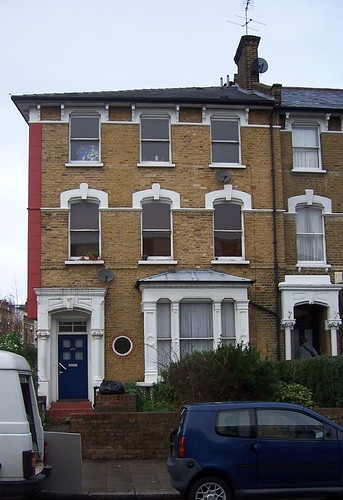
While I’m about it, here’s a picture of the house next to my gran’s. That’s it on the right — it’s not me going in, though. Once uncle and his family lived next door. Another the next house along. A cousin next to that etc etc. The house straight ahead is 97 Evering Rd, Stoke Newington. That’s where the Krays killed Jack The Hat McVitie. (They lived a few streets away, in Cazenove Rd, so it wasn’t much of a journey home for them.)

Caetano Veloso ‘I cross the streets without fear . . .’ What sounds dumb and cliched isn’t. Veloso was in exile here from the Brazilian military dictatorship. ‘A group approaches a policeman. He seems so pleased to please them.’ I moved (back) to London the year this song came out, 1971. To my shame, I never even noticed Caetano Veloso moved in, too.
And finally, thinking of songs and London and alleys, some Sondheim . . .
‘There's a whole in the world like a great black pit
and the vermin of the world inhabit it
and its morals aren't worth what a pin can spit
and it goes by the name of London.’
(Just asking, Mr Sondheim, but where can you buy a spitting pin?)
Next up Back to the Origin of the World
Subscribe to:
Posts (Atom)