

 Posts


The delight of alleys etc
One Further to my posting about Billy Fury Way in West Hampstead, a friend who knows wrote to tell me that it used to be known as Spider Gang Alley in the 1980s. It was where skinheads with a spider web tattooed on them would hang out and ‘waylay unsuspecting folk and ask for a 'loan' when their supply of glue ran out’.
Two My Occitanian connection tells me of a Salubrious Passage. He says it’s a little back road by Swansea Docks. I say it’s a suggestive line from an Ian Dury song.
Three I discovered there’s a Potteries Path near Billy Fury Way. I must have a look.
Next up Bastard sons and drinking fountains
Monday, 31 January 2011


Wednesday, 26 January 2011
The story of Courbet’s Origin of the World, part seven

I finally found a picture of the man who commissioned and paid for Courbet’s Origin. There’s no date on it but it looks like it was taken around the time of the picture. There’s no photographer’s name on it, either, so it probably wasn’t by Auguste Belloc, who took the picture that Courbet based his painting on.
It’s not the original image, I’m fairly sure. I also have a very grainy photocopy of a far grainier original — in which Bey’s hand is on the left. So it’s probably been flipped. The curtain has been moved, too — and retouched to green. Which is the colour of the curtain with which, it’s said, he concealed his painting. The colour of Islam, of course. Théophile Gautier described Bey’s collection as ‘the first ever to be formed by a child of Islam’.
So we have a Muslim — in contradiction to his religion’s eternal ban on representational art — collecting the most modern versions of representation. ‘A magnificent gallery of pictures despite the law of the Prophet which forbids the representation of figures,’ L’Artiste magazine commented in January 1868 — when Bey’s collection came to auction, with the introduction to the catalogue written by Gautier.
In particular, of course, Bey’s magnificent gallery contained one image which represented something which had never before been represented in a public form — well, semi-public. Then he hid that representation with an abstract representation of his own religion — which notably sought (seeks, come to that) to forbid it.
One could read that symbolic act as a deliberate irony: the curtain itself as an enactment of Islam’s censorship of the human (or godly) form. An irony which was, in turn, compounded by the picture’s title, itself a challenge not just to Islam but to all religions — all of which, in my experience, posit far less visceral origins of the world.
If that makes Bey sound like a conscious radical, he was — certainly in his politics. ‘While in Paris he had been planning the extreme liberal reforms which he felt had to be put in effect if the Ottoman Empire was to be preserved . . . a constitution and an egalitarian regime,’ according to the fullest account I’ve found of Bey and his art, a 1982 piece by Francis Haskell in the Oxford Art Journal.
In Paris, by the way, Bey lived near the new Opera. He would, though, have departed the city — to become the Ottoman ambassador in Vienna — before the ink was spilt on the La Danse sculpture (then expended on it by newspapers). He rented rooms from Lord Hertford whose own gallery of paintings became the Wallace Collection — housed in the former family town home in Manchester Square, London W1.
Actually, it’s more complicated that that . . .
Next up A break from Courbet and a one-shot return to alleys etc
Monday, 24 January 2011
Through the dark alley-ways and passages of London*

I like an alleyway. Well, you do if you live in a city. Knowing the alleys is one of the ways you distinguish yourself from — okay, can make yourself feel superior — the out-of-towners.
I like the fact that I can walk most of the way from Marble Arch to Tottenham Court Rd station without touching Oxford Street. It makes me feel I know where I am.
Yesterday, I found a new alley. Two, actually.
I’d heard of one of them before but found it quite by accident. It runs from Finchley Road down the side of Finchley Road and Frognal railway station. Despite having lived not far away for a very long time, I’d never walked down it (or up it) before.
It’s called Billy Fury Way, named for the Scouse popster born Ronald William Wycherley — whose Sound of Fury 10-inch album should be in every home, if only for the cover picture.
Why? Again, I’d forgotten but it was the oddest of reasons. Someone — who knows who — realised/decided that there were alleys which didn’t have names. Which meant . . . the police couldn’t record crimes committed there. ‘I’m sorry, sir, I know you’re dead but there’s nothing we can do. You can’t just die nowhere. Therefore you can’t be dead. Evening all.’
So it was decided to name the local alleys. Billy Fury? Because he recorded at the nearby Decca studios — now the base for the ENO, I think. So: West Hampstead, the rockabilly connection.
The alley? Long and dark, with no way out most of the time, but a wonderful short-cut, with trainspottery views on both sides. The whole of the side wall is painted a dramatic black, giving it a distinct threatening air — not unsuitably for an alley, I guess. They’re not meant to be warm, sunny and welcoming. On a fairly busy Sunday afternoon, I had it all to myself. It emerges almost opposite West Hampstead north London line station.
Cross the road, past the Thameslink station — such a small locality, so many stations — and there’s the second alley. This one runs down to the bottom of my friends’ house. I’d walked this one before, several times. But now it has a name, too. Black Path — from, I guess, the black-painted wall motif which continued on from Billy Fury Way. Fantastically prosaic, too.

Which got me thinking of two things . . .
One, daft street names (and signs). In London . . . Crooked Usage (in Hendon) and Amen Corner (near St Pauls). In Truro, Squeeze Guts Alley — there’s one in Whitstable, too, apparently. In St Ives, there’s a Teetotal Street and a Virgin Street — yet it still manages to call itself a holiday resort.
Two, London and songs generally. Here a couple . . .
Ray Davies. I’ve seen it written that the Krays liked this so much they asked — well, you know what I mean — the Kinks if they could manage them. But that can't be true, as it wasn't written till the 1990s.
* A line from the Ray Davies song.
While I’m about it, here’s a picture of the house next to my gran’s. That’s it on the right — it’s not me going in, though. Once uncle and his family lived next door. Another the next house along. A cousin next to that etc etc. The house straight ahead is 97 Evering Rd, Stoke Newington. That’s where the Krays killed Jack The Hat McVitie. (They lived a few streets away, in Cazenove Rd, so it wasn’t much of a journey home for them.)
Caetano Veloso ‘I cross the streets without fear . . .’ What sounds dumb and cliched isn’t. Veloso was in exile here from the Brazilian military dictatorship. ‘A group approaches a policeman. He seems so pleased to please them.’ I moved (back) to London the year this song came out, 1971. To my shame, I never even noticed Caetano Veloso moved in, too.
And finally, thinking of songs and London and alleys, some Sondheim . . .
‘There's a whole in the world like a great black pit
and the vermin of the world inhabit it
and its morals aren't worth what a pin can spit
and it goes by the name of London.’
(Just asking, Mr Sondheim, but where can you buy a spitting pin?)
Next up Back to the Origin of the World

I like an alleyway. Well, you do if you live in a city. Knowing the alleys is one of the ways you distinguish yourself from — okay, can make yourself feel superior — the out-of-towners.
I like the fact that I can walk most of the way from Marble Arch to Tottenham Court Rd station without touching Oxford Street. It makes me feel I know where I am.
Yesterday, I found a new alley. Two, actually.
I’d heard of one of them before but found it quite by accident. It runs from Finchley Road down the side of Finchley Road and Frognal railway station. Despite having lived not far away for a very long time, I’d never walked down it (or up it) before.
It’s called Billy Fury Way, named for the Scouse popster born Ronald William Wycherley — whose Sound of Fury 10-inch album should be in every home, if only for the cover picture.
Why? Again, I’d forgotten but it was the oddest of reasons. Someone — who knows who — realised/decided that there were alleys which didn’t have names. Which meant . . . the police couldn’t record crimes committed there. ‘I’m sorry, sir, I know you’re dead but there’s nothing we can do. You can’t just die nowhere. Therefore you can’t be dead. Evening all.’
So it was decided to name the local alleys. Billy Fury? Because he recorded at the nearby Decca studios — now the base for the ENO, I think. So: West Hampstead, the rockabilly connection.
The alley? Long and dark, with no way out most of the time, but a wonderful short-cut, with trainspottery views on both sides. The whole of the side wall is painted a dramatic black, giving it a distinct threatening air — not unsuitably for an alley, I guess. They’re not meant to be warm, sunny and welcoming. On a fairly busy Sunday afternoon, I had it all to myself. It emerges almost opposite West Hampstead north London line station.
Cross the road, past the Thameslink station — such a small locality, so many stations — and there’s the second alley. This one runs down to the bottom of my friends’ house. I’d walked this one before, several times. But now it has a name, too. Black Path — from, I guess, the black-painted wall motif which continued on from Billy Fury Way. Fantastically prosaic, too.

Which got me thinking of two things . . .
One, daft street names (and signs). In London . . . Crooked Usage (in Hendon) and Amen Corner (near St Pauls). In Truro, Squeeze Guts Alley — there’s one in Whitstable, too, apparently. In St Ives, there’s a Teetotal Street and a Virgin Street — yet it still manages to call itself a holiday resort.
Two, London and songs generally. Here a couple . . .
Ray Davies. I’ve seen it written that the Krays liked this so much they asked — well, you know what I mean — the Kinks if they could manage them. But that can't be true, as it wasn't written till the 1990s.
* A line from the Ray Davies song.
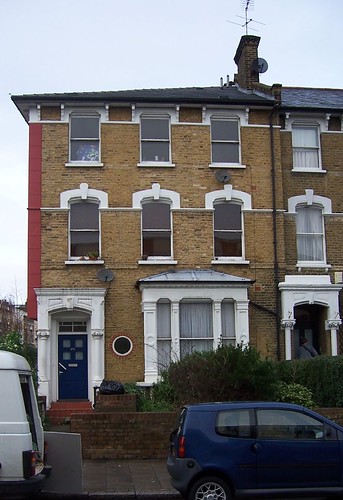
While I’m about it, here’s a picture of the house next to my gran’s. That’s it on the right — it’s not me going in, though. Once uncle and his family lived next door. Another the next house along. A cousin next to that etc etc. The house straight ahead is 97 Evering Rd, Stoke Newington. That’s where the Krays killed Jack The Hat McVitie. (They lived a few streets away, in Cazenove Rd, so it wasn’t much of a journey home for them.)

Caetano Veloso ‘I cross the streets without fear . . .’ What sounds dumb and cliched isn’t. Veloso was in exile here from the Brazilian military dictatorship. ‘A group approaches a policeman. He seems so pleased to please them.’ I moved (back) to London the year this song came out, 1971. To my shame, I never even noticed Caetano Veloso moved in, too.
And finally, thinking of songs and London and alleys, some Sondheim . . .
‘There's a whole in the world like a great black pit
and the vermin of the world inhabit it
and its morals aren't worth what a pin can spit
and it goes by the name of London.’
(Just asking, Mr Sondheim, but where can you buy a spitting pin?)
Next up Back to the Origin of the World
Thursday, 13 January 2011
Courbet’s Origin of the World, sixth part
Not that we can be at all certain about where Bey kept Courbet’s L’Origine du Monde - or if it's true, as is generally said, that he kept it hidden behind a green velvet curtain. In fact, we only know anything about the painting's early existence because of a couple of passing references in contemporary accounts. Which does, of course, confirm one thing - that it was hidden, elided, shielded from public view.
If such prudishness seems surprising for the supposedly licentious 19th century Paris of our understandings, that's a reflection of our lack of understanding. It's true that this was the first heyday of the can-can - then a working-class dance of sexual directness, legs lifted high in a pre-knickers world.
Yet Napoleon III's Second Empire was not a liberal place. (That and some of the other facts above and below come from Rupert Christiansen's Tales from The New Babylon: Paris 1869-75.) The Marseillaise was banned - yes, that one, the one they sing in Casablanca. It had been outlawed for fifteen years or so and wouldn't be unbanned for a couple of years more.
When La Danse, a sculpture of naked women was put up outside the new Opera house, outraged attackers sprayed it with ink — and railway companies offered special, cut-price return tickets to suburbanites anxious to see for themselves the terrible, terrible havoc ink can wreak on naked young female flesh (well, stone).
The tensions that were pulling French society in two directions were there in one of the two near-contemporary accounts of Courbet's painting. On the one hand, there was Ludovic Halévy in his memoirs. 'A nude woman, without feet and without a head. After dinner, there we were, looking and admiring . . . We finally ran out of enthusiastic comments . . . This lasted for ten minutes. Courbet, he never had enough of it.'
On the other hand, there were the less-enthusiastic comments made in a late 1870s attack on the Commune by right-wing journalist Maxine du Camp. This is what he wrote . . .
'To please a Moslem who paid for his whims in gold, and who, for a time, enjoyed a certain notoriety in Paris because of his prodigalities, Courbet, this same man whose avowed intention was to renew French painting, painted a portrait of a woman which is difficult to describe. In the dressing-room of this personage, one sees a small picture hidden under a green veil. When one draws aside the veil, one remains stupefied to perceive a woman, life-size, seen from the front, moved and convulsed, remarkably executed, reproduced con amore, as the Italians say, providing the last word in realism. But, by some inconceivable forgetfulness, the artist who copied his model from nature, had neglected to represent the feet, the legs, the thighs, the stomach, the hips, the chest, the hands, the arms, the shoulders, the neck and the head.'
It’s not that accurate a description of the picture, though, is it? It’s true that there are no legs, feet or head in it. But there are certainly thighs, hips, stomach and a touch of chest. My guess is either du Camp never actually saw the picture and so was relying on a second-hand account or when he did see the picture he couldn’t, so to speak, see the wood for the bosky grove. Maybe he was shocked into only being able to see one thing. Maybe he was only interested in one thing.
By the by, I see no visual evidence in the picture of the orgasm that he alludes to either. Then, according to Rupert Christiansen's book, mid-19th century (male) France was stupefiedly fascinated by its new-found discovery, the female orgasm - to the point of cataloguing its supposedly different manifestations in thin and fat women.
Next up The Turk loses his chemise . . . and his femme sans culottes
Monday, 10 January 2011
Wonders of the modern world, six . . . Cheese and its link to international terrorism
An Israeli cousin, a young woman, who had just spent a couple of weeks with us, flew back the other day. My wife gave her some cheddar to take back for her parents. For some reason, she packed the cheese in a board game she'd bought here, War on Terror. 'Stunning satire,' said the Guardian — not the kind of comment I've ever seen on, say, Cluedo. My wife warned her against the putting the cheese there. 'They might think it's explosives on the x-ray,' she said.
At the Heathrow check-in desk, the young cousin found her luggage was a little overweight. So she removed the board game and took it with her in her hand-luggage. At security, they stopped her. Of course they did. They were worried the cheese was explosives. They didn't like the board game, either. They decided it would worry other travellers. They might think she was a terrorist herself.
Oh, yes. Your average mad bomber spends his last flight playing War on Terror — which comes with black balaclava masks, with the word 'Evil' on them. (It's so hard to play, by the way, that if George W and Osama BL had started it on 9/11, they still wouldn't be finished.)
So security took the game from her and put it on the hold. For free. So now we all know how to get free extra baggage allowance. Put everything in a bag marked Terrorist or somesuch.
Next up Back to the story of a blue-glassed Turk, a column-smashing French painter and a headless young woman. Bottomless, too. Well, not literally but in the sense of reverse toplessness. On the other hand, I guess you could say she was bottomless in a metaphorical sense, too. That is kind of the point of the painting.
Sunday, 9 January 2011
Un conte d'un con et de M Lacan, épisode cinq
By all accounts, Bey kept his Origine hidden in a secret cabinet - or back room or bathroom/toilet. My guess is that it’s the last. Though I’ve not found the French original text, my guess is that the word used is cabinet — short for cabinet de toilette. Which phrase was shorted to cabinet in French — and to toilet in English.
Which was? Not a toilet in the English sense, nor a cabinet in the English sense, nor what we think of today as a bathroom etc. It was a room where you made your toilette — washing, getting ready etc. That is, an equivalent of an English dressing room, with a washbasin — and a bidet, I guess.
Cabinets could be quite grand. This one, in a painting by Lobre, has a fireplace and a decent-sized art collection.

(There's a lot more to the picture, by the way, including a young girl leaving the room. But for some reason I can't manage to upload the whole image.)
This one is Louis XVI’s.

This one, by Bonnard, has a woman in slippers, a day bed and the usual spectacular Bonnard wallpaper.

(Bonnard really liked painting in the cabinet/toilet. He even did a naked self-portrait sitting at his sink, facing his mirror. You do find yourself wondering where he put the easel and paint pots.)
And here is the one used by Napoleon III’s wife, Princess Eugénie, in the 1850s. I should imagine Bey’s cabinet was at least as lavish — if not as, to re-turn a phrase of Alfie’s, poncified.

Next up A quick break from Courbet for a true story about the wonders of modern airline security checks.
By all accounts, Bey kept his Origine hidden in a secret cabinet - or back room or bathroom/toilet. My guess is that it’s the last. Though I’ve not found the French original text, my guess is that the word used is cabinet — short for cabinet de toilette. Which phrase was shorted to cabinet in French — and to toilet in English.
Which was? Not a toilet in the English sense, nor a cabinet in the English sense, nor what we think of today as a bathroom etc. It was a room where you made your toilette — washing, getting ready etc. That is, an equivalent of an English dressing room, with a washbasin — and a bidet, I guess.
Cabinets could be quite grand. This one, in a painting by Lobre, has a fireplace and a decent-sized art collection.

(There's a lot more to the picture, by the way, including a young girl leaving the room. But for some reason I can't manage to upload the whole image.)
This one is Louis XVI’s.
This one, by Bonnard, has a woman in slippers, a day bed and the usual spectacular Bonnard wallpaper.
(Bonnard really liked painting in the cabinet/toilet. He even did a naked self-portrait sitting at his sink, facing his mirror. You do find yourself wondering where he put the easel and paint pots.)
And here is the one used by Napoleon III’s wife, Princess Eugénie, in the 1850s. I should imagine Bey’s cabinet was at least as lavish — if not as, to re-turn a phrase of Alfie’s, poncified.

Next up A quick break from Courbet for a true story about the wonders of modern airline security checks.
Saturday, 8 January 2011
Un conte d'un con et de M Lacan, part four
Courbet’s L’Origine du Monde was painted to commission, for Khalil Bey, a Turkish diplomat and gambler with a taste for paintings of unclothed women. He also suffered from some kind of eye ailment and so wore blue spectacles, a fact much commented on by gossip columnists. He was a big figure in Second Empire Paris, big enough, in fact, to rate a passing mention in Stephen Frears' recent film, Chéri, from Colette's novel about an ageing courtesan - which is set nearly half a century after Bey's heyday.
It's possible that Bey and Courbet met at the funeral of Proudhon - the first man to call himself an anarchist and who came up with the phrase 'property is theft'. (Well, of course, what he actually said was: La propriété, c'est le vol!) Courbet was a social radical, set on depicting life beyond 'bourgeois' propriety and reinvigorating French painting. Along with Manet, he was the first shapers of our modern visual world. He painted giant, life-sized paintings of workers and peasants and naked women.
It was his impulsive politics that was finally to undo him, though, rather than his pictures. At the height of the Commune, set up by radical Parisians in the wake of France's collapse in the face of Prussia's 1971 invasion, Courbet was the main advocate of the column in the Place Vendôme which commemorated Napoleon I's achievements. For which, in the counter-revolutionary aftermath of the Commune, Courbet was sentenced to six months and fined 500,000 francs (500, according to Wikipedia). So he fled to Switzerland where he died, of the drink, aged 58.
I’ve no idea how much that was in 2011 euros but, by way of comparison, I’ve seen the price Bey paid Courbet for L’Origine quoted as 25,000 francs It was far from his only purchase. Bey was a major collector — and inspirer — of contemporary artists, many of whom would lay the foundation for Paris’s emergence as the world centre of art for the next half-century at least.
Over three years or so, he bought 124 paintings, including six by Delacroix. He also commissioned Ingres' Bain Turc and Courbet's Le Sommeil (Musée du Petit Palais, Paris) - in which Jo Hiffernan is also supposed to be one of the two sleeping women, the dark-haired one on the left.
According to his - excitable - obituary in the London World, he also pressed tea sets on women he met - 47 in that three-year stretch. A seduction technique, I assume. It must have worked sometimes. His mistress, Jeanne de Tourbey was previously mistress of Prince Napoleon. (I assume the similarity of his and her surnames — Bey/Tourbey — was coincidence, though possibly remarked upon by gossips.) When people talk of the courtesans of late 19th century Paris, it’s her they mostly have in mind.
She is generally described as 'the illegitimate daughter of an illegitimate waitress' - which sounds like the title of a Danny Kaye song and makes me, at least, wonder how you might distinguish between legitimate and non-legitimate waitressing.
Napoleon arranged for her to be given a polish of education by his friend Sainte-Beuve, a leading literary critic, who is also said to have been responsible for introducing Bey to Courbet. Thus polished, she married a comte, becoming comtesse de Loynes. Once free of the comte, she set up a literary salon, the model for Madame Swann's in Proust's big, big book - which I haven't read, of course. Later in life, she became a fervid reactionary, a leading anti-Dreyfussard and a major funder of Action Francaise — in time, a major backer of the Vichy regime. There is a painting of her in the D'Orsay. She looks trouble.
The first recorded reference to Courbet’s painting as L'origine du Monde is late, very late — 1935, in a piece by a Courbet scholar It’s generally said, though, that the title was Bey's idea - as was, perhaps, the small size of the canvas, quite unlike Courbet's usual giant paintings. All the better to conceal it.
PS My Occitanian correspondent Richard pointed out that there was a typo in the heading for the last couple of Courbet postings. I actually meant to write ‘conte’ — story or tale, in French. In fact, I typed ‘comte’ — French for count.
And . . . well, and here is a sentence from my book, Filthy English. ‘It is claimed that English counts were renamed earls because of their titles’ homophonic closeness to the word.’ The word, of course, was cunt.
Next up What a Turk hides in his toilet
Subscribe to:
Posts (Atom)